Nishiyama Honmon-ji Temple: A Head Temple of the Fuji Buddhist Lineage


Site at a Glance
- Rating
- 4.1
- Popularity
- Low
- Country
- Japan
- Primary era
- Unclassified
- External website
- Open
- Eras represented
- Unclassified
- Civilizations
- Unclassified
- Site type
- Religious
- Remains
- Temple
On this page9 sections
History
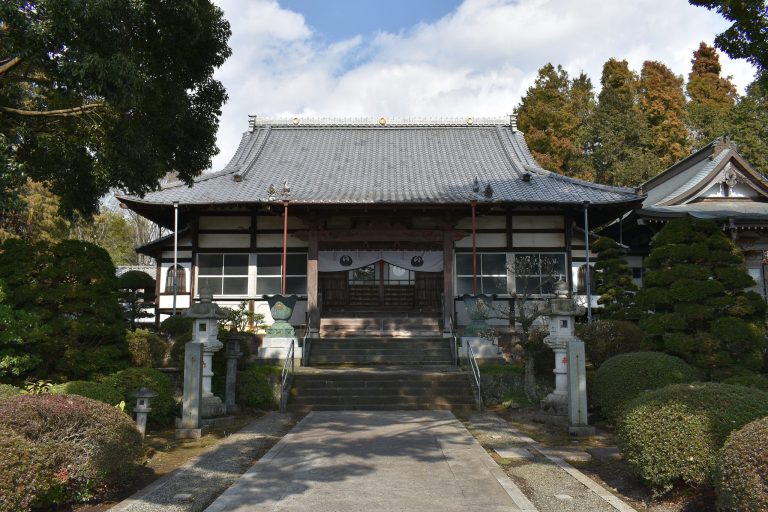
Nishiyama Honmon-ji Temple is a Buddhist head temple in Fujinomiya, Japan, founded in 1344 by Nichidai, a disciple of Nikko. Formally called Fujisan Honmon-ji, it belongs to the Hokke-shu Komon-ryu, a Lotus Sutra tradition within the Fuji lineage associated with Nikko, one of Nichiren Buddhism’s principal early disciples. The temple is one of the Fuji Five Head Temples and one of the Eight Head Temples of the Komon lineage.
Foundation and Fuji Lineage
After Nikko’s death, Nichidai inherited Omosu Honmon-ji. Disputes later developed between him, the local land steward Ishikawa Sanetada, and the temple’s followers. Nichidai eventually departed with his disciples. In 1344, the Nishiyama land steward Ouchi Yasukiyo donated land, allowing Nichidai to establish Nishiyama Honmon-ji at its present foundation.
Imperial and Tokugawa Connections
The eighteenth abbot, Nichijun, strengthened the temple’s connections with the imperial court through Jogyo-in, a Buddhist temple in Kyoto. Imperial Princess Tsuneko became devoted to Nichijun’s teaching. In 1678, she deposited the memorial tablet of Emperor Go-Mizunoo at Nishiyama Honmon-ji. Five years later, she placed there a handwritten Lotus Sutra commemorating her parents after their deaths.
When Tsuneko’s husband, Konoe Motohiro, became imperial regent, he deposited a copied prayer sutra and designated Nishiyama Honmon-ji as a place of prayer. The temple later received important support from the Mito branch of the Tokugawa family. Its twentieth abbot, Nichien, came from that family and developed the temple complex after receiving a donation from Tokugawa Mitsukuni, its prominent lord.
Institutional Reorganization
In 1876, Nishiyama Honmon-ji and twelve branch temples joined in forming Nichiren-shu Komon-ha, a unified organization of the Fuji school. The organization adopted the name Nichiren Honmon-shu in 1899. In 1941, Nichiren Honmon-shu merged with Nichiren-shu and Kempon Hokke-shu in a three-school consolidation that created the modern Nichiren-shu. The forty-ninth abbot, Yui Nikkō, represented his school in the procedures.
In 1957, Nishiyama Honmon-ji, its subtemples, and its branch temples left Nichiren-shu and became an independent religious corporation, although some branch temples remained with Nichiren-shu. Under Yui Nikkō’s leadership, Nishiyama Honmon-ji then joined Nichiren Shoshu without the agreement of its subtemples, branch temples, or lay-parish representatives. Opponents challenged the validity of the move in court.
After Yui Nikkō died in 1960, Nichiren Shoshu appointed Yoshida Nichiyu of Shimojo Myoren-ji as acting abbot under the succession designated by Yui Nikkō. The dispute eventually reached the Supreme Court, which ruled in favor of the lay parishioners in 1975. Yoshida Nichiyu left the head temple, and Morimoto Nichisho of the former branch temple Fukusho-ji became the formal successor. The current chief priest is Morimoto Nichiju, the temple’s fifty-second chief priest.
Religious Treasures and Tradition
Nishiyama Honmon-ji is associated with nationally designated Important Cultural Properties, including a Lotus Sutra written in gold characters on blue paper, an eight-volume Lotus Sutra, the Proof of the Lotus Sutra, and the Record of Nichiren’s Death.
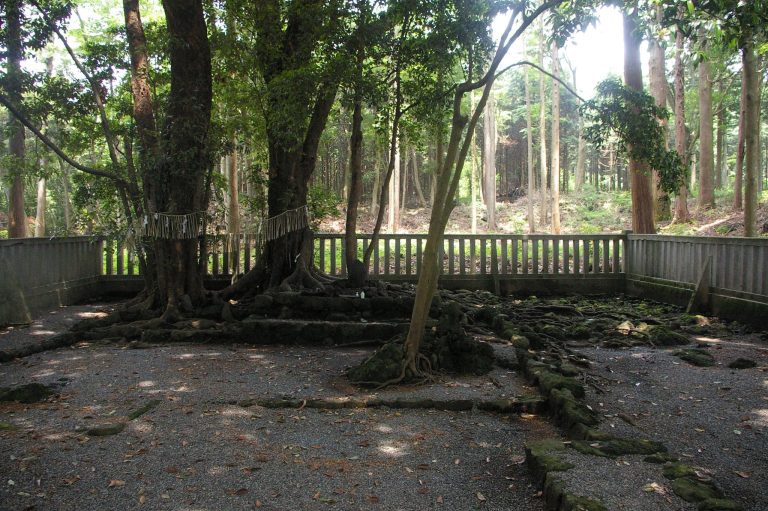
Temple tradition also connects Nishiyama Honmon-ji with Oda Nobunaga, a major military ruler of late sixteenth-century Japan. According to the tradition, Hara Muneyasu, Nichijun’s father and holder of the title Shima no Kami, carried Nobunaga’s head to the temple on the instructions of Hon’inbo Sansa, a Buddhist monk and renowned go player associated with the Hon’inbo house. The tradition says that Muneyasu buried the head and planted a holly beside the mound.
Remains
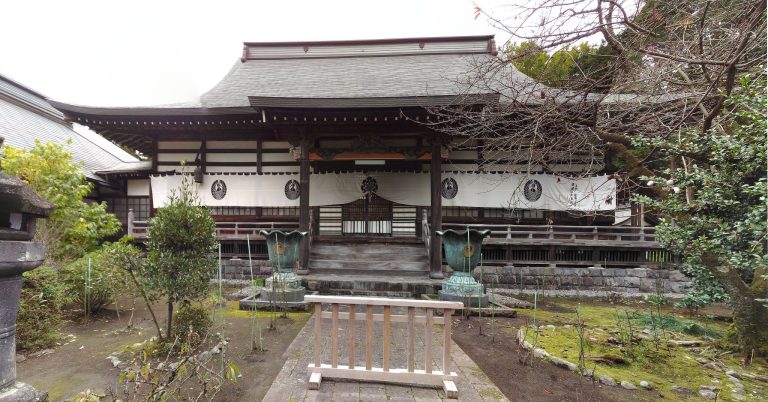
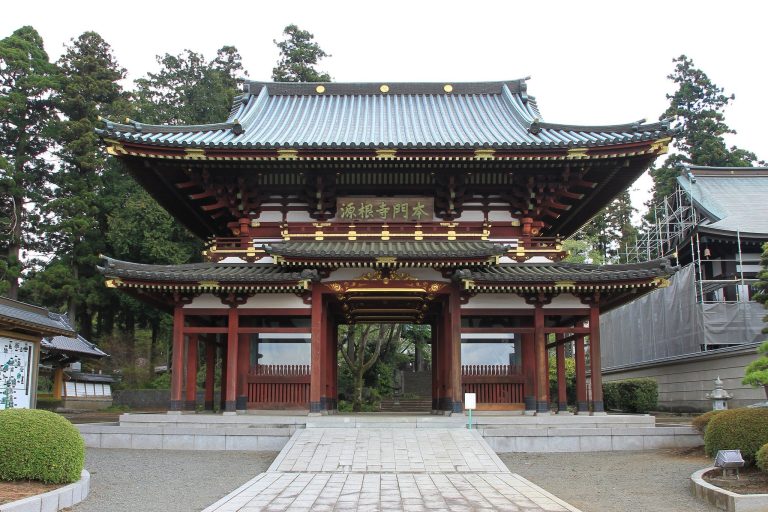
The temple precinct covers approximately 360 chobu, a traditional Japanese unit of land area, and forms a straight line for about 2 kilometers from the Black Gate to the cemetery behind the main hall. This unusually extensive linear arrangement defines the physical reach of the temple grounds.
Precinct and Burial Tradition
Linear Temple Grounds
The surviving precinct is organized along a long, direct axis extending between the Black Gate, the main hall, and the cemetery at the rear. The documented length of about 2 kilometers and the area of approximately 360 chobu convey the scale of the grounds and their ordered relationship between entrance, principal worship space, and burial area.
Oda Nobunaga Burial Mound
A burial mound traditionally identified as the resting place of Oda Nobunaga’s head lies within the temple grounds. The holly beside it is estimated to be about 450 to 500 years old, an age considered consistent with the chronology of the burial tradition. The mound and tree together preserve the physical setting of this long-standing association.