Krzysztofory Palace: A Baroque City Residence and Museum in Kraków


Site at a Glance
- Rating
- 4.7
- Popularity
- Low
- Country
- Poland
- Primary era
- Early Modern
- External website
- Open
- Eras represented
- Medieval, Early Modern
- Civilizations
- Kingdom of Poland, Polish–Lithuanian Commonwealth
- Site type
- Domestic
- Remains
- Palace
On this page12 sections
History
Krzysztofory Palace is a historic tenement and city palace in Kraków, Poland, at the corner of Szczepańska Street and Main Market Square. A building probably occupied the site by the second half of the thirteenth century, while its principal transformation into a Baroque residence took place in the seventeenth century. Since 1965, the palace has housed the Historical Museum of Kraków, now Muzeum Krakowa.
Medieval houses and patrician ownership
The property passed through the hands of prominent Kraków families during the late Middle Ages. In the fourteenth century, known owners included the Spycymirowie, followed in the first quarter of the fifteenth century by the Czirlowie. From 1423 until the middle of the sixteenth century, it belonged to the patrician Morsztyn family, giving rise to the alternative name Morsztyn House.
Members of the Kozłowie and Boner families became co-owners in 1557. During the sixteenth century, the building functioned as a rented tenement. Marcin Iwan, a councillor from Olkusz, owned it from 1590 to 1609, and the Ronenberg family retained it until 1644. Around the turn of the sixteenth and seventeenth centuries, one of Kraków’s oldest pharmacies operated on the ground floor. The pharmacist Stanisław Haller rented rooms there and acquired ownership rights to four-sixths of the building.
The seventeenth-century palace
In 1644, Adam Kazanowski, Crown Court Marshal to King Władysław IV, purchased the tenement and neighbouring houses. He converted them into a residence and planned to transform the property into a royal palace. The resulting rebuilding is generally placed in the 1640s, with construction dated approximately to 1640–1649. Earlier Gothic houses were joined into a Baroque palace, creating the building’s basic early modern form.
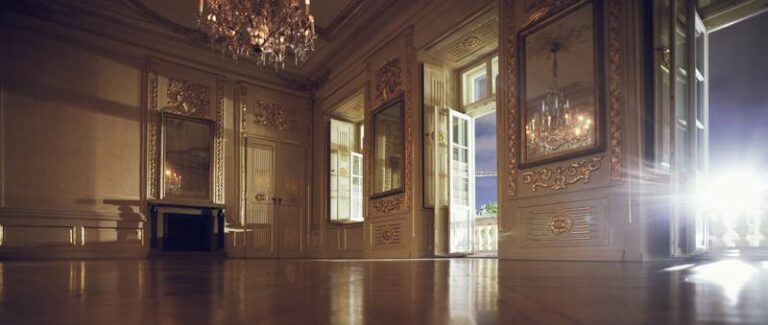
The Swedish invasion severely damaged the residence. After 1680, Jan Wawrzyniec Wodzicki owned the palace and ordered a comprehensive rebuilding between 1682 and 1684. Further work followed toward the end of the seventeenth century. The Italian architect Jakub Solari contributed to the rebuilding, while the Italian sculptor and stucco artist Baltazar Fontana created ornamental plasterwork and interior finishes.
After 1726, additional work strengthened the palace’s Baroque character and altered its interiors. Ownership and tenancy continued to change, with the Radziejowski family among those associated with the residence. After abdicating, King Jan Kazimierz lived there, followed later by King Michał Korybut Wiśniowiecki. Bishop Kajetan Ignacy Sołtyk resided in the palace from 1775 to 1782 after returning from Kaluga.
Royal associations and nineteenth-century use
Furniture from Krzysztofory Palace was lent to Wawel Castle for the coronation ceremonies of Augustus II. In 1809, after Kraków was liberated by Polish forces led by Prince Józef Poniatowski, the building became the headquarters of the general staff. During the nineteenth century, ownership changed frequently, while the palace continued to accommodate commercial and public activity.
The ground floor housed the Czas printing house from 1856 to 1861. Antoni Hawełka operated a colonial-goods shop and a popular breakfast business there, and toward the end of the century the premises also contained the Pod Palmą restaurant. The Europejska café was established in the building in 1929.
Protection, artistic activity, and museum use
In 1912, a construction company acquired the palace with plans to demolish it and replace it with a profitable tenement. Public opposition led by the Society for the Care of Polish Monuments of Art and Culture prevented the demolition. The palace was restored in 1916 according to a design by the architect Wacław Krzyżanowski.
During the First World War, volunteer units of the Polish Legions used the building for quarters. The State Treasury took it over in 1918. In 1919, it housed the Polish Governing Commission, and after renovation it accommodated the Directorate of Public Works.
The basements later became associated with the Krzysztofory Gallery. The Kraków Group, an association of modern artists, was established there in the early 1930s and operated until 1937 before being reactivated in 1958. In 1961, the avant-garde artist and theatre director Tadeusz Kantor moved his Cricot 2 theatre into the basements. The theatre moved to 5 Kanonicza Street in 1980.
The palace underwent repairs in 1958 and 1959, followed by a further renovation from 2001 to 2021. The Historical Museum of Kraków adapted the renewed building as a multifunctional museum complex with exhibitions and spaces for cultural and educational activity. Krzysztofory Palace forms part of Kraków’s Historic Centre, inscribed on the UNESCO World Heritage List in 1978. The Kraków historic city complex became a Historic Monument of Poland in 1994, and the palace is also registered as a Polish cultural-heritage monument.
The palace remains connected with Kraków’s cultural traditions through the annual post-competition exhibition of Kraków nativity scenes. These elaborate models draw inspiration from the city’s historic architecture and continue a distinctive local artistic practice.
Remains
Medieval fabric and corner layout
Krzysztofory Palace occupies a corner plot at the junction of Szczepańska Street and Main Market Square. Its market-facing section incorporates a medieval corner house. The earliest known masonry structure was a square tower, approximately 10 metres on each side, built about halfway along the plot beside its southern boundary. The tower survives in stone, together with a brick frame around an opening on its eastern side.
Before the middle of the fourteenth century, the tower had been incorporated into a larger house with a front section and a wing extending along Szczepańska Street. A forebuilding was probably added at about the same time or shortly afterward. These medieval elements remain within the later palace, whose plan reflects the joining of earlier Gothic tenements.
Baroque residence
Courtyard and ceremonial spaces
The Baroque palace is arranged on an L-shaped plan. Surviving features from the seventeenth-century rebuilding include a cloister and an arcaded gallery. The complex also contains a representative entrance hall, a courtyard colonnade, large rooms on the principal residential floor, and a well in the courtyard.
Chapel cabinet and interior decoration
Late-seventeenth-century decoration by Baltazar Fontana survives in a cabinet with a mirror vault, a ceiling with a broad, relatively flat centre joined to curved sections. Its stucco scenes represent the overthrow of Phaethon, the figure from Greek mythology who lost control of the solar chariot. During the eighteenth century, this room served as the palace chapel. Some rooms on the first and third floors retain polychrome decoration, using multiple colours on their architectural surfaces.
Facades and later additions
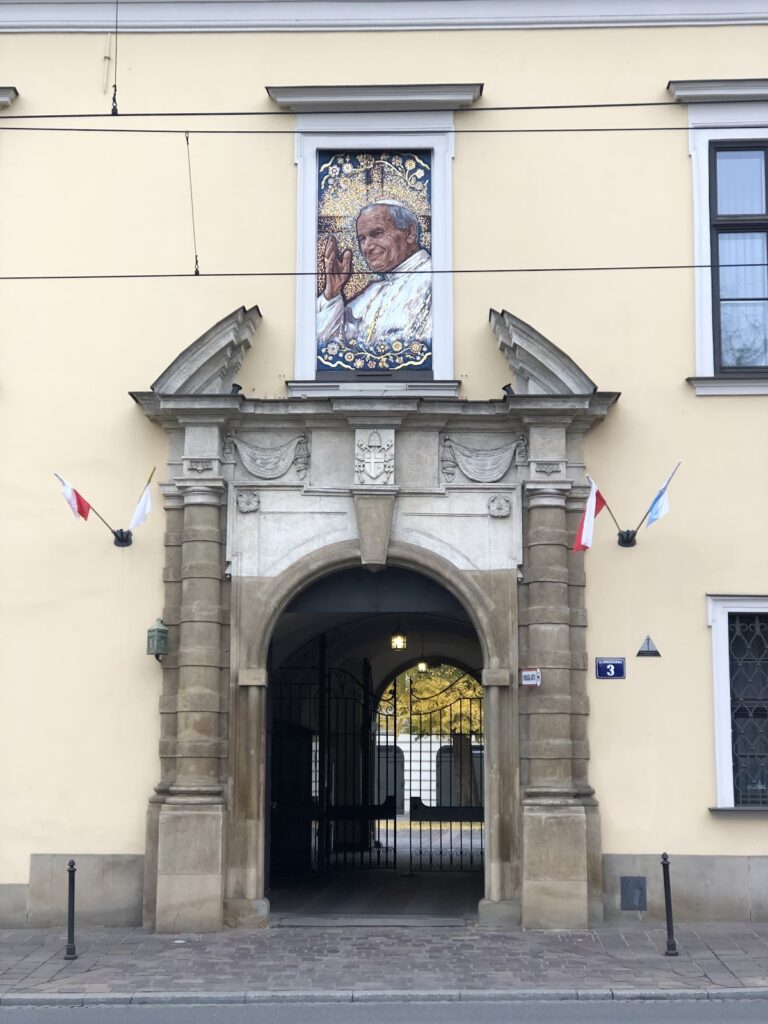
Work undertaken from 1726 onward gave the exterior stronger Baroque features. The facade received stone cladding and a Baroque entrance portal. Around 1380, a stone figure of St. Christopher was probably installed on the corner facade. The Christian saint is traditionally associated with protecting travellers and is commonly shown carrying the Christ Child; his figure gave the palace its name.
A new sculpture of St. Christopher, designed by Professor Aleksander Śliwa, was unveiled on 23 July 2021. Śliwa also designed a monument to Miedzianna, the Kraków market woman, which was unveiled on 17 December 2021 on the facade facing Szczepański Square.
Museum interiors and collections
The renovated interiors include the Krzysztofory Gallery in the basements, together with a library, archive, educational and administrative spaces, commercial and gastronomic areas, and a conference hall. The palace houses the exhibition Kraków from the Beginning, to No End, which presents objects connected with the history of the city.
Among the displayed objects are a Lajkonik costume, traditional Kraków nativity scenes including a life-size example, ornamental mascarons, and the sixteenth-century silver rooster of the Fowler Brotherhood, a historic civic shooting association. The collections also include a sixteenth-century ring and scepter of Kraków mayors, an eighteenth-century counter of the Kraków Merchant Congregation, a merchants’ association, and works associated with Jan Matejko, Józef Mehoffer, Zofia Stryjeńska, Jacek Malczewski, Wojciech Weiss, and Wlastimil Hofman.
Nearby sites