Church of SS. John the Baptist and John the Evangelist in Kraków: A Historic Conventual Church


Site at a Glance
- Rating
- 4.7
- Popularity
- Low
- Country
- Poland
- Primary era
- Early Modern
- External website
- Open
- Eras represented
- Medieval, Early Modern
- Civilizations
- Kingdom of Poland, Polish–Lithuanian Commonwealth
- Site type
- Religious
- Remains
- Church
On this page8 sections
History
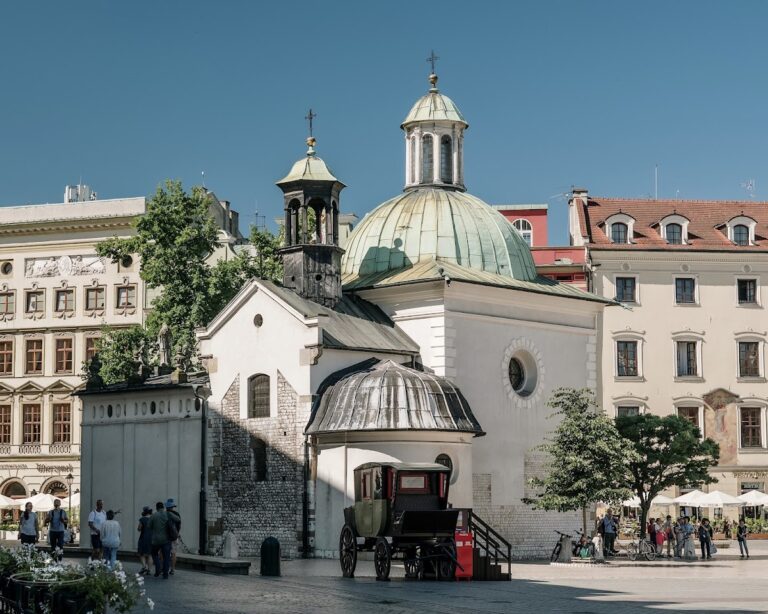
The Church of SS. John the Baptist and John the Evangelist in Kraków, Poland, is a historic Roman Catholic conventual church of the Presentation Sisters. Traditionally attributed to the twelfth-century magnate Piotr Włostowic, it is also described as originating as a Romanesque collegiate church, a medieval church served by a college of clergy. Dedicated to the two St. Johns, it now belongs to the parish of the Assumption of the Blessed Virgin Mary in Kraków.
Medieval Origins
The church first appears in Kraków’s municipal books in 1308, when it was a filial church dependent on St. Mary’s Church. A filial church is one administered by another parish. In 1325, it became a parish church. Its traditional connection with Piotr Włostowic places its beginnings in the first half of the twelfth century, while the description of its original form as Romanesque situates the foundation within the medieval architectural period known for massive forms and rounded arches.
Seventeenth- and Eighteenth-Century Transformation
A major rebuilding took place in the middle of the seventeenth century, and the church was reconsecrated in 1659. In 1715, Bishop Kazimierz Łubieński transferred the church to the Presentation Sisters, a Roman Catholic women’s congregation. The sisters moved into the church between 1715 and 1723. Afterward, the architect Kacper Bażanka carried out another reconstruction, giving the building much of the character associated with its later Baroque interior.
The church developed several devotional associations. It serves as a sanctuary connected with Our Lady of the Redemption of Slaves, also called Our Lady of Freedom and Our Lady of St. John. It is also associated with Blessed Zofia Czeska, the seventeenth-century Polish Catholic founder of the Presentation Sisters and the congregation’s revered founder.
Modern Devotion and Conservation
On 9 May 1965, Archbishop Karol Wojtyła crowned the figures of the Virgin and Child in the church’s St. John image. Wojtyła later became Pope John Paul II, but this act took place during his service as a Polish Catholic archbishop. In 1998, the former sacristy was converted into a chapel dedicated to Blessed Zofia Czeska, designed by Czesław Dźwigaj, and her relics were placed there. Pope Francis visited the church on 28 July 2016 and prayed before the relics.
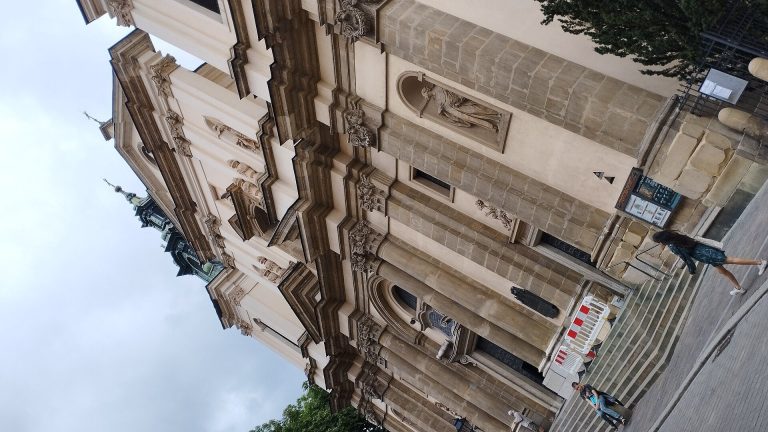
Conservation in 2015 changed the façade from white to pink and altered the interior color scheme to evoke the church’s Baroque appearance. The church forms part of Kraków’s Historic Centre, inscribed on the UNESCO World Heritage List in 1978. It also belongs to the Kraków historical city complex designated a Historic Monument of Poland in 1994, and it was entered in the Polish register of historic monuments in 1986.
Remains
Church Layout and Interior
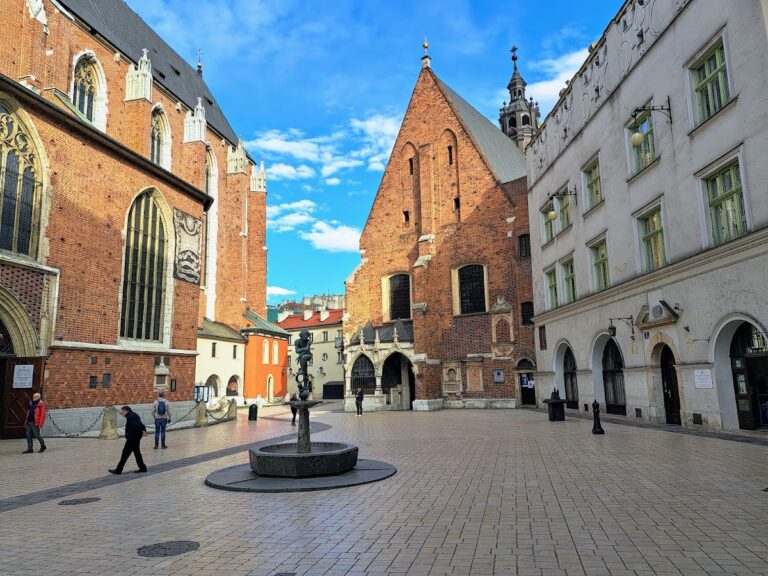
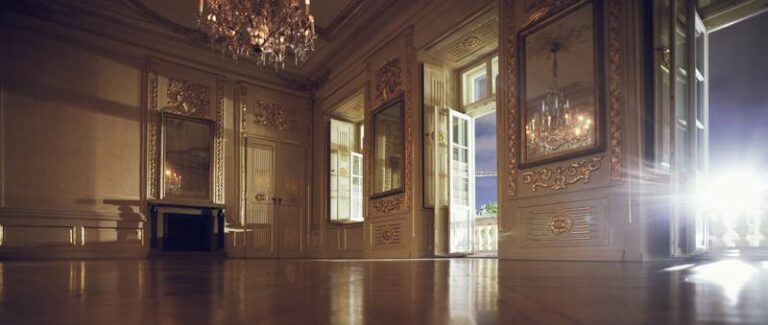
The oriented church is built of brick and has a single nave leading to a smaller presbytery, the part reserved for the clergy and altar. The presbytery ends in a semicircular apse, a curved termination of the building. Its interior is late Baroque in character. A nineteenth-century painting of Our Lady of Grace is displayed on the façade, while the chapel of Blessed Zofia Czeska occupies the former sacristy.
Altars and Marian Image
The main altar dates from 1730. At its center is a sixteenth-century painting known as Our Lady of the Redemption of Slaves or Our Lady of St. John. Tradition holds that Prince Stanisław Radziwiłł brought the image from Spain. Statues of St. John the Baptist and St. John the Evangelist stand beside it. Near the altar hang votive objects, items offered in fulfillment of a vow or in gratitude, including a Polish karabela, a curved sabre associated with Polish military and ceremonial use, a seventeenth-century Turkish sabre, and two pairs of eighteenth-century iron shackles with chains. They were left by a prisoner freed after prolonged captivity, an event linked to the image’s names Our Lady of the Redemption of Slaves and Our Lady of Freedom.
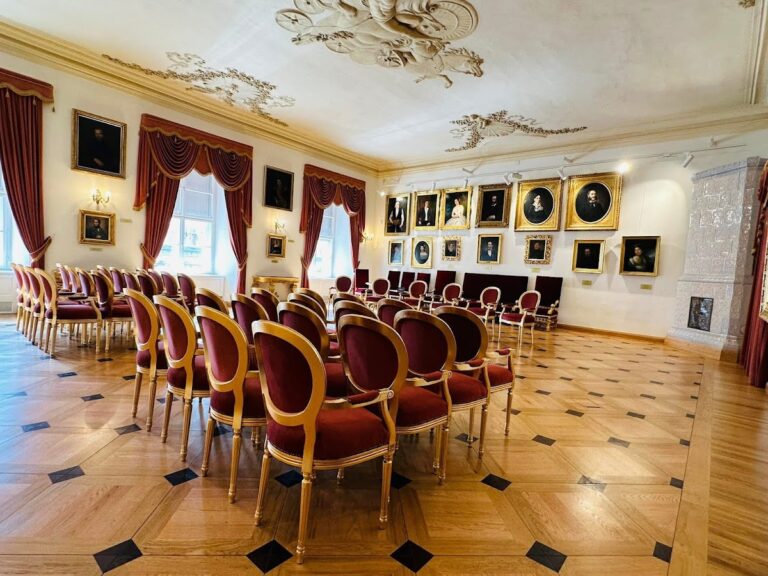
The side altars are late Baroque and were made before 1748. The present ceiling polychromy, a multicolored painted decorative scheme, was executed by Edward Mytnik in 1959. It replaced a design created and painted by Zygmunt Milli in the 1920s, while an older painted scheme has also been uncovered.
Organ
The organ was probably built in the late seventeenth or early eighteenth century. An inventory from 1715 lists a small organ, or positive, on a wooden choir. The case probably survives from that period, although the pipes are from substantially different dates. The instrument was restored in 1862 and renewed in 1927 and 1960; it was tuned in 1946. Zinc-sheet pipes probably remain from the 1927 work.
The organ has one manual, six stops, a C to c3 compass, and mechanical action for both playing and registration. Its Baroque prospect, the visible front and decorative case of the instrument, is crowned by three large sculptures. A central royal figure, possibly King David, stands between two music-making angels, one holding a violin and the other a cello. The central sculpture is one metre high, while the side figures measure 80 centimetres. The prospect includes 31 tin pipes belonging to the Octave 4-foot stop. The organ measures 1.40 by 1.70 metres, and the prospect measures 1.70 by 1.70 metres.
The manual contains Principal 8-foot, Major Flute 8-foot, Portunal Flute 8-foot, Super Octave 2-foot, Portunal Flute 4-foot, and Octave 4-foot stops. The Principal is open, with a wooden first octave and metal pipes above it. The Major and Portunal Flutes 8-foot are fully wooden covered stops, the Super Octave is entirely metal, the Portunal Flute 4-foot is entirely wooden, and the Octave 4-foot is made entirely of tin, with part of it visible in the prospect.