Kristiansten Fortress: Trondheim’s Eastern Defence


Site at a Glance
- Rating
- 4.5
- Popularity
- Medium
- Country
- Norway
- Primary era
- Early Modern
- External website
- Open
- Eras represented
- Early Modern
- Civilizations
- Denmark–Norway
- Site type
- Military
- Remains
- Fort
On this page12 sections
History
Kristiansten Fortress is a Danish-Norwegian fortress in Trondheim, Norway, built on a hill east of the city between 1681 and 1685 after the great fire of 1681. It formed part of Trondheim’s reconstruction and was designed to protect the city centre from attacks approaching from the east, while controlling the area from Ila to Lade.
Construction and expansion
King Christian V of Denmark-Norway ordered the fortress. General Johan Caspar von Cicignon prepared the plans, while Anthony Coucheron served as chief quartermaster and builder. Cicignon was also chief inspector of fortifications and directed Trondheim’s post-fire town plan. In 1691, the fortress was strengthened with an eastern advanced post called Kristiandsands Bastion. Møllenberg Sconce followed in 1695 beside the Nidelven River. Together with a continuous palisade, these works linked Kristiansten to Trondheim’s fortified urban defences.
A major modernization took place in 1750, when new bastions and protected artillery chambers, known as casemates, were added to counter mortar and heavy artillery. Two separate eastern works, Grüner’s Redoubt and Frølich’s Redoubt, were also constructed as part of the wider defensive system.
The Swedish invasion of 1718
During the Great Northern War, a conflict fought from 1700 to 1721 between Sweden and a coalition that included Denmark-Norway and Russia, Swedish General Carl Gustaf Armfeldt led an army into Trøndelag. His objective was to capture Trondheim. About 6,900 Norwegian troops under Vincens Budde defended the city, assisted by resistance from local rural inhabitants.
Kristiansten Fortress and the other fortifications prevented Armfeldt from taking Trondheim and forced his army to retreat toward Verdal. Although the Swedish force later surrounded the city, Budde’s troops continued to hold it. Poor provisions, winter conditions, and illness reduced the Swedish army to about 4,000 men. After Sweden’s King Charles XII was killed at Fredriksten Fortress in December 1718, Armfeldt withdrew. During the retreat across the mountains, almost the entire force was lost to cold, snow, and a severe blizzard.
From military fortress to memorial site
Kristiansten remained in military use from 1685 until King Charles XIV John ordered its decommissioning in 1816. After the Swedish-Norwegian union removed the immediate Swedish threat, the fortress lost much of its military importance, and the royal order directed that it be left to decay. It was nevertheless used for fire-watch purposes from 1816 until 1997, and a museum has occupied the fortress since 1997.
The fortress also figured in important events connected with Norway’s separation from Sweden. On 9 June 1905, the Norwegian war flag bearing the union badge was lowered there and replaced by the national war flag during a ceremony with military honours and gun salutes. On 18 November 1905, a twenty-one-gun salute from the fortress proclaimed the election of Prince Carl of Denmark as King Haakon VII of Norway.
During the German occupation of Norway in the Second World War, Kristiansten was used as a prison and execution site for Norwegian patriots and resistance members. After the war, it became the official execution site for convicted traitors and war criminals during Norway’s legal purge. Henry Rinnan, a Norwegian collaborator who led the Rinnan gang in cooperation with the German occupation authorities, was executed there on 1 February 1947. Nine of his followers were also executed, eight on the same day.
Remains
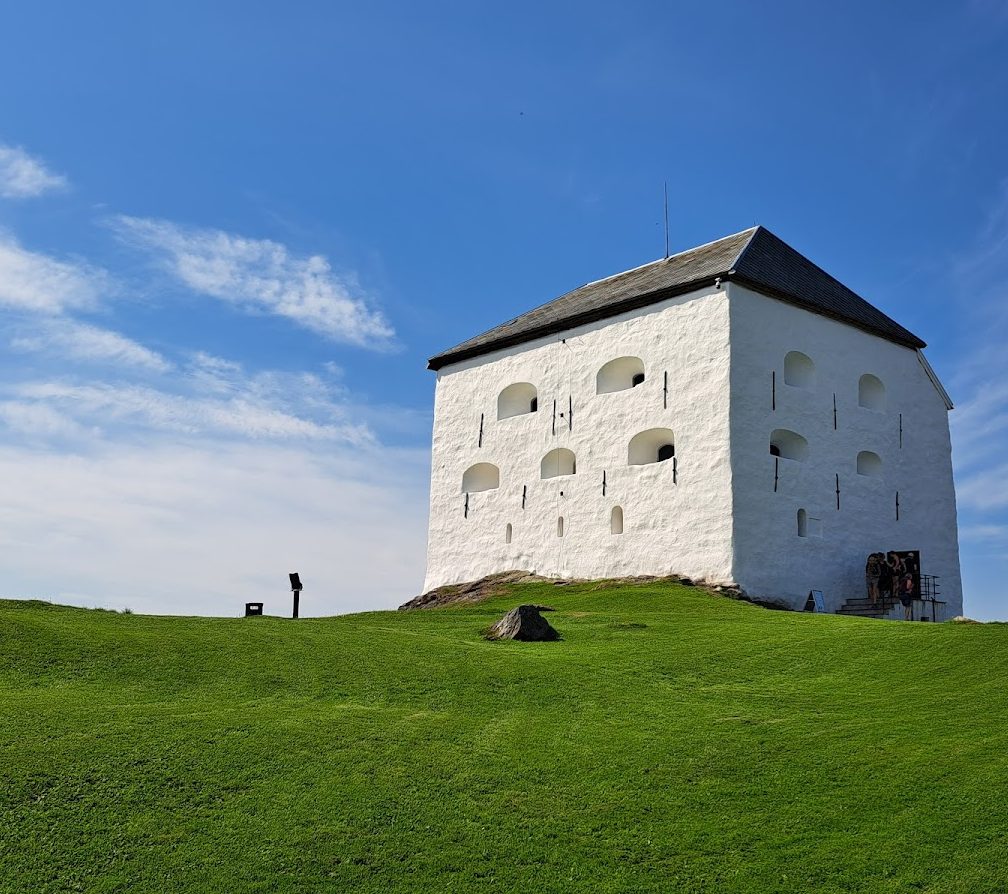
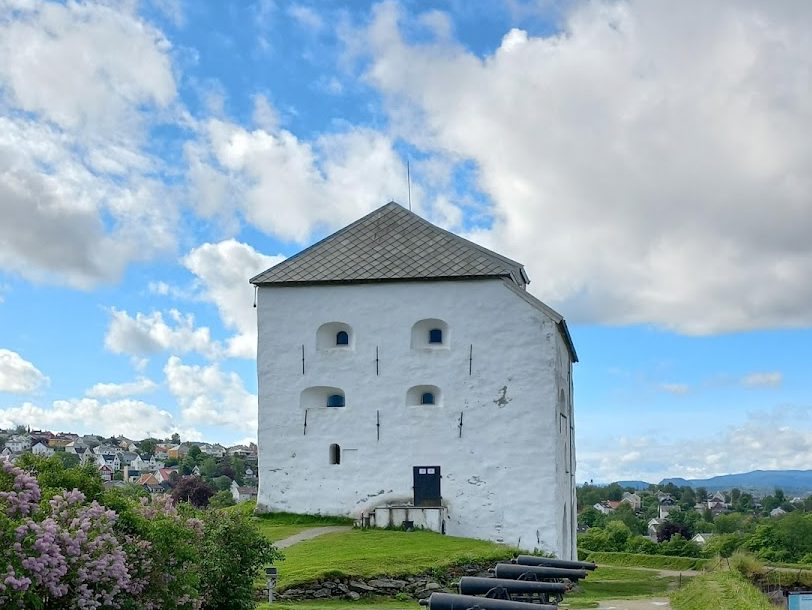
Kristiansten occupies a hill in eastern Trondheim, about 700 metres from Nidaros Cathedral. Its position reflects the weakness of earlier defences along the Nidelven River and at Skansen, which left the city exposed from the east. The fortress is organized around the Donjon, a four-storey defensive artillery tower, within a circuit of walls, bastions, casemates, and detached earthworks.
Central fortress and defensive circuit
Donjon
The Donjon is a quadrangular, four-storey fortified tower at the centre of the defences. A donjon is the principal fortified tower of a castle or fortress. The building contained artillery, living quarters, and storage, combining military and practical functions within the main structure.
Walls, palisade, and bastions
Defensive walls enclosed the original fortress by 1691. A continuous palisade later extended from Kristiansten to Trondheim’s fortified city. The northern side of the outer circuit includes the Crown Prince’s Bastion, built between 1745 and 1748. The 1750 modernization added bastions and casemates, which were protected chambers intended to shield the defences from mortar artillery.
Detached eastern works and landscape setting
Frølich’s Redoubt
Frølich’s Redoubt is a quadrangular eastern defensive work originally planned by Cicignon. It was built as an earthwork, and traces of its ramparts survive.
Grüner’s Redoubt
Grüner’s Redoubt formed another isolated defensive position east of the fortress. Along with Frølich’s Redoubt, it is now difficult to see, although both belonged to the eastern system that reinforced Kristiansten.
The strandlinja
From the fortress, the topographical line known as the strandlinja can be seen along the hills of Bymarka toward Byåsen. This landform marks former beaches and sea cliffs and continues through the hills around Trondheim, placing the fortress within a landscape shaped by earlier changes in sea level.
Nearby sites