Haltdalen Stave Church: A Medieval Timber Church in Norway


Site at a Glance
- Rating
- 4.7
- Popularity
- Very Low
- Country
- Norway
- Primary era
- Medieval
- Eras represented
- Medieval
- Civilizations
- Norwegian
- Site type
- Religious
- Remains
- Church
On this page9 sections
History
Haltdalen Stave Church is a medieval timber church in Norway, originally built around 1170 as the parish church of Haltdalen in what is now Holtålen Municipality, Trøndelag. Dendrochronology, the dating of wood through its tree rings, places its oldest timbers around that date, while the church first appears in written records in 1345. It is described as Norway’s northernmost authentic stave church and represents a simple building type that was once more widespread.
Medieval parish church
The church served the local parish for centuries. Its form belongs to the East Scandinavian, or Haltdalen, type, a simple stave-church design of which only six Norwegian examples of this general construction survive today. The building has retained substantial portions of its original timber, allowing its medieval character to remain visible after many later changes.
Alterations and relocation
A large extension was added to the west in 1704. Repeated dismantling and repairs over the following centuries also led to the rebuilding of some smaller sections with newer materials. Later changes altered the building’s medieval appearance, while decay increasingly threatened its survival.
In 1884, the church was dismantled and transported to Trondheim. It was extensively restored and re-erected in the Kalvskinnet district, where later additions were removed to bring the building closer to its medieval form. The earlier western expansion had resulted in the loss of the western wall and portal. These elements were replaced with parts from Ålen Stave Church, a similarly aged church from the same municipality that was demolished in the late nineteenth century.
Haltdalen Stave Church was moved again in 1937, this time to the grounds of the Sverresborg Trøndelag Folkemuseum in Trondheim. It is now used almost exclusively as a museum church and only rarely for worship. The surviving original material represents more than 800 years of the building’s history.
Replicas and later legacy
A replica was built at Heimaey in Iceland between 1998 and 2000 as Norway’s official gift commemorating the millennium of Iceland’s conversion to Christianity. The project was carried out by the Norwegian Institute for Cultural Heritage Research under Elisabeth Seip, and the replica was built and consecrated in summer 2000.
Another replica was constructed at the original site in Haltdalen and consecrated in 2004 by Finn Wagle, Bishop of Nidaros. A third, the Lutheran Church of St. Nicholas, was built by children in Lübeck-Kücknitz in 2007. The Haltdalen replica was intended in part to encourage regional tourism.
Remains
Structure and layout
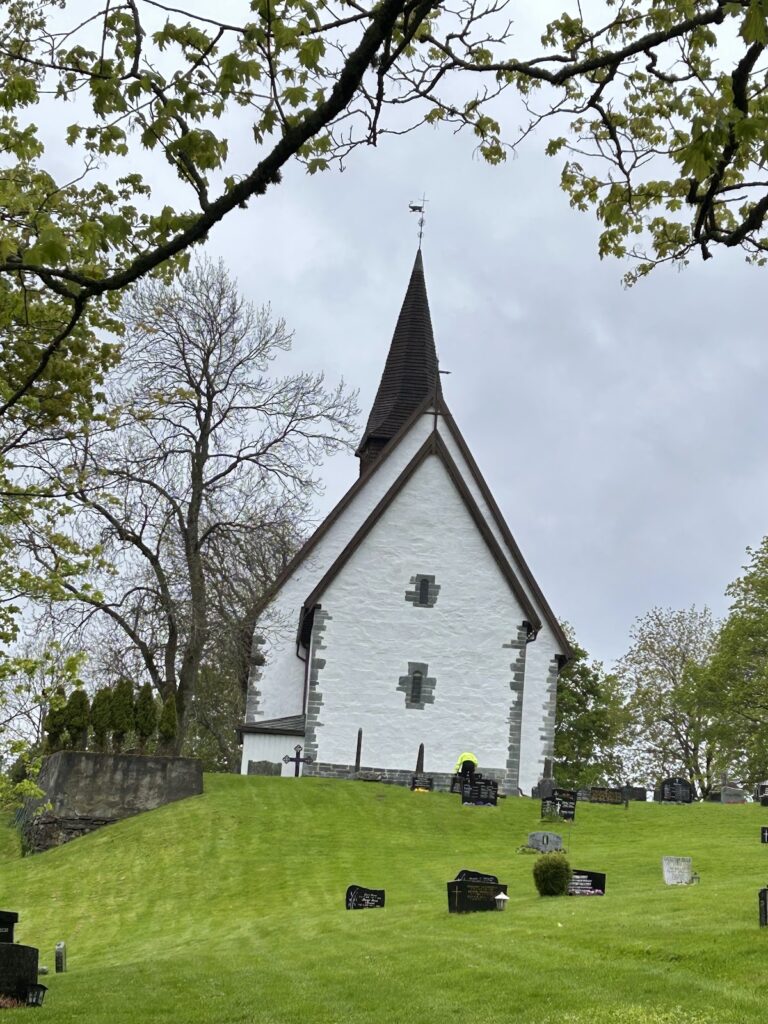
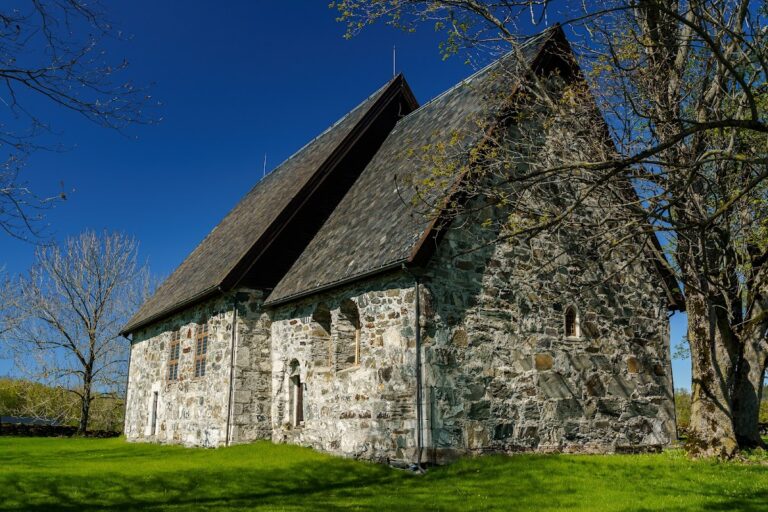
Haltdalen Stave Church is a simple single-nave building with a rectangular nave measuring approximately 6 by 5 metres and a narrower, straight-ended choir measuring about 3 by 3.5 metres. A stave church is a timber building carried by upright load-bearing posts, called staves, joined to horizontal framing members. The church has no internal posts, a gabled roof, and the roof structure typical of this tradition. Its choir ends directly rather than in an apse.
Portals and surviving timber
The building has a western portal, a southern portal, and a separate south-facing entrance to the choir. Most of the timber belongs to the original Haltdalen church, while the western wall and western portal came from Ålen Stave Church during the nineteenth-century restoration.
The surviving corner posts preserve evidence for a former svalgang, a covered exterior gallery or passage around the church. The gallery itself has not survived. The corner posts have spherical bases made from several timbers arranged across one another. Two original window openings in the long walls were later closed, and windows added after the Reformation were subsequently removed.
Interior and movable remains
Faint painted decoration survives on the eastern wall and dates to the beginning of the seventeenth century. The interior contains an altar, a baptismal font, and a pulpit painted in 1652 by Peter A. Lilje. A bronze incense vessel and a 1519 missal from Haltdalen Church are held at the Science Museum in Trondheim. A missal is a Christian liturgical book containing the texts and instructions for celebrating Mass.
Heimaey and Lübeck replicas
The Heimaey replica differs from the original by including an exterior gallery, added to provide extra strength in Iceland’s stormy climate. It was constructed in Lom from materials deliberately gathered from several parts of Norway, including timber from Røros, shingles from Odalen, tar from Skjåk, wrought iron from Vågå, and a doorstep from Holtålen. Its altar includes a replica of the medieval St. Olav frontal, a decorated altar front associated with Saint Olav, the medieval king traditionally regarded as Norway’s principal Christianizing ruler. The frontal was produced under the direction of Terje Nordsted.
The St. Nicholas replica in Lübeck has no exterior gallery. Its main portal is wider than the original and includes an additional carving. Its wider south portal is placed in the choir rather than the nave, while the choir itself has no portal.