Kōsoku-ji Temple: A Jishū Buddhist Temple in Kamakura


Site at a Glance
- Rating
- 4
- Popularity
- Low
- Country
- Japan
- Primary era
- Early Modern
- External website
- Open
- Eras represented
- Early Modern
- Civilizations
- Tokugawa
- Site type
- Religious
- Remains
- Temple
On this page16 sections
History
Kōsoku-ji Temple is a Jishū Buddhist temple in Kamakura, Japan, founded in 1278 during the Kamakura period. Its formal name is Iwazō-san Chōshun-in Kōsoku-ji, and it is a subordinate temple of Shōjōkō-ji in Fujisawa. Jishū is a Japanese Pure Land school founded by Ippen, whose practice emphasizes devotion to Amitabha and the recitation of the nenbutsu, the invocation of Amitabha’s name.
Foundation and the Amitabha tradition
Temple tradition identifies Ippen as the founder and Saku’a as the founding priest. Kōsoku-ji is said to have moved to its present site in 1278, although the earlier history of Iwazō-ji and the institution’s development before that move remain unclear. The surviving illustrated origin scroll preserves the central tradition associated with the temple and its principal image.
The story begins in the early Kamakura period, when the Buddhist sculptor Unkei came to Kamakura at a shogun’s invitation. At the request of a woman named Machi no Tsubone, he carved an Amitabha triad, a group showing Amitabha accompanied by two attendant bodhisattvas. A Kamakura municipal cultural inventory dates this episode to 1215.
According to the story, a badly behaved monk called Manzai Hōshi was accused of theft and branded on the cheek with a heated iron bit. The mark did not scar his skin. Amitabha then appeared in Machi no Tsubone’s dream and questioned why a fire brand had been applied to his cheek. The following morning, a burn mark was found on the cheek of the statue. Twenty-one attempts to repair it were unsuccessful, giving rise to the names “Burned-Cheek Amitabha” and “Fire-Brand Hall.”
Machi no Tsubone later entered religious life and is said to have founded the Shingon Buddhist temple Iwazō-ji west of Hiki-ga-yatsu. She enshrined the Amitabha triad there as its principal image. A related version appears in Mujū Dōkyō’s medieval Buddhist tale collection Shasekishū, where the episode is presented as an example of Amitabha’s miraculous benefit.
Adoption of Jishū identity
After the temple’s third abbot became a devotee of Ippen and took the name Saku’a Amitabha, Ippen was adopted as the institution’s founder. The temple took Iwazō as its mountain name and was renamed Kōsoku-ji. During the early Edo period it was also known as Fujisawa-zan.
A major earthquake during the Genroku period, from 1688 to 1704, caused the temple to collapse. Its twenty-second abbot led the revival. A later collapse followed an Ansei-period earthquake and strong wind between 1854 and 1860, after which the thirty-third abbot restored the temple. The former precinct included five subtemples and several subsidiary shrines, alongside the main hall, kitchen and living quarters, and gate. These institutions were lost through disasters and other changes by the Edo period, while nearby Jūnisho Shrine, formerly one of the subsidiary shrines, was moved in 1838.
Earthquake damage and cultural status
During the tenure of the thirty-seventh abbot, the Great Kantō Earthquake of 1 September 1923 tilted the main hall. Repairs followed in 1924. The same earthquake brought down the study within the kitchen and living quarters, and those facilities were later moved onto the study’s former site.
Kōsoku-ji belongs to several Kamakura pilgrimage circuits. It is stop 7 on the Kamakura Thirty-Three Kannon Pilgrimage, stop 5 on the Kamakura Twenty-Four Jizō Pilgrimage, and is identified as stop 6, or in some listings stop 5, on the Kamakura Six Amitabha pilgrimage. Its principal image and illustrated origin scroll are nationally designated Important Cultural Properties. The Amitabha triad painting and a copy of the Burned-Cheek Amitabha Origin Scroll have municipal designations. The scroll was designated in 1900, the principal image in 1925, the painting in 1969, and the copy in 1988.
Remains
The surviving complex consists of the main hall, the kitchen and living quarters, and a Sanmon gate. The present buildings represent the temple’s reconstructed and repaired form after repeated earthquake and wind damage. Historical precinct maps show that the institution once occupied a broader arrangement containing subtemples and subsidiary shrines.
Temple buildings
Main Hall
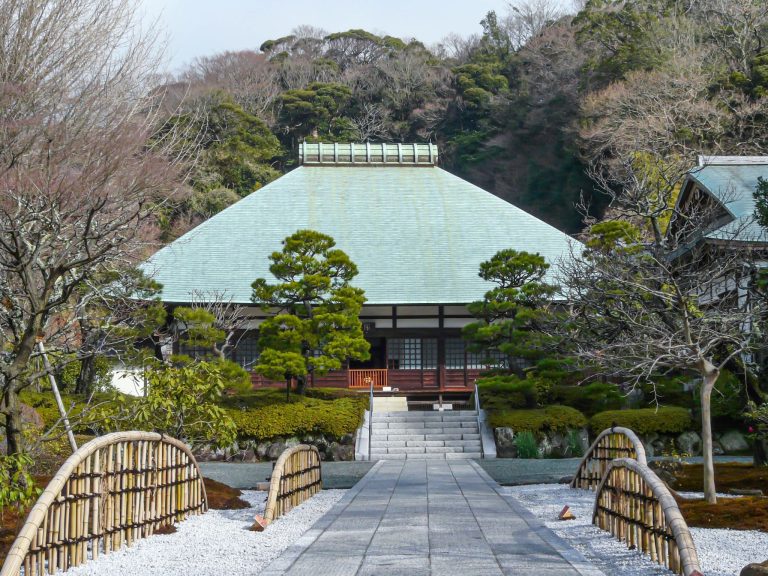
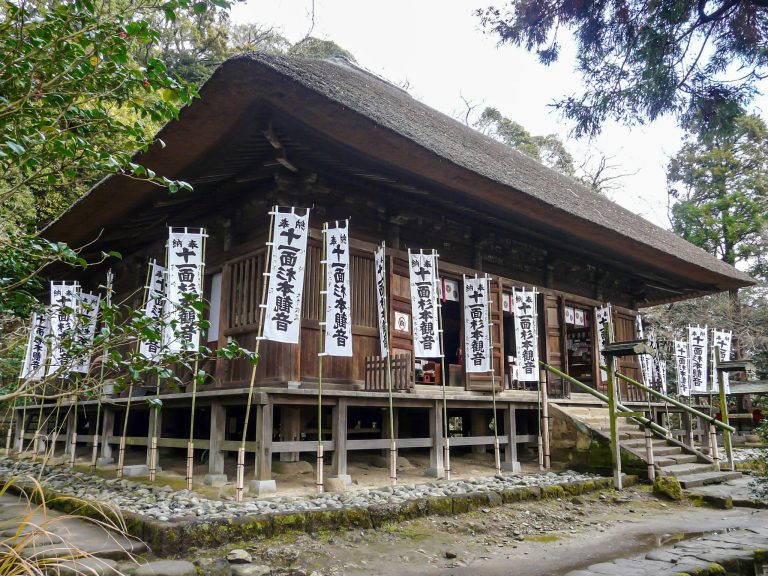
The present main hall was erected during the Ansei reconstruction and was topped out in April 1859. It houses the principal wooden image group and several other religious objects associated with the temple. The building was repaired after the Great Kantō Earthquake tilted it in 1923.
Sanmon Gate
The Sanmon gate is traditionally said to have been built by local villagers during the Bunka period, from 1804 to 1818. Its original thatched roof was replaced with tile roofing in 1923, giving the gate its present roof material.
Kitchen and Living Quarters
The kitchen and living quarters form part of the surviving complex. Their study collapsed in the Great Kantō Earthquake, and the kitchen and living quarters were subsequently moved onto the former study site.
Sacred images and temple objects
Burned-Cheek Amitabha Triad
The principal image is a standing wooden triad with Amitabha at the center and two attendant bodhisattvas at the sides. The central figure is the Burned-Cheek Amitabha. Tradition attributes the group to Unkei and the attendant figures to Kaikei and Tankei, but the treatment of the drapery and other sculptural features is considered inconsistent with Unkei’s authorship. The triad is instead regarded as an early-thirteenth-century work of the Kamakura period.
Other Images and Altar
The altar supporting the principal image is traditionally said to have been donated by Ashikaga Mochiuji. The main hall also houses a Buddha head said to have been the principal image of the Jōroku Hall at Daiji-ji, an image of the Inari deity, and a wooden standing statue of Shō-Kannon. Shō-Kannon is a principal form of Kannon, the Buddhist bodhisattva of compassion, and this image serves as the principal image for stop 7 of the Kamakura Thirty-Three Kannon circuit. It is traditionally attributed to the Heian-period sculptor Jōchō. An imperial plaque said to have belonged to Emperor Go-Daigo is also kept in the hall.
Salt-Licking Jizō
A stone statue of Jizō stands in the hall in front of the main hall. Jizō is associated particularly with the protection of travellers, children, and beings in difficult circumstances. The statue formerly stood beside the prefectural road across the Namerigawa River, and temple tradition dates its relocation to 1897. Salt sellers from Mutsuura placed offerings of salt before it while travelling along the road. When the salt had disappeared on their return, the statue acquired the name “Salt-Licking Jizō.”
The Kamakura Diary of Tokugawa Mitsukuni gives another version of the story. In that account, the statue suddenly emitted light, and a salt seller pushed it over and sprinkled it with salt, causing the light to stop.
Illustrated records and paintings
Origin Scrolls
Kōsoku-ji preserves the illustrated Burned-Cheek Amitabha Origin Scroll in two volumes. The work dates from the middle or later part of the Kamakura period and presents the tradition surrounding the principal image. The temple also holds a two-volume painted copy of the scroll.
Amitabha Triad Painting
A painted silk image of the Amitabha triad is preserved at the temple. Together with the municipal copy of the origin scroll, it forms part of the temple’s group of municipally designated artworks, while the original illustrated scroll and the principal image hold national Important Cultural Property status.