Amagiri Castle: A Medieval Mountain Fortress in Kagawa, Japan
Site at a Glance
- Popularity
- Medium
- Country
- Japan
- Primary era
- Medieval
- Eras represented
- Medieval
- Civilizations
- Ashikaga shogunate
- Site type
- Military
- Remains
- Castle
On this page10 sections
History
Amagiri Castle is a Japanese mountain fortress built by Kagawa Kagenori in 1364 on Mount Amagiri in Kagawa Prefecture, Japan. It dates to the Muromachi period, when the Ashikaga shogunate, Japan’s military government, ruled. The Kagawa clan used it as an emergency stronghold because its usual residence, Tadotsu Castle, was considered vulnerable to siege.
Origins and Kagawa rule
Local tradition places a stronghold for a military corps on Mount Amagiri as early as 702. Kagenori came from Sagami with the Hosokawa clan and became deputy to the military governor of western Sanuki, the historical province broadly corresponding to present-day Kagawa. The Kagawa governed the province as Hosokawa retainers.
In the fourteenth century, the Kagawa accompanied the Hosokawa in a campaign to take Shikoku from supporters of the Southern Court, one of two rival imperial courts in a struggle over succession. The clan rose with the Hosokawa under the Muromachi shogunate, later serving the Hosokawa head family and joining campaigns around Kyoto.
Hosokawa and Miyoshi rivalry
The Hosokawa and Miyoshi were warrior clans competing for political and military power. Hosokawa influence weakened after Miyoshi Nagayoshi defeated Hosokawa Harumoto in 1549 and Miyoshi Jikkyu killed Hosokawa Mochitaka, governor of neighboring Awa, in 1553. Awa broadly corresponds to present-day Tokushima, and Miyoshi power then spread into Sanuki.
In 1558, Miyoshi Jikkyu and forces from eastern Sanuki attacked Amagiri, but Kagawa leader Yukikage repelled them. He later made peace, kept his lands, and entered the Miyoshi sphere of control. Yukikage may have left the castle and returned later with support from the Mori, a warrior clan based in western Japan. Around 1570, the Kagawa again asserted independence, breaking with Miyoshi Nagaharu. In 1576, Yukikage allied with Oda Nobunaga, a leading military ruler during Japan’s late-sixteenth-century unification, and took the name Nobukage, incorporating a character bestowed by Nobunaga.
Chosokabe control and abandonment
Chosokabe Motochika’s forces conquered the region in the late 1570s. In 1581, Kagawa Nobukage adopted Motochika’s second son, Chikakazu, an alliance that helped preserve the Kagawa house. Amagiri became a Chosokabe base in Sanuki for operations into Iyo, broadly corresponding to present-day Ehime, and for controlling local lords in Sanuki and eastern Iyo. Chikakazu entered the castle in 1583.
In 1585, Toyotomi Hideyoshi’s campaign to bring Shikoku under his rule defeated the Chosokabe. Motochika surrendered after two months of fighting; the Kagawa house was abolished, its members were exiled to Tosa, broadly present-day Kochi, and Amagiri was abandoned.
The alternate name “Nun-Slaying Castle” comes from a legend about the siege of the castle. The tale says that, after the defenders lost their water supply, they washed horses with white rice to make it appear that water remained plentiful. A passing nun supposedly revealed the deception to the Chosokabe, whose assault then captured the castle; Kagawa stragglers later killed her. The tale is not evidence of an attack, and no evidence shows that Chosokabe forces assaulted Amagiri.
The castle ruins have been designated a National Historic Site of Japan since May 16, 1990.
Remains
Amagiri’s defenses follow a long, narrow ridge, adapting the fortifications to the mountain’s natural contours. Stone walls and trenches formed part of a spread-out plan of defended areas and outer works across the ridge system.
Mountain setting
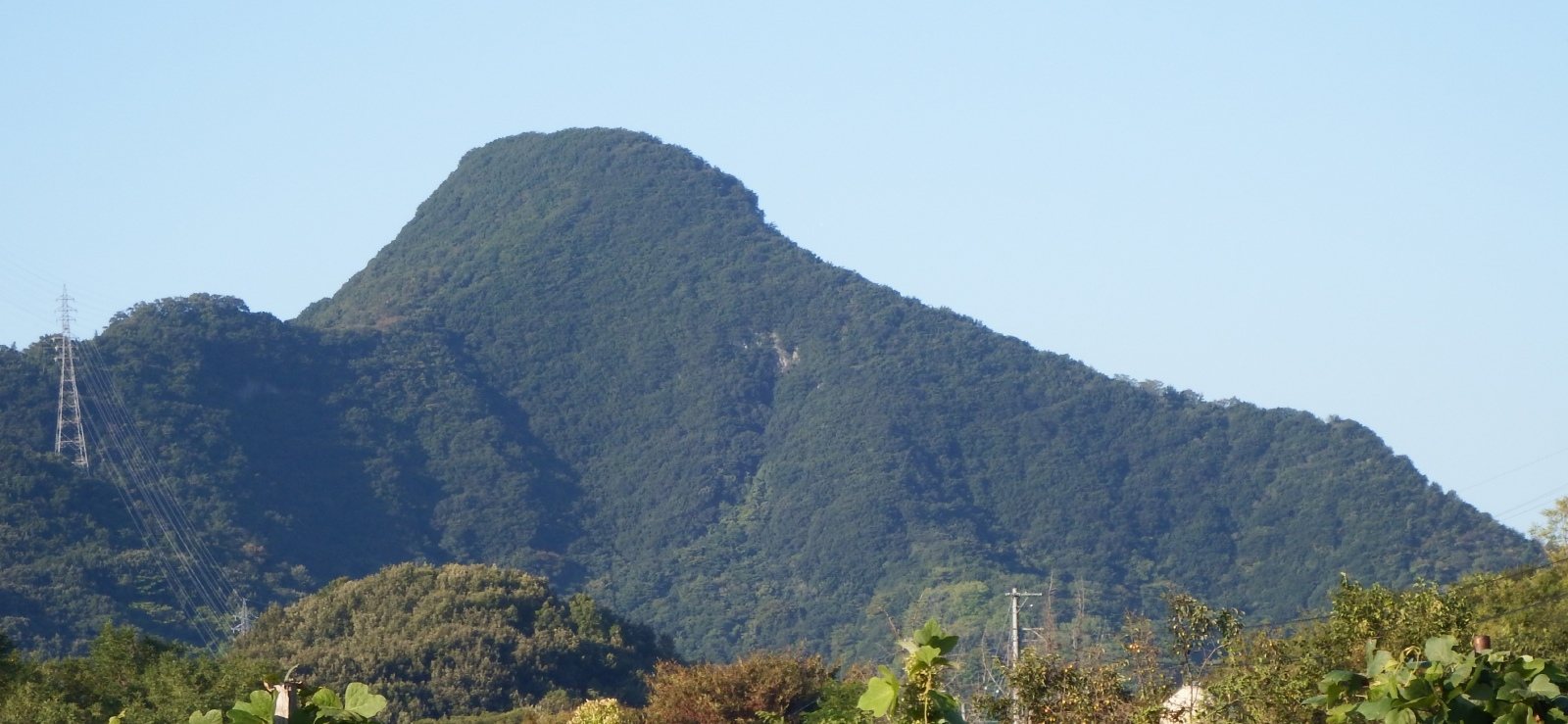
Mount Amagiri, about 380 metres high, lies on the western edge of the Marugame Plain, at the boundary of present-day Zentsuji, Mitoyo, and Tadotsu. The mountain is about five kilometres west of central Marugame, near the coast, and overlooks the approach to Utazu, an important port during the Muromachi period. Nearby Mount Iyadani reaches roughly the same elevation. It was revered as sacred and associated with the religious training of Kūkai, and it is home to Iyadani-ji, a temple on the Shikoku Pilgrimage, an 88-temple Buddhist circuit associated with him.
Enclosures and defenses
Ridge enclosures and approaches
The main enclosure, also described as a watch platform, occupied the summit. The second and third enclosures lay to the east, while further defended areas extended northward for more than 200 metres and along two eastern ridges. The full castle stretched for more than 800 metres and included a hidden fort and outer defenses. Its main gate stood on the southern side, approached from Iyadani-ji. Four routes once climbed toward the castle; quarrying removed the eastern ridge route, known as the Horse Road, leaving three.
Stonework, trenches, and well
Surviving features include stone ramparts, trenches cut across the ridges, and a well. Fragments of stone walls and signs of quarrying remain near the summit. Quarrying has removed substantial portions of the site, especially on the southeast side, where the mountain has been heavily cut away. Local tradition says the mountain once held 47 castle turrets.
Artifacts
Some artifacts associated with Amagiri Castle are preserved at the Zentsuji City Local History Museum.