Kongōshō-ji Temple: A Rinzai Zen Temple in Ise, Japan


Site at a Glance
- Rating
- 4.3
- Popularity
- Medium
- Country
- Japan
- Primary era
- Early Modern
- Eras represented
- Early Modern
- Civilizations
- Tokugawa
- Site type
- Religious
- Remains
- Sanctuary
On this page12 sections
History
Kongōshō-ji Temple is a Rinzai-school Zen Buddhist temple in Ise, Japan, on Mount Asama in Mie Prefecture. Traditionally traced to a chapel founded in the mid-sixth century, it became a Shingon Buddhist center in the ninth century before its revival as a Zen temple in the late fourteenth and early fifteenth centuries. Its principal image is Kokūzō Bosatsu, a bodhisattva associated with space, wisdom, and learning, and the temple is the second station of the Ise Saigoku Thirty-Three Kannon Pilgrimage.
Traditional Origins and Shingon Revival
The temple’s earliest history is preserved through tradition rather than a continuous early record. In the mid-sixth century, Emperor Kinmei is said to have ordered the monk Kyōtai to establish a chapel called Myōjō-dō at the site. In 825, the Buddhist monk Kūkai, founder of the Shingon school of esoteric Buddhism, is traditionally credited with reviving the institution as a center for religious training. He is also said to have installed Kokūzō Bosatsu as its principal image, performed the Kokūzō Gumonji-hō practice, and established the formal name Shōhōzan Tōsotsuin Kongōshō-ji.
A temple at the foot of Mount Asama in present-day Toba is traditionally regarded as Kongōshō-ji’s inner sanctuary. This relationship became important to the temple’s religious identity and later connected the mountain and the main precinct through pilgrimage and memorial practices.
Revival as a Rinzai Temple
After a prolonged decline that included a period without resident clergy, Kongōshō-ji was revived from 1392 through the Ōei period by Tōgaku Bun’iku, the seventy-first abbot of Kenchō-ji in Kamakura. Tōgaku is regarded as the institution’s restorer and its first abbot after the revival. Under his leadership, the temple changed from Shingon affiliation to the Rinzai tradition, a major Japanese Zen school emphasizing disciplined monastic practice and meditation.
During the period when Buddhist and Shinto institutions and beliefs were historically combined, Kongōshō-ji’s position northeast of Ise Grand Shrine gave it a special religious role. The northeast was regarded as a spiritually vulnerable direction, and the temple came to be viewed as the shrine’s protector. It attracted pilgrims and grew into the largest temple in Ise and Shima provinces. A pilgrimage saying held that visiting Ise without climbing Mount Asama made the journey only partial.
Uhōdōji, understood in the temple’s tradition as a manifestation of Amaterasu, the central kami of Ise Grand Shrine, was worshipped at Kongōshō-ji as an attendant of Kokūzō Bosatsu. The temple consequently came to be treated as the inner sanctuary of Ise Grand Shrine. Its ritual practice used sakaki branches, associated with Shinto rites, rather than shikimi branches commonly used in Buddhist observances.
The Kuki Connection and Early Modern Fires
Kongōshō-ji was associated with the naval commander Kuki Yoshitaka and became the Kuki clan’s family memorial temple, a temple responsible for rites commemorating a lineage. Yoshitaka’s third son entered the priesthood there in memory of his father and later became the temple’s twelfth abbot.
Fire repeatedly altered the complex. Fires in 1597 and 1608 damaged the temple, with the later blaze destroying the main hall. In 1609, Tokugawa Ieyasu ordered Ikeda Terumasa, lord of Himeji Castle and Ieyasu’s son-in-law, to rebuild the main hall and Mani-den. Another fire damaged the complex in 1804.
Meiji Survival and Twentieth-Century Renewal
During the Meiji period, Kongōshō-ji escaped the abolition that closed many Buddhist temples connected with Ise Grand Shrine. A fire in 1887 nevertheless destroyed many buildings. The temple’s later history was also shaped by changing access to Mount Asama. A cable car opened in 1925, increasing access to the mountain and the temple, but its line was dismantled in 1944 for military metal requisitioning during the Pacific War. General access to Mount Asama was then prohibited, and the temple entered another period of decline. Further damage, including damage caused by the Isewan Typhoon, deepened its difficulties.
The opening of the Ise-Shima Skyline in 1964 brought a major increase in pilgrims, and Kongōshō-ji was restored to a level of activity exceeding its former prosperity. The Niōmon was rebuilt in 1979. The temple, its principal buildings, and associated objects include nationally designated cultural properties. These include the main hall, a portrait of Kuki Yoshitaka, a standing statue of Uhōdōji, and materials excavated from the Asamayama Kyōgamine Sutra Mounds.
Mountain Burials and Memorial Traditions
Sutra burial mounds on Mount Asama provide evidence of a late-Heian practice in which Buddhist scriptures were placed in underground or earthen deposits for religious merit and protection. Multiple containers bearing inscriptions dated 1173 were found in 1894, and further mounds were discovered after the Isewan Typhoon. The excavated materials received National Treasure designation in 1963, while the Asamayama Sutra Mound Group was designated a National Historic Site.
Since the Edo period, people of different Buddhist affiliations have traditionally climbed Mount Asama after funerals to erect wooden sotoba, or memorial tablets used in Buddhist funerary rites, at the inner sanctuary and conduct memorial ceremonies. The mountain was also associated with confinement, refuge, and death. In 1630, the feudal lord Akita Sanesue was confined at its foot. The fugitive military commander Bitō Tomonobu and the warlord Fukuhara Nagataka are linked to episodes of refuge or suicide there.
Remains
Kongōshō-ji stands on the eastern flank of Kyōgamine, the southern peak of Mount Asama. Its surviving buildings and associated collections combine an early modern temple complex with material evidence from late-Heian Buddhist practices on the mountain. The principal buildings include the main hall, Mani-den, and the reconstructed Niōmon, while a treasure hall preserves excavated objects from the sutra mounds.
Principal Temple Buildings
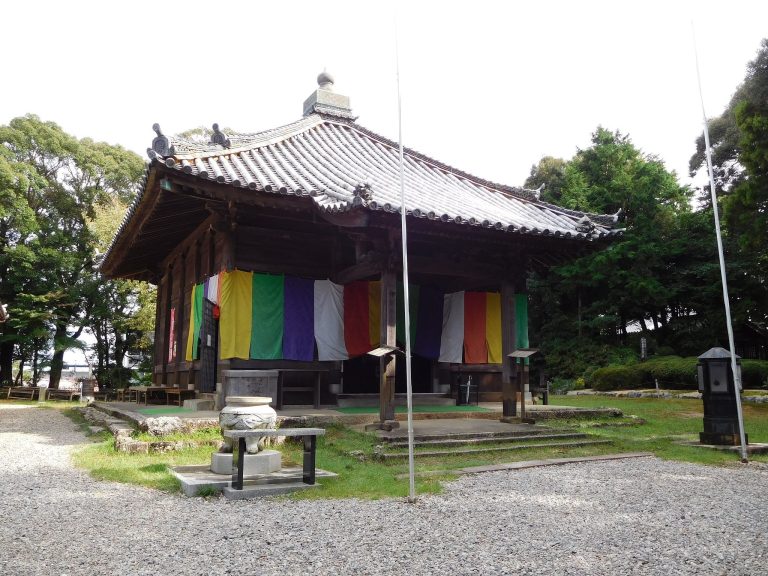
Main Hall
The main hall, or Hondō, is a six-by-seven-bay building, with each bay representing a structural division in the plan. It has a hipped roof covered with Japanese cypress bark. The building was reconstructed in 1609 after the fire of 1608 and repaired in 1701 by Keishōin, the mother of shogun Tokugawa Tsunayoshi. The hall survives as one of the temple’s principal historic structures.
Mani-den and Niōmon
Mani-den was rebuilt at the same time as the main hall in 1609. The temple entrance is marked by the Niōmon, a gate whose present structure dates from its reconstruction in 1979. Together, these buildings express the complex’s early modern rebuilding and its later physical renewal.
Sutra Mounds and Treasure Hall
The Asamayama Kyōgamine Sutra Mounds were found on Mount Asama behind the temple. Their excavated assemblage includes bronze sutra containers, mirrors engraved with Amida and the Amida triad, ceramics, and a mirror showing the Welcoming Descent of Amida and the bodhisattvas. The objects date from the late Heian period and can be viewed in the temple’s treasure hall. Their forms and inscriptions connect the mountain deposits with the Buddhist practice of preserving scriptures in earthen or underground mounds.
Sacred and Memorial Objects
A portrait of Kuki Yoshitaka dated 1607 is associated with Kongōshō-ji, reflecting the temple’s role as the Kuki clan’s family memorial temple. Other sacred and cultural objects include a standing wooden statue of Uhōdōji, a Kamakura-period statue of Jizō Bosatsu, a Heian-period tachi sword, and a Heian-period bronze mirror decorated with paired phoenixes.
Uhōdōji is enshrined as an attendant of Kokūzō Bosatsu. The use of sakaki branches in the temple’s rites, in place of the shikimi branches commonly used in Buddhist observances, gives physical form to Kongōshō-ji’s distinctive combination of Buddhist and Shinto traditions.