Kommos: A Minoan Harbour Town in Greece
Site at a Glance
- Popularity
- High
- Country
- Greece
- Primary era
- Bronze Age
- Eras represented
- Bronze Age, Iron Age, Classical
- Civilizations
- Ancient Greek, Minoan, Phoenician
- Site type
- City
On this page18 sections
History
Minoan harbour town
Kommos was a harbour town of the Minoan civilization, a Bronze Age society centred on Crete, on the coast of the Mesara Plain in Greece. Occupation reaches back to the Late Neolithic, and a settled community existed by about 1900 BC. During the Middle Minoan phase, one of the successive periods of Minoan civilization, Kommos developed into a major port serving Phaistos and later Hagia Triada.
The harbour’s importance has been linked to silting near the Geropotamos River, which left Phaistos and, later, Hagia Triada without direct access to the sea. Kommos was probably politically dependent on those centres, though its monumental buildings have prompted questions about the nature of that relationship. An earthquake around 1700 BC destroyed the settlement. It was rebuilt soon afterward to serve Phaistos or Hagia Triada and expanded in later phases. Commercial activity reached a high point in the early Late Minoan III period, even as living standards declined.
The Minoan town was abandoned around 1200 BC, after the Late Minoan IIIB phase, and was not settled again on a comparable scale. Greek occupation followed and continued into the Roman period. A sanctuary was established at the abandoned settlement, and religious use continued into Roman times. Religious activity across Crete had declined around 600 BC.
Kommos has been proposed as the location of the ancient Cretan city of Amyklaion, but the identification remains unproven. A passage in the Odyssey describing a small rock that holds back waves has also been linked to the area. Suggested locations include the Papadoplaka reef, Cape Lithino and the Paximadia Islands.
Archaeological investigation
In 1924, Arthur Evans recognized the surface remains as those of a Minoan port, although he misidentified some features. What he thought was a customs house proved to be a residence, and his supposed Minoan road was a later fortification wall. Until the early 1970s, some archaeologists placed Phaistos’s port near Kokkinos Pyrgos instead. German amateur archaeologist Friedhelm Will argued for Kommos and found early walls in unauthorized excavations; Greek authorities detained him after a complaint.
Official excavations began in 1976 with permission from Greece’s Archaeological Service. A University of Toronto team led by Joseph W. Shaw and Maria Coutroubaki Shaw worked at the site through 1995, uncovering Minoan remains as well as unexpected Greco-Roman roof tiles. The excavations considered the site’s landscape and evidence of everyday activity. Consolidation work in 2004–2006 helped protect the remains from erosion.
Remains
The town and harbour
Layout and extent
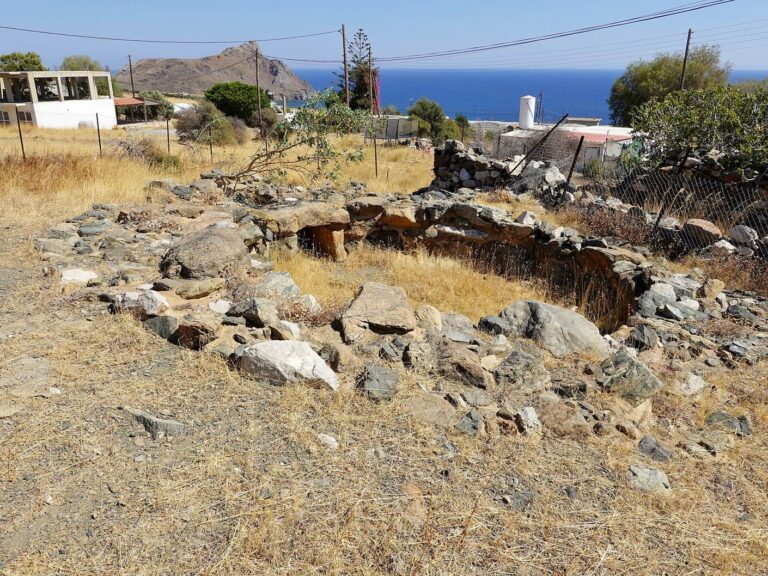
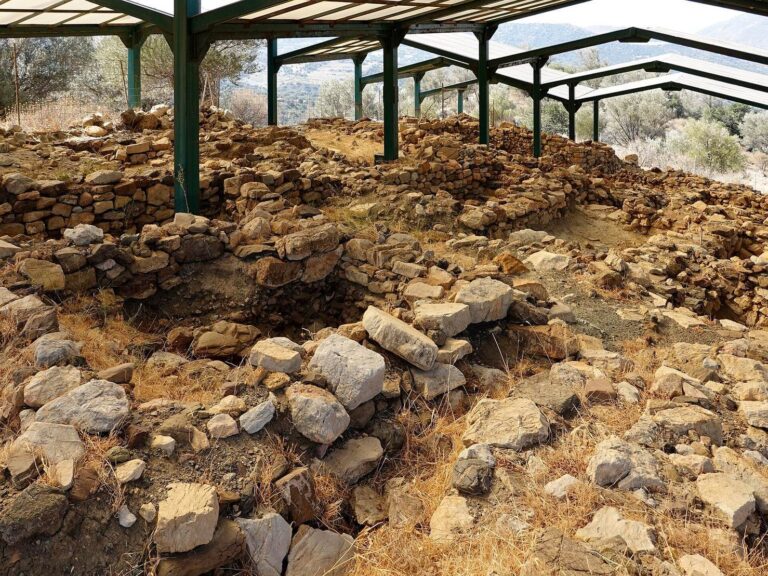
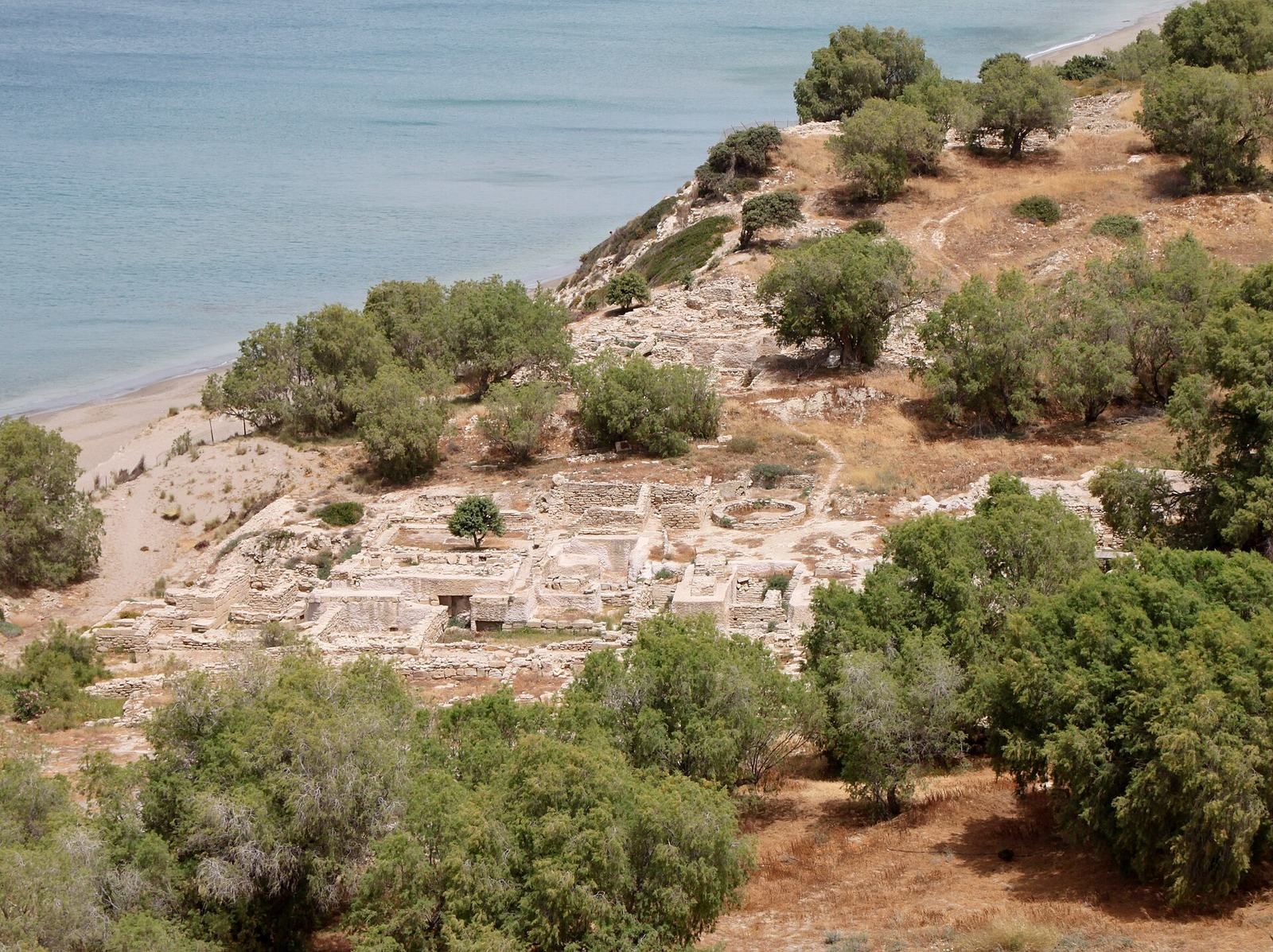
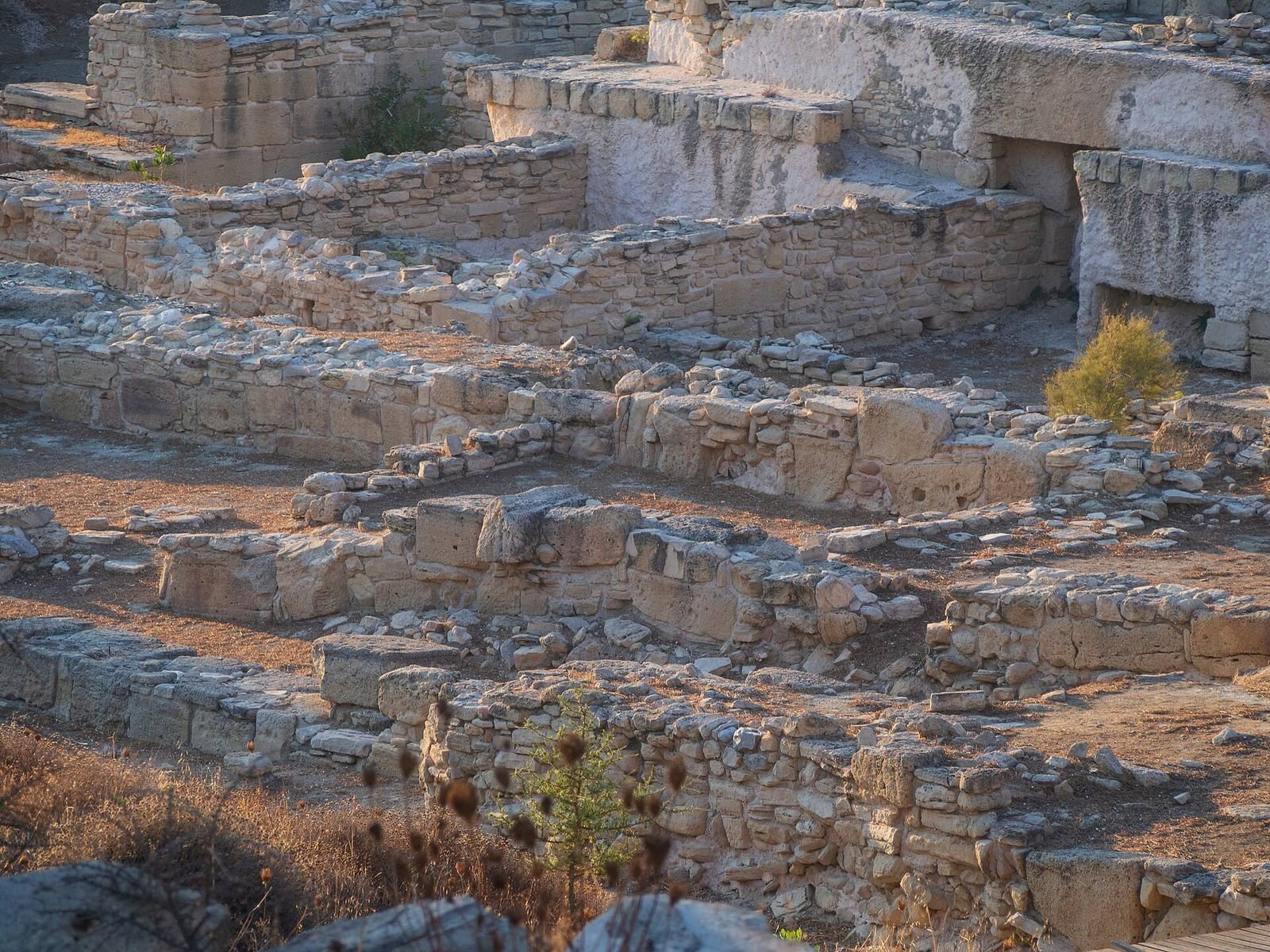
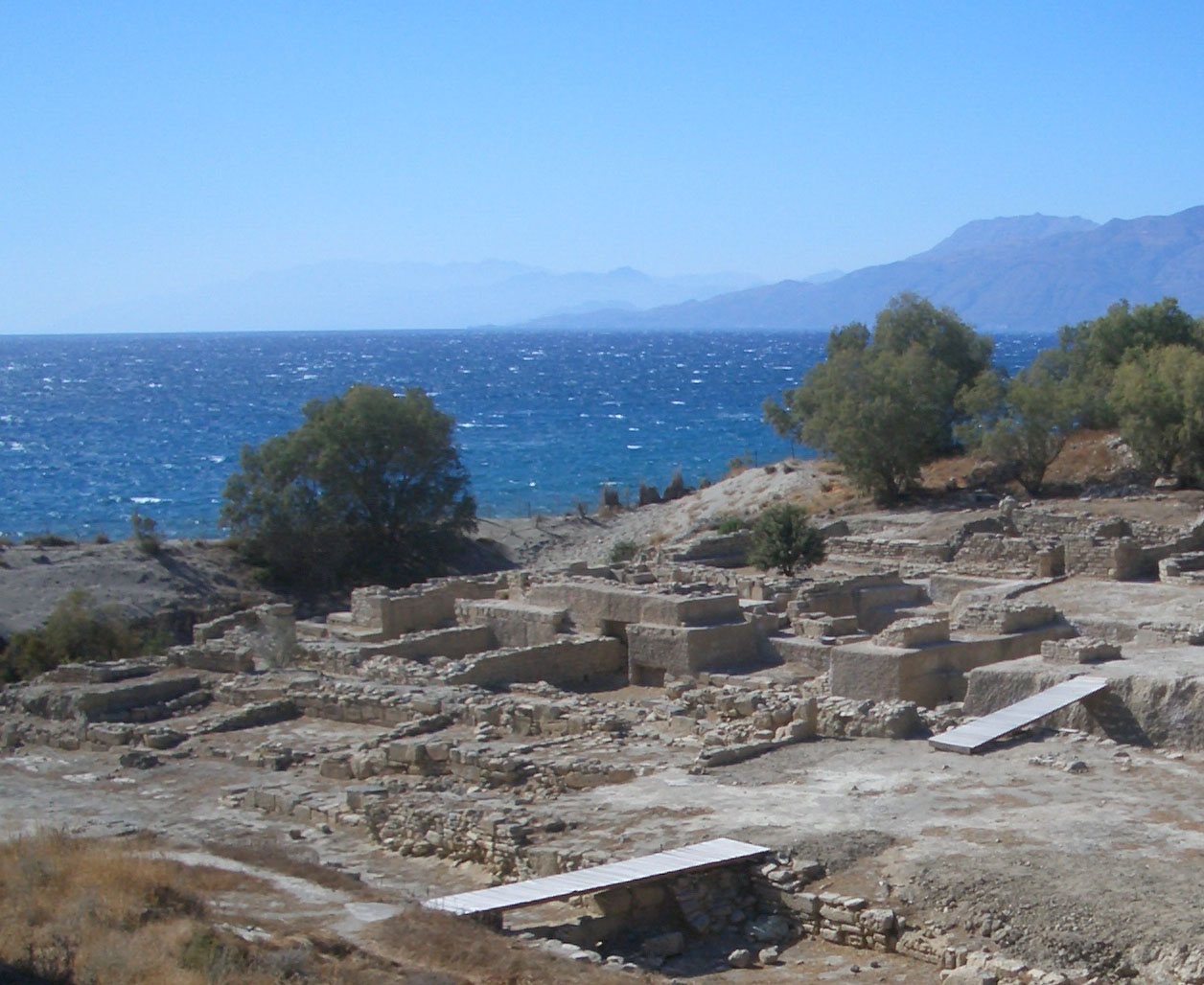
Kommos occupies the southern side of a small hill beside the Mesara Plain coast. Its excavated remains fall into three nearby areas: the largest, at the hill’s southern foot, preserves the harbour town’s centre; another lies about 20 metres north on the slope; and a third is on the hilltop, roughly 40 metres farther north. The middle area contains houses and remains from successive Old Palace and New Palace periods, when Minoan society was centred on palaces. The upper area preserves remains from the later phase after the palaces ceased to function.
A broad road paved with stone slabs divided the northern residential area on the hill from the flatter civic area to the south. Buildings from different periods often lie one above another. The settlement covered about 1.5 hectares during the Middle Minoan period and may have reached 3.5 hectares after the earthquake. By around 1200 BC, built-up areas extended north and east beyond the present excavation boundary. Stairways in many houses indicate that some had two storeys. The nearby Papadoplaka reef islet partly sheltered the town from wind and waves. It is now substantially submerged, following sea-level rise and German bombing during the Nazi occupation of Crete.
Courtyard and ship sheds
In the southern area, buildings were arranged around a courtyard that formed the town’s central open space. The complex included a small palace and six long buildings interpreted as ship sheds, used to store and repair vessels. Earlier Minoan structures in this part of the town were later built over during the Greek Geometric, Archaic and Classical periods.
Palace buildings
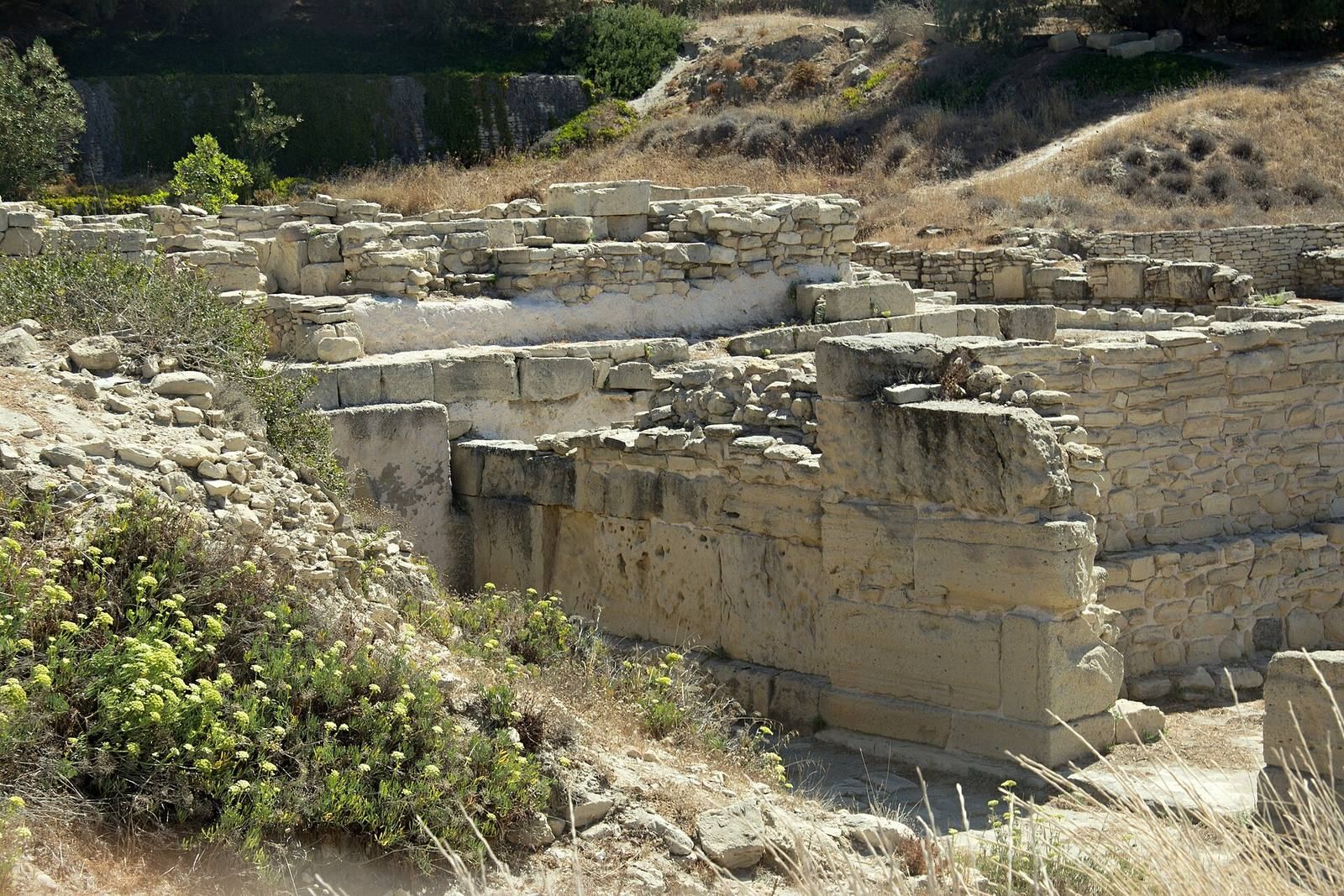
Building AA, the earliest known palace-style structure at Kommos, dates to Middle Minoan II, shortly after the first palace at Phaistos. A walkway beneath its central court may point to an earlier building. Building T replaced AA during Middle Minoan III. Its monumental front used the largest carefully shaped masonry blocks employed by the Minoans.
After Building T collapsed, the area was redeveloped in Late Minoan IIIA2 with court-centred Buildings N and P. Building P occupied the eastern wing of T. Its six long, narrow galleries opened west toward the sea. The structure stood inland from the shore and had no launching ramp.
Workshop and harbour buildings
Building P is interpreted as a ship shed, possibly intended for longer-term storage than later examples. Residue from a coating used to protect hulls from marine growth supports this interpretation, as does a comparable building at Katsamba, the port of Knossos. It is the largest known Minoan building of the Late Minoan IIIA period and yielded most of the short-necked amphoras found at Kommos.
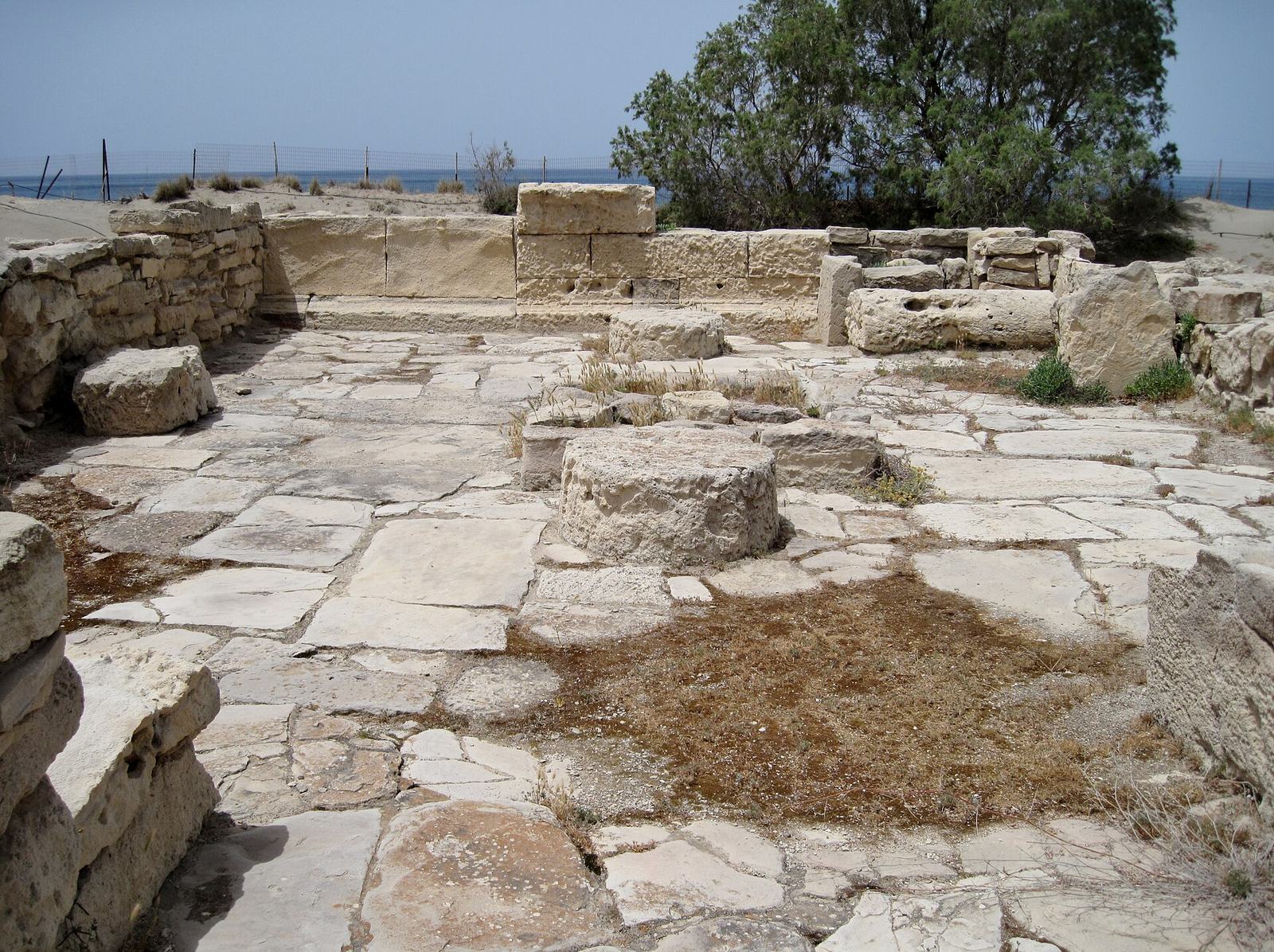
A pottery workshop and kiln were established in the earlier courtyard after Building T had collapsed. The kiln stood in a covered walkway along the courtyard’s south side, supported by six limestone bases for wooden columns. Its location has been taken to suggest that Building T had lost its former prestigious role.
Sanctuary buildings
Temples A and B
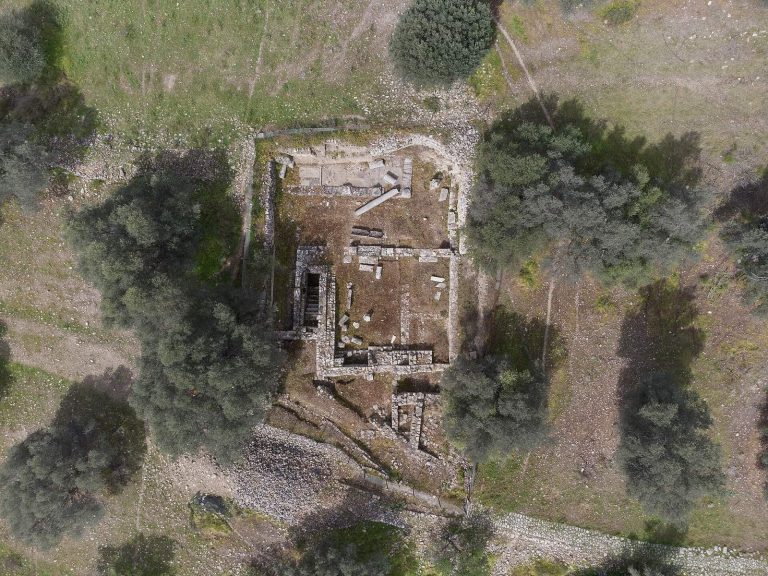
The sanctuary lies in the northwest part of the southern excavation area. Temple A was built around 1020 BC using stone blocks reused from the Minoan town. Temple B replaced it around 800 BC. Within Temple B, a Phoenician shrine, associated with an eastern Mediterranean people active in maritime trade, consisted of three stone columns set into a floor block. It is one of only two such shrines known in the Aegean.
Finds from the sanctuary area include Cretan terracotta figures, a small Greek bronze horse, and glazed non-clay figures of the Egyptian gods Sekhmet, associated with war and protection, and Nefertum, associated with the lotus. Weapons from the area are thought to have belonged to a local group of elite warriors.
Temple C and the altars
Temple C, built around 400 BC over the remains of a Minoan palace building, was a single rectangular room. Its foundations survive. Like other Cretan temples of its type, it had no columns outside the building. Two statues originally stood inside; their surviving remains include the statue bases and one eye. The temple remained in use until about AD 150.
Four altars were erected in the sanctuary east of Temple C at different stages. The earliest, Altar H, dates to around the second half of the sixth century BC; the other three belong to the period of Temple C. An inscription names the Greek gods Zeus, Athena and Poseidon, associated respectively with rule, wisdom and warfare, and the sea. Whether the altars reflect worship of different gods in successive periods is uncertain.
Pottery and evidence of exchange
Local pottery and transport vessels
Kommos produced pottery as well as receiving imported wares. Its ceramics include vessels from Middle and Late Minoan times and the later Proto-Geometric and Geometric periods. Examples include large storage jars, mixing bowls, small oil containers, jugs and cups. Imported ceramics link the town with Sardinia, southern Italy, Egypt, Cyprus and the Levant, the eastern Mediterranean coastal region. Among Bronze Age sites in the Aegean, Kommos has yielded more evidence of intercultural trade in imported pottery than any other.
Stirrup jars, closed vessels used chiefly to transport liquids, have a distinctive arrangement of handles and a false neck sealed with a clay disk. Examples occur at Kommos and across mainland Greece, the Aegean islands and the western Anatolian coast. Related Cretan jars have also been found at Tell el-Amarna in Egypt, Cyprus and the Levant. Study of their mineral inclusions and chemical composition indicates that most came from northern Central Crete.
Short-necked amphoras and imported jars
A short-necked amphora, a two-handled storage or transport jar, began appearing at Kommos at the start of the fourteenth century BC. This form had handles fixed at the shoulder, a very short neck and a rounded mouth. The building interpreted as a ship shed yielded most of the examples found at the site.
Sixty Canaanite transport jars are represented by fragments or vessels that can be restored. Related forms went to Cyprus and Lower Egypt, where shoulder-handled types were adopted and imitated. Differences in materials and surface treatment distinguish Egyptian versions. Kommos is the only Aegean site where the particular undecorated Late Bronze Age Egyptian pottery found here has been recovered. It includes closed vessels, amphoras, flasks and necked jars, probably used to carry wine.
Homes, production and animal remains
Household and workshop evidence
House X, on the northeast side of the southern excavation area, yielded parts of a fresco decorated with white lilies. A kiln area produced more than 450 kilograms of pottery fragments, most of them misfired pieces. Other finds include household and furnishing objects, tools and installations associated with an olive press.
Food and animals
Animal remains include about 9,400 large-mammal bones, 150 rodent bones, 1,150 fish bones and approximately 36,000 marine invertebrates. Many of the invertebrates came from Archaic vessels and pottery. Pigs are prominent among the large mammals, alongside cattle and deer. Some skulls were partly opened, probably to obtain the brains. Bird finds include eggshell and bones of woodpigeon, rock dove, turtle dove, Scopoli’s shearwater and chukar partridge; birds were used for food and, in some cases, kept domestically.