Vranjina Monastery: A Medieval Serbian Orthodox Monastery in Montenegro


Site at a Glance
- Rating
- 4.6
- Popularity
- Very Low
- Country
- Montenegro
- Primary era
- Medieval
- Eras represented
- Medieval
- Civilizations
- Byzantine, Serbian
- Site type
- Religious
- Remains
- Monastery
On this page14 sections
History
Vranjina Monastery is a Serbian Orthodox monastery on Vranjina Island in Montenegro, founded in the early thirteenth century during the medieval period. Its foundation is dated to 1221–1223, or specifically to 1223, and its earliest surviving documentary mention appears in the 1232/33 charter of Archbishop Sava Nemanjić. The monastery was built over the remains of a sixth-century Byzantine church and became part of the religious and political landscape of medieval Zeta.
Foundation and medieval endowment
The founder is identified in different traditions as Saint Sava, the first archbishop of the autocephalous Serbian Church, or as his disciple Ilarion, the first bishop of Zeta. Tradition holds that Ilarion was buried at Vranjina after his death. The monastery was placed directly under the Serbian archbishop rather than under the bishop of Zeta. Its foundation was intended to remain independent rather than later becoming a metochion, an estate or monastery placed under the authority of another religious institution.
Its original endowment was built through grants from the Nemanjić dynasty. Saint Sava transferred land from the Holy Savior metochion at Plavnica, while King Stefan Vladislav granted the villages of Godinje, Medveđa Glava, and Kruševica. Queen Helen of Anjou added land around Krnjice and Uljanik in 1280. Around 1296, King Stefan Milutin granted Orahovo and assigned Vranjina 100 perpers, a medieval Balkan monetary unit, from the revenue of the Sveti Srđ market near Skadar.
Another charter tradition describes a confirmation by Sava’s nephew Vladislav. He reaffirmed Sava’s gift to Saint Nicholas at Vranjina, added two villages, and exempted them from military service, taxation, and the wine levy. The monastery’s workers were placed under the authority of Saint Nicholas rather than local nobles or secular officials. The annual payment from the Sveti Srđ market continued under both Queen Helen’s charter and King Milutin’s chrysobull, a formal ruler’s charter recording rights and privileges.
Ecclesiastical influence in Zeta
During the fourteenth century, Vranjina became wealthy and influential. In 1348, Emperor Stefan Dušan assigned the monastery and half of its annual income to the Church of the Archangel Michael in Jerusalem. This made Vranjina a metochion of that institution. Later grants from the Balšić and Crnojević ruling families expanded or restored its possessions. Đurađ Stracimirović gave the village of Rake in 1404, Balša III granted two salt pans in 1417 and the village of Karuč in 1420, and Ivan Crnojević restored former estates in 1469. These included villages in the Zeta valley and the settlements of Limljani, Limsko Polje, Brčeli, Ovtočići, Tomići, and Šišovići.
The monastery’s role became especially important after the destruction of the monastery of the Holy Archangel Michael in 1441. Vranjina then served temporarily as the seat of the Metropolitanate of Zeta, the medieval Orthodox jurisdiction serving Zeta and surrounding regions. In 1455, during the growing Ottoman threat, Stefan Crnojević organized an assembly on the island. The assembly affirmed the metropolitan’s authority, requested a Slavic Orthodox hierarch, and sought recognition of Vranjina as the official metropolitan seat.
The agreement reached in 1455 between Stefan Crnojević and Venice also sought to prevent Latin clergy from exercising authority over Orthodox churches. It referred to Orthodox communities near present-day Shkodra, including Fishta, Stajka, and Skotari, and supported the metropolitan’s authority over churches in Krajina and on the lake islands. The metropolitan seat moved in the early 1480s, first briefly to Kom Monastery and finally to Cetinje.
Ottoman pressure and destruction
During the Ottoman siege of Shkodra in 1478, Sultan Mehmed the Conqueror confirmed Vranjina’s existing rights and privileges, apparently to secure the support of surrounding tribes. In 1527, the monastery appealed to Skenderbeg Crnojević, an Ottoman-appointed ruler of Montenegro and the surrounding Zeta region, for protection against renewed pressure from neighboring villages over its property.
Vranjina became increasingly poor during the seventeenth century. In 1665, its hegumen, or abbot, and the hegumen of Moračnik requested assistance from Pjetër Bogdani, the Catholic bishop and writer based in the region of Scutari. During this period, monastic estates were progressively alienated or taken over for cultivation.
Ottoman forces set the monastery on fire in 1714 during Numan Pasha’s invasion of Montenegro. Nine defenders, including the hegumen Nikolaj of Podgora and the vojvoda Ratko Orlandić, barricaded themselves inside and died in the fire. The church was later repaired, but the monastery continued to decline. In 1843, Osman Pasha Skopljak captured Vranjina and Lesendro and killed the monastery’s defenders. He ordered the church and monastery demolished and built a fortified tower on their ruins. The remaining ruins were reportedly destroyed completely in 1862.
Reconstruction and modern decline
After the settlement reached at Berlin in 1878 brought Vranjina Island into the Principality of Montenegro, Prince Nicholas ordered the monastery’s reconstruction with assistance from Emperor Alexander III of Russia. Monks returned, and the church and monastic lodgings were rebuilt.
Monastic life declined again after the Second World War, following the abolition of the monarchy and the establishment of the communist regime in Yugoslavia. It continued until the death of Abbot Roman Vukmanović in 1960, after which the monastery became deserted. Metropolitan Danilo Dajković allowed impoverished residents to occupy the main lodge while caring for the church and adjoining buildings. The main lodge burned for unknown reasons in 1971, destroying much of the monastery’s property. Renovation began in 1998, followed by further reconstruction of the larger lodge in 2010. A monk later returned to the lodge and served daily liturgy in the church.
Vranjina belongs to the group of monasteries around Lake Skadar traditionally called the Zeta Holy Mountain, a spiritual and historical complex associated with the religious landscape of medieval Zeta.
Remains
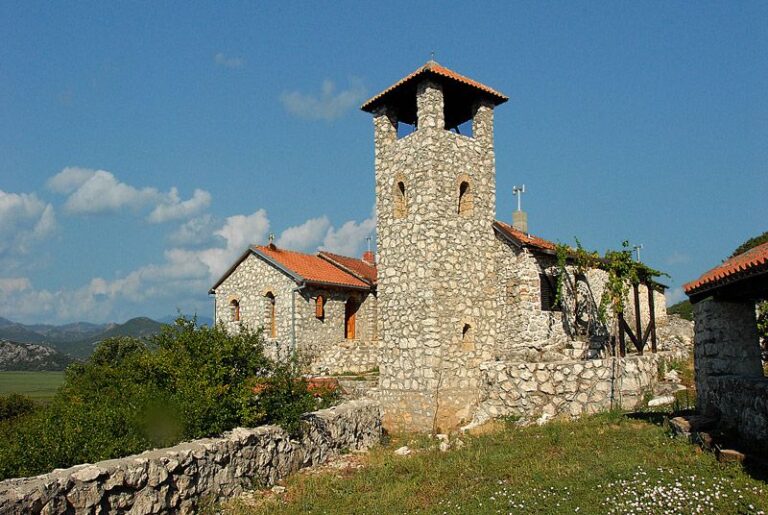
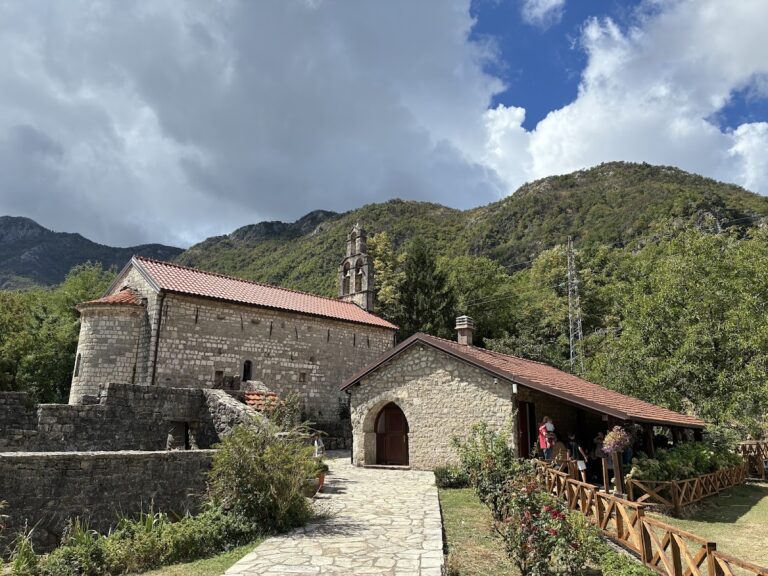
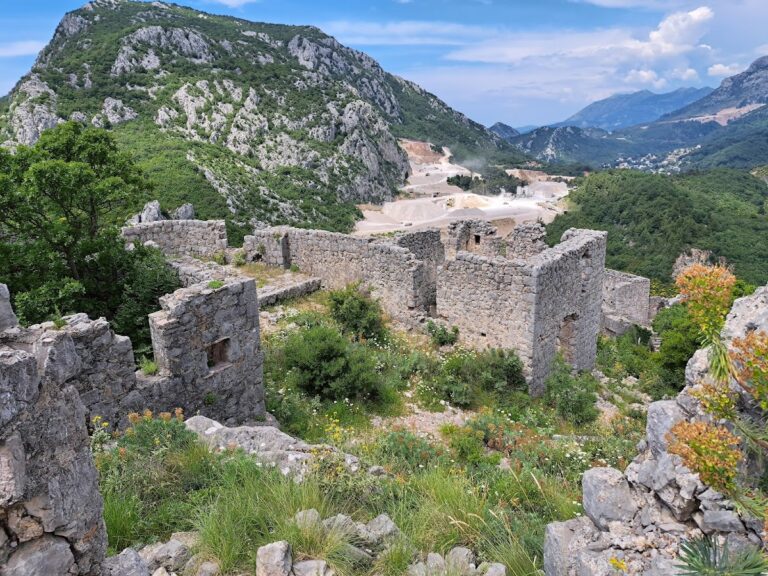
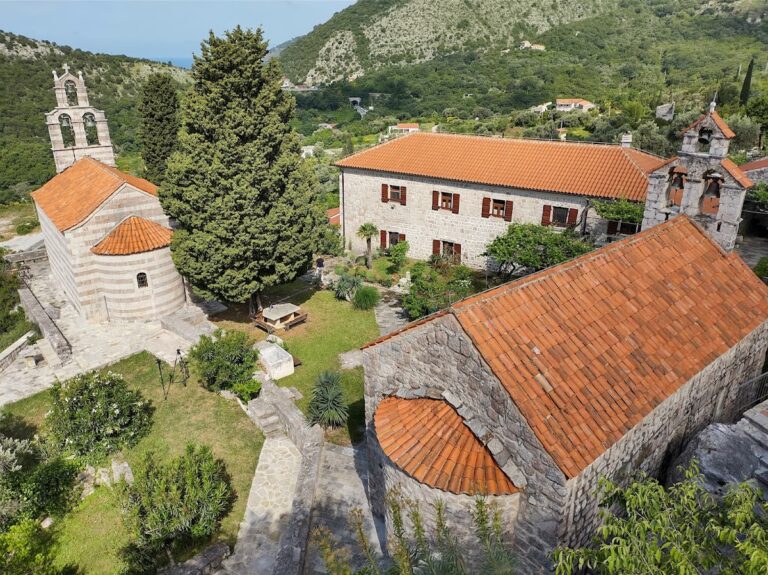
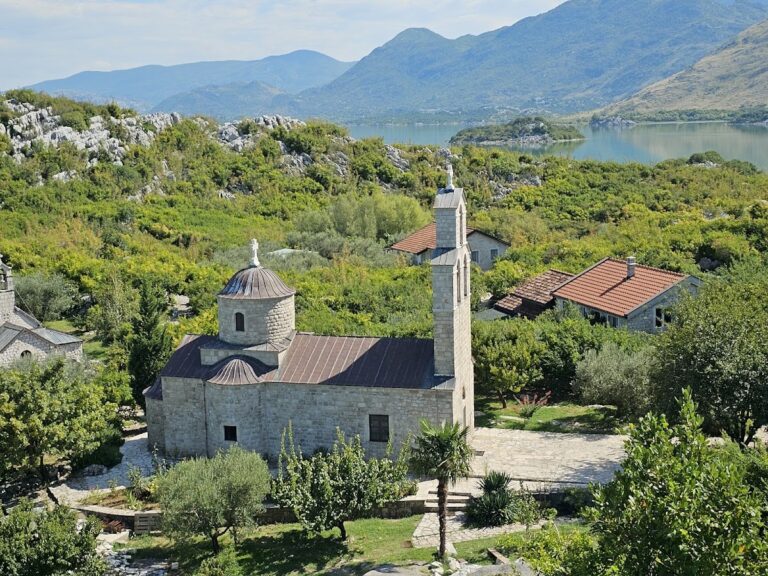
The monastery stands on elevated ground in the south-eastern part of Vranjina Island, above the mouth of the Morača River. The present complex consists of the Church of Saint Nicholas, a larger lodge, and a smaller lodge. The original monastery had three churches, dedicated to Saint Nicholas, Saint Sava, and the Dormition of the Mother of God, the Orthodox feast commemorating Mary’s death and glorification. The surviving complex reflects repeated rebuilding after fire, military destruction, and later reconstruction.
Churches
Church of Saint Nicholas
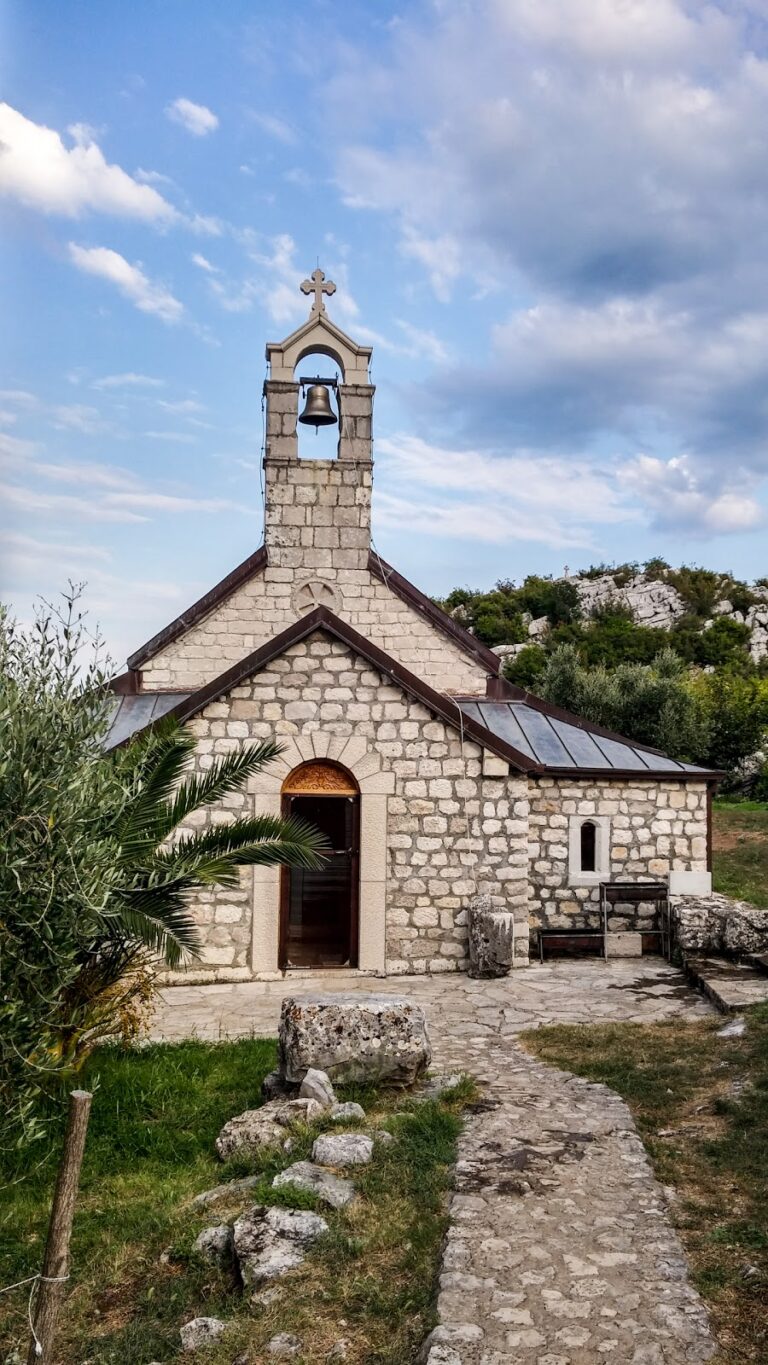
The Church of Saint Nicholas was rebuilt repeatedly on the site of the earlier church. The present building was erected in 1886 after the nineteenth-century destruction and is dedicated to the Translation of Saint Nicholas’s relics. It has a simple nave-shaped plan, with the nave serving as the principal lengthwise space of the church. Stone walls, wooden doors, arches, and a bell tower on the gabled front form its main architectural elements. The building was described as lacking elaborate ornament.
Strong southerly winds blew down the bell tower in 1892. The church subsequently developed cracks, and its bells were broken. Later reconstruction preserved Saint Nicholas’s church as the principal surviving ecclesiastical building of the monastery.
Church of the Mother of God
A church probably dedicated to the Mother of God stood below and north-west of Saint Nicholas. It was attributed to the thirteenth century and formed part of the earlier group of monastery churches. The building was destroyed in the nineteenth century.
Church of Saint Sava
The church dedicated to Saint Sava stood on a hill west of Saint Nicholas. Built in the fourteenth century, it included the monastic cemetery. This church was also destroyed in the nineteenth century.
Monastic buildings and endowment
Larger lodge
The larger monastic lodge often served as a residence or court for members of the Petrović ruling family. It was damaged by the later history of the monastery and has undergone reconstruction, including work that began in 2010. The building forms part of the present complex alongside the Church of Saint Nicholas.
Smaller lodge
The smaller lodge was built after the earlier lodge burned. Together with the larger lodge and the church, it represents the rebuilt monastic settlement on the island.
Historic estates
Vranjina’s medieval material base consisted of agricultural lands, villages, salt-producing installations, and income from markets. The monastery’s historic possessions included grants in the Zeta valley and around Lake Skadar, as well as the salt pans associated with the grants of Balša III. These lands, settlements, and revenues supported the monastery’s religious and institutional life.
Nearby sites