Klosterruine Seligenstatt: Ruins of a Benedictine Nunnery in Germany
Site at a Glance
- Rating
- 3.8
- Popularity
- Very Low
- Country
- Germany
- Primary era
- Medieval
- Eras represented
- Medieval
- Civilizations
- Holy Roman Empire
- Site type
- Religious
- Remains
- Monastery
On this page15 sections
History
Klosterruine Seligenstatt in Germany is the ruin of a former Benedictine nunnery near Seck, first recorded in 1181 during the medieval period. Mechthild, countess of the Rhine, her coheirs, and members of the Runkel, Bickenbach, and Seck families donated the institution to the archbishopric of Trier. The monastery was probably founded by Siegfried of Runkel and was dedicated to the Virgin Mary and Saint Nicholas.
Foundation and medieval development
In 1213 or 1215, Theoderic, archbishop of Trier, confirmed the monastery’s possessions. They included two hides of land at Stöckgen, half the tithe at Seck and Dapprich, and a mill at Hadamar. A hide was a medieval measure of land whose size varied by place and period, while a tithe was a customary contribution from agricultural produce or income. Because the nuns could not use the distant mill, they transferred it to Eberbach Abbey as permanent hereditary property in return for payment. The arrangement was confirmed in 1218.
Seligenstatt was listed in 1215 as a daughter monastery of Maria Laach Abbey, meaning that it was affiliated with and subject to the authority of that parent house. A confraternity followed in 1217, when the knight Werner of Erbach joined the association and transferred all his paternal property to the monastery. A convent seal from 1234 shows the Virgin Mary between two lilies and bears the inscription “Conventus in Seligestat.”
The monastery’s limited resources led Theoderic II of Wied to order the abbot of Maria Laach in 1239 to restrict the community to 30 nuns. The abbot repeated the instruction in 1324 under threat of excommunication, the formal exclusion of a person from participation in the sacraments and institutional life of the Church. The measure addressed the worsening poverty caused by the indiscriminate admission of new nuns.
Religious life and expanding possessions
Before joining a crusade to the Holy Land in 1219, Siegfried of Runkel surrendered the rights and services he held as the monastery’s advocate. An advocate was a lay protector who represented and defended a religious institution in legal and secular affairs. A later legend says that the Virgin Mary appeared to Siegfried at the Holy Sepulchre and told him that he would find salvation at the holy place he had founded. After his return, he was supposedly responsible for giving the monastery the name Seligenstatt. Another knight, Crafto, left the nunnery a quarter of his mill at Weilnau if he failed to return from the Holy Land.
For a time, monks associated with Seligenstatt lived in a monastery house at Limburg. An altar dedicated to Saint Catherine is recorded in 1315. That year, a married couple assigned income from property at Wörsdorf to their daughters, who were nuns at Seligenstatt, so they could supply oil and other necessities for the altar lamps.
The monastery’s position helped its property grow through donations and endowments during the thirteenth and fourteenth centuries. Its possessions were spread across areas corresponding to the modern districts of Marburg-Biedenkopf, Lahn-Dill, Gießen, Mayen-Koblenz, Limburg-Weilburg, Neuwied, Rheingau-Taunus, and Hochtaunus. Poor economic management and the dispersal of these holdings contributed to the institution’s decline. Its rent registers also preserve the first documentary mentions of several surrounding villages, including Rennerod, Hüblingen, and Willmenrod, as well as the abandoned settlements of Schorrenberg, Stöckgen, Oberndorf, Bruchhausen, and Fackenhahn.
Dissolution and competing claims
The last recorded community of nuns dates from 1423, although the convent seal continued in use until 1432. The monastery was dissolved either in 1432 or in 1439–1440. In October 1451, the abbot of Maria Laach appointed Reyner of Westerburg, a Benedictine and priest of Westerburg, to improve worship, repair the deteriorating buildings, and recover neglected or lost rents and revenues. Reyner was to live at Seligenstatt and administer its provostry, the local office governing the monastery’s possessions and affairs.
On 14 March 1481, Maria Laach entrusted the monastery and its revenues to Werner Hont, a canon of Gemünden, dean of the rural district of Dietkirchen, and parish priest of Montabaur, together with Reinhard Apoldus. Historian Hellmut Gensicke later proposed that Hont may have transferred the devotional image now venerated at the Marian pilgrimage church in Wirzenborn from Seligenstatt to that church, possibly shortly before 1497. This remains an interpretation rather than a certainty.
After the priest Reinhard Flach resigned, Christian Sartorius of Seck claimed the abandoned monastery. Johann, lord of Runkel, nominated Sartorius to the office in 1488, and Sartorius pursued his claims against Hont and Apoldus before the Roman Curia, the central administrative authority of the medieval papacy. The dispute involved Maria Laach, Leiningen-Westerburg, Johann of Runkel, and later Count Johann of Wied-Runkel. Supported by the archbishop of Trier, Wied-Runkel confiscated the monastery’s revenues in his county and ordered the abbot of Maria Laach not to act without his consent.
Estate administration and decline
An inventory was compiled on 29 July 1516 as the monastery approached dissolution. In 1528, Count Kuno III of Leiningen-Westerburg appointed Reinhard of Schonenburg to administer its properties. From 1538, Wied-Runkel and Leiningen-Westerburg jointly used the Seligenstatt hermitage. The former monastery became the seat of a manorial official who cultivated the monastery farm in the Seck district.
Large parts of the estate had already been leased to inhabitants of Seck around 1510, 1530, and 1531. From the late sixteenth century, some holdings were leased to the community, which had to provide 95 measures of butter each year from what it called its “butter estate.” A settlement of 24 May 1540 divided part of the property between Westerburg and Runkel, while their officials at Gemünden jointly administered the remainder. They were responsible for paying the priest who still celebrated Mass at the site twice a week, or for directing the money to other religious purposes.
In 1660, Prince Moritz Heinrich of Nassau granted the monastery farm, which had entered his possession, to the municipality of Seck. The buildings continued to decay, and their stones were taken for house construction. Count Johann of Runkel protested twice in 1570 that servants of the Westerburg count were removing stone from the deteriorating monastery. The bells had been transferred to Westerburg in 1591 and later passed, first on loan and then permanently, to Gemünden. The baptismal font was used for many years at Seck’s communal well before disappearing before 1599. The monastery farm was demolished in 1785, and by 1818 the site was described through its old walls and ruins.
Later history and memory
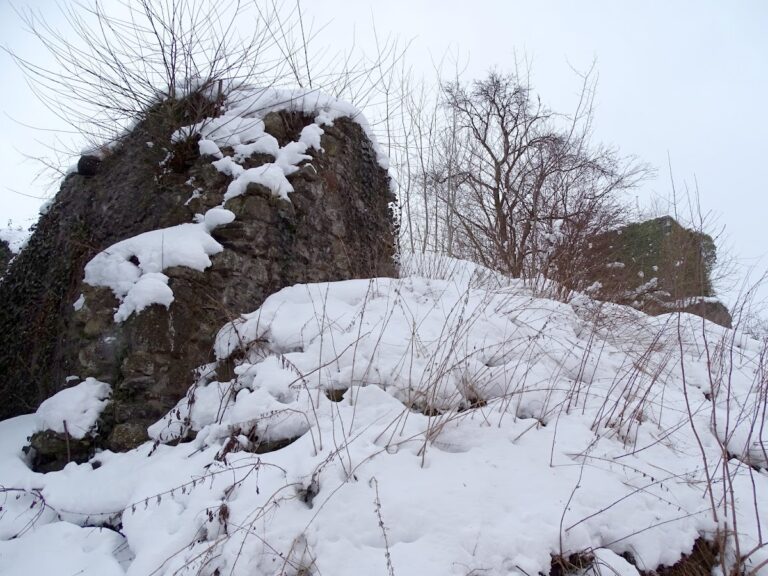
In 1874, the remaining enclosure walls stood between one and three metres high and were about one metre thick, surrounding an area of approximately 1,200 square metres. The site had been filled during the second half of the nineteenth century and was used as farmland until the mid-1950s. Cultivation ended during land consolidation in 1955. Wolf-Heino Struck attributed much of the decline to the conflict between the houses of Westerburg and Runkel, especially Westerburg’s repeated unilateral actions.
A support association founded in 1990 organized extensive stabilization work. The ruin received monument protection on 17 June 1992 and is classified as a monument zone. The name appears in several medieval and early modern forms, including “Seligenstat” in 1215, “Seluenstat” in 1296, “Seligenstad” in 1336, “Salichstat” in 1423, “Selegestayt” after 1492, and “Selgenstaidt” in 1499.
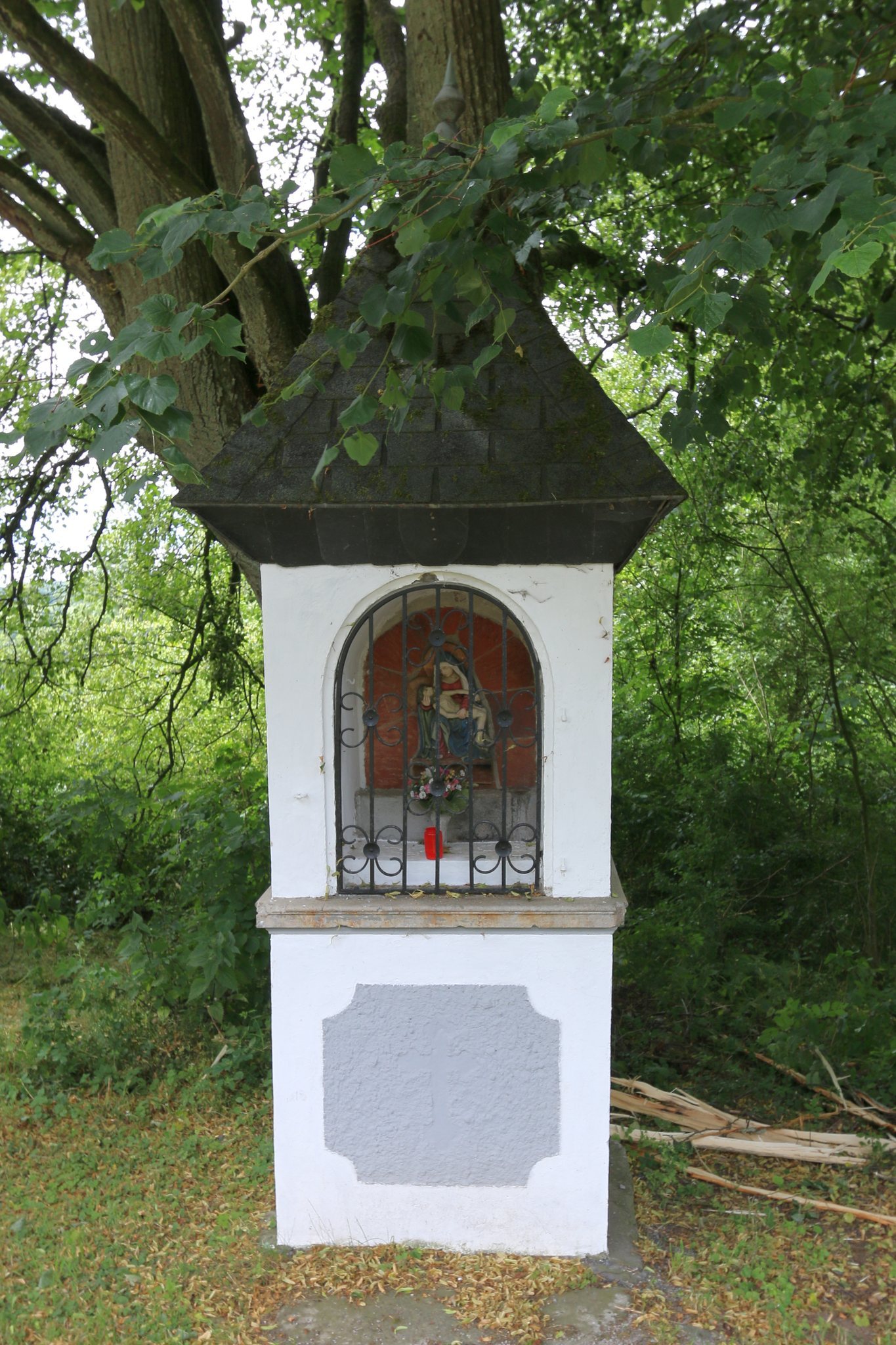
Two wayside shrines near the ruin were built in spring 1856 after a local legend about a night traveller who encountered a white apparition. He promised to erect one shrine if he could return safely and another if he reached home unharmed. The apparition was later interpreted as Gustav II Adolf, king of Sweden and a leading Protestant commander in the Thirty Years’ War, which lasted from 1618 to 1648. The tradition claimed that he could not rest because he had destroyed the monastery. Historically, Seligenstatt had already been declining by the late fifteenth century and was no longer functioning as a Benedictine nunnery during that war.
Remains
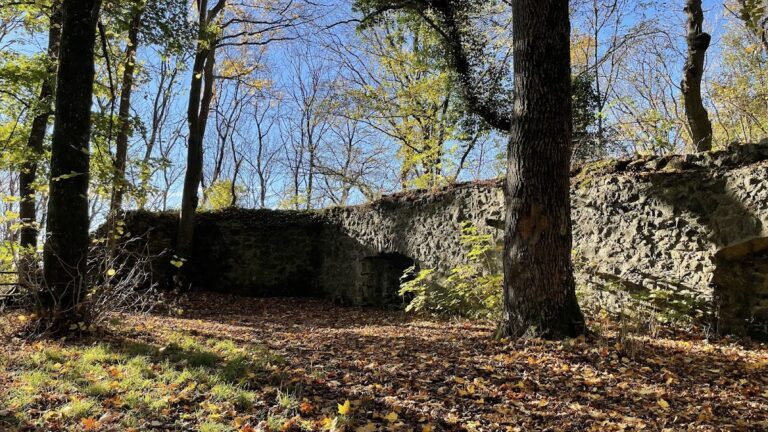
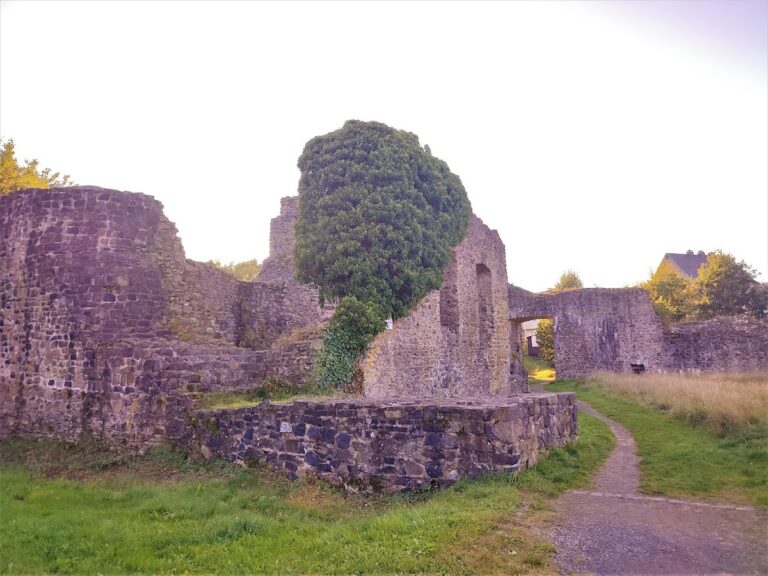
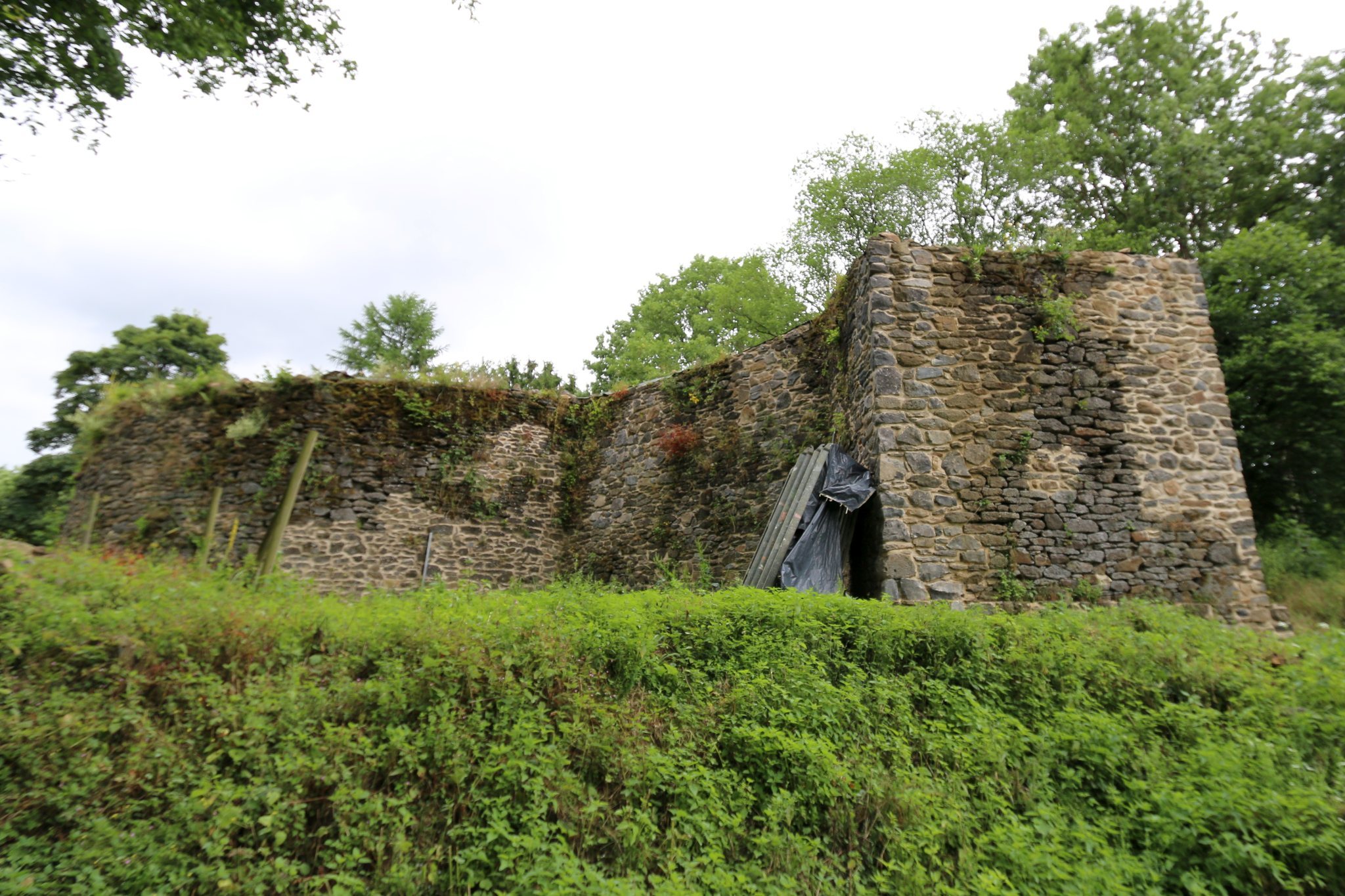
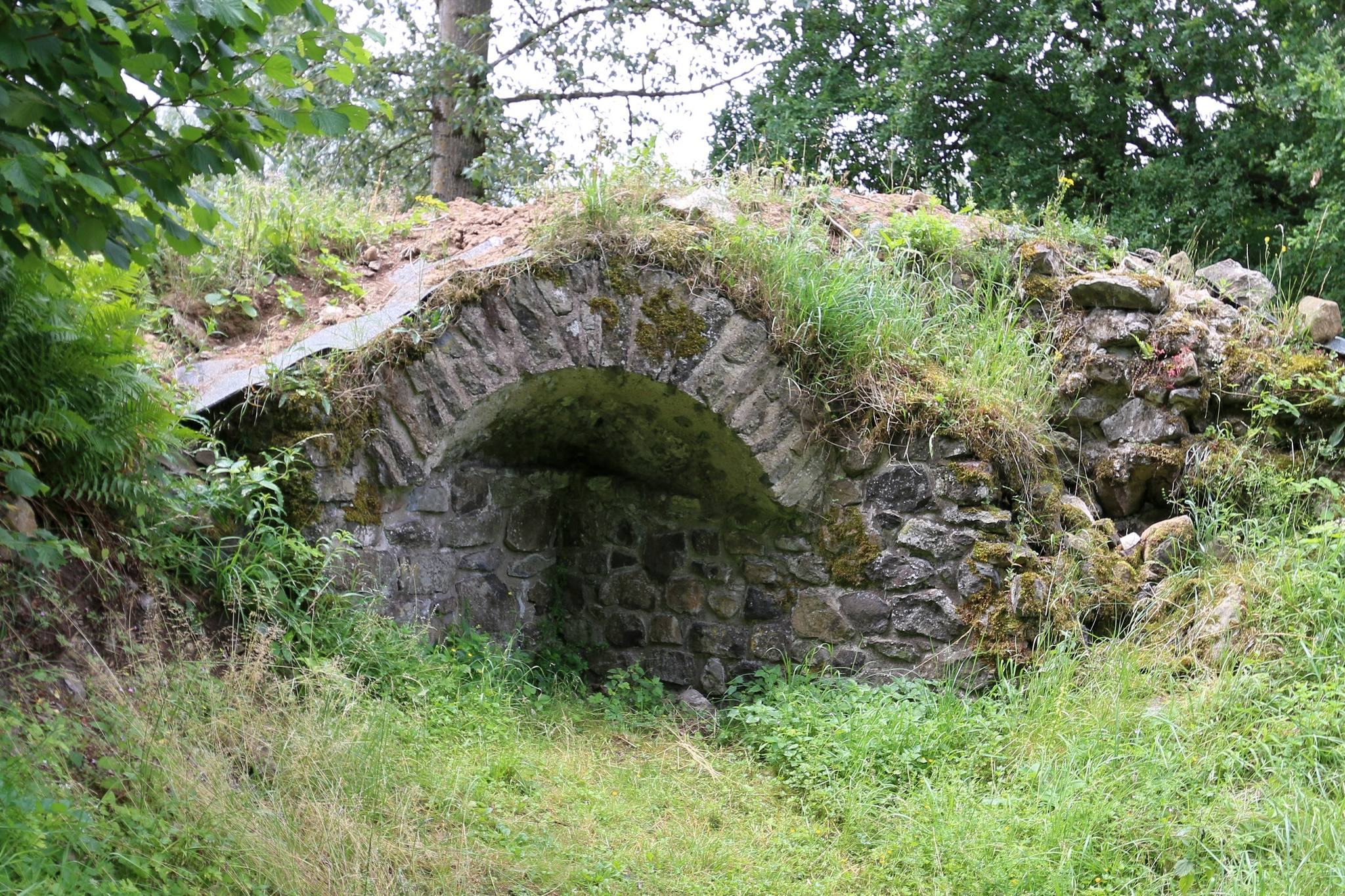
The surviving complex is arranged as a rectangle on an east–west axis. Its enclosing walls measure approximately 36 by 72 metres, and the highest surviving point reaches 9 metres. The visible remains form part of a larger buried complex, while a monastery pond lies immediately beside the ruin.
Enclosure and western structures
Enclosing walls
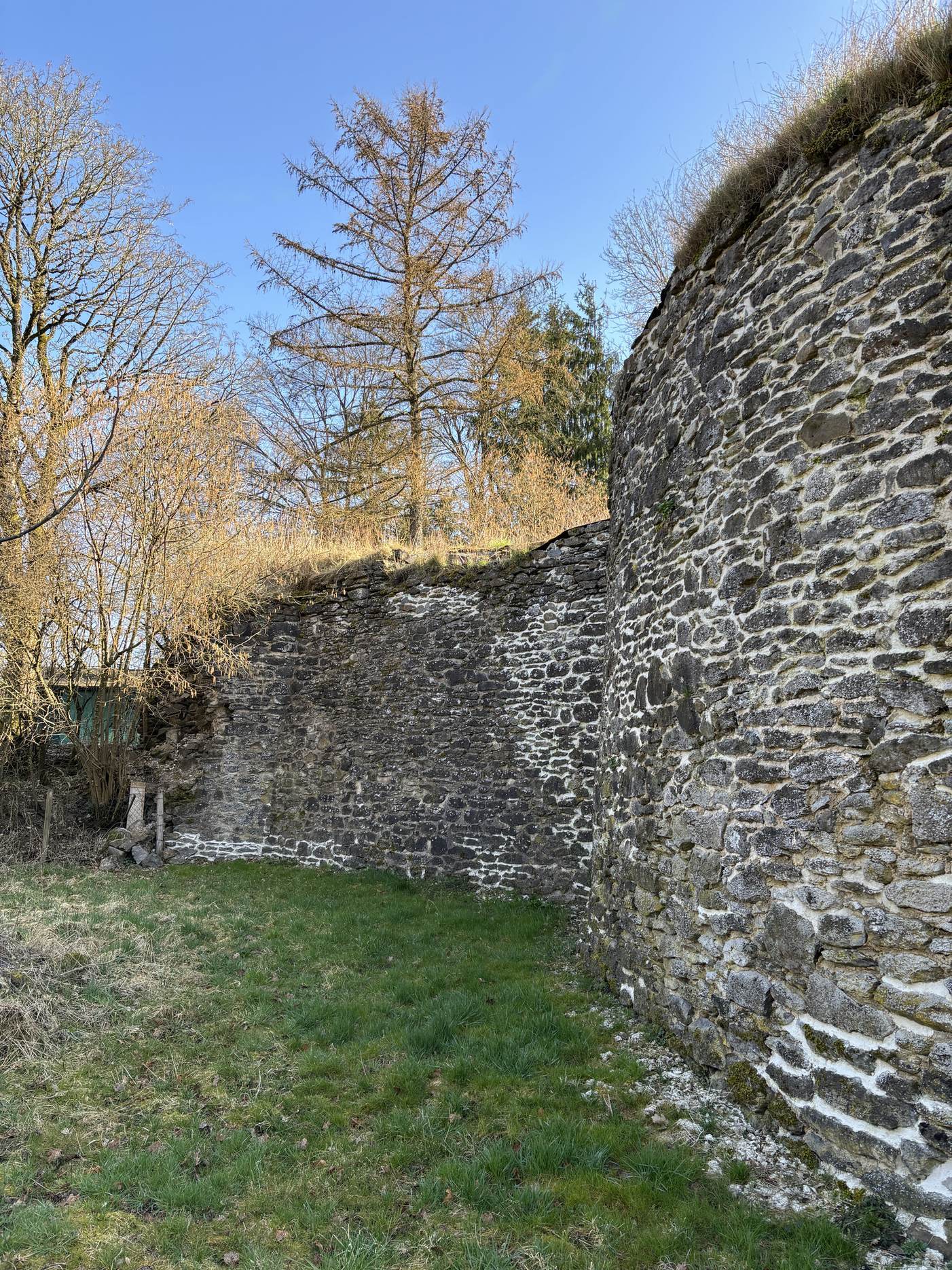
The enclosure defines a rectangular area with a west–east longitudinal axis. Its walls survive in substantial sections, including masonry about one metre thick. The present ruin represents the exposed part of the complex, while buried wall lines continue considerably farther east than the visible remains.
Apse and corner towers
A semicircular apse, a curved terminal space commonly associated with the liturgical end of a church, occupies the middle of the west side. Small square towers set diagonally at the western corners survive in part. Some of the segmental arches supporting the towers are also preserved. A segmental arch is formed from less than a semicircle.
Archaeological evidence and associated features
Trial excavation
A trial excavation in 2000 extended knowledge of the site’s buried plan by revealing wall lines farther east than the standing remains. The excavation recovered a fourteenth-century pottery sherd and a sixteenth-century ring. Both objects are displayed at the Westerwald Landscape Museum in Hachenburg.
Monastery pond
A pond stands immediately beside the ruin. It was dammed again during the 1970s on the initiative of Franz Kolle, then the Seck hunting leaseholder and later an honorary citizen.
Wayside shrines
Two small wayside shrines stand near Seligenstatt. One is immediately beside the ruin, while the other is approximately 400 metres away at the entrance to Seck from the direction of Hellenhahn. Both were built in 1856.
Inventory and surviving religious objects
A monastery inventory from 1565 lists five Mass vestments, five albs, a missal, three hymn books, an altar cloth, a thurible, two cruets, relics, and a chalice. The chalice was transferred to the church at Seck. These objects provide a record of the religious furnishings associated with the former monastery after its dissolution.