Klášter Castle: A Late-Baroque Castle on a Former Benedictine Monastery Site
Site at a Glance
- Rating
- 4.2
- Popularity
- Very Low
- Country
- Czechia
- Primary era
- Early Modern
- External website
- Open
- Eras represented
- Early Modern
- Civilizations
- Holy Roman Empire
- Site type
- Domestic
- Remains
- Castle
On this page12 sections
History
Klášter Castle is a late-Baroque castle in Czechia, built on the site of a Benedictine monastery established in the twelfth century. Its present construction dates to 1746, when the estate was reshaped according to plans by the Prague architect Jan Josef Wirch. The monastery had been one of the largest Benedictine communities in Central Europe, giving the site a long religious and architectural history before its transformation into a noble residence.
Monastery, destruction, and dissolution
The Benedictines formed a Western Christian monastic order governed by the Rule of Saint Benedict. Their monastery at Vilémov was burned by the forces of Rudolf of Habsburg in 1278. In 1421, during the Hussite Wars, it was captured by Hussite forces. The Hussite movement was a reformist religious and political movement that arose in Bohemia during the early fifteenth century.
The monastery was dissolved in 1575. Emperor Rudolf II, a sixteenth-century Habsburg ruler of the Holy Roman Empire, subsequently sold its ruined buildings and the surrounding land. A fortress was erected on the monastic ruins in 1578, beginning the site’s transition from a religious foundation to a fortified estate.
From fortress to noble residence
The Caretto-Millessimo family acquired the estate during the seventeenth century. Václav Ferdinand Caretto-Millessimo had a castle built on the site around 1689. The residence was later rebuilt in its present late-Baroque form under Jan Josef Wirch. He probably planned a building with several wings, but only one wing was constructed, and the castle’s construction is dated to 1746.
The Czech branch of the Caretto-Millessimo family became extinct in 1852. Ownership then passed to the related Rajský family of Dubnice. During the Second World War, the German authorities seized the castle in the German-occupied Protectorate of Bohemia and Moravia. Soviet units under Marshal Malinovsky, a Soviet military commander, stayed there in 1945. After 1948, the building was used as a primary school.
Restoration and present ownership
The empty and severely dilapidated buildings were returned to the Rajský family in 1991. Vladimír Reiský, a member of the family who had returned from emigration in the United States, commissioned restoration between 1992 and 1997. The property remains owned by the Rajský family of Dubnice and is used for conferences and social events. Klášter Castle was entered in the state register of cultural monuments in 1963.
Remains
Castle and entrance court
Castle building
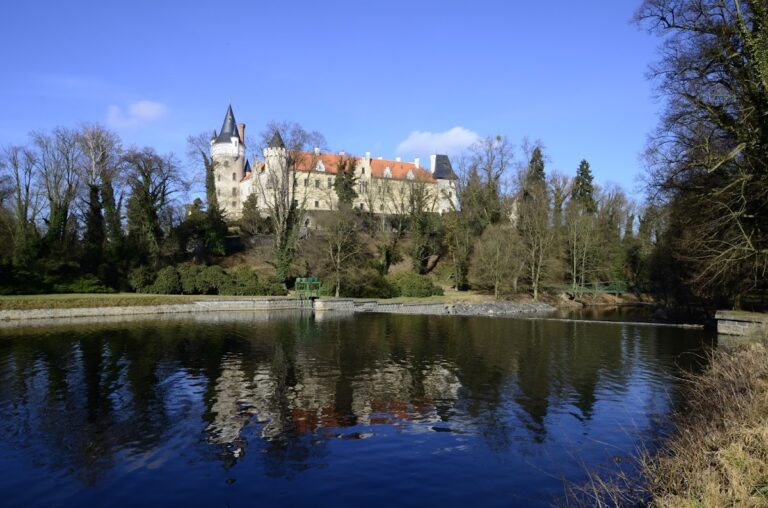
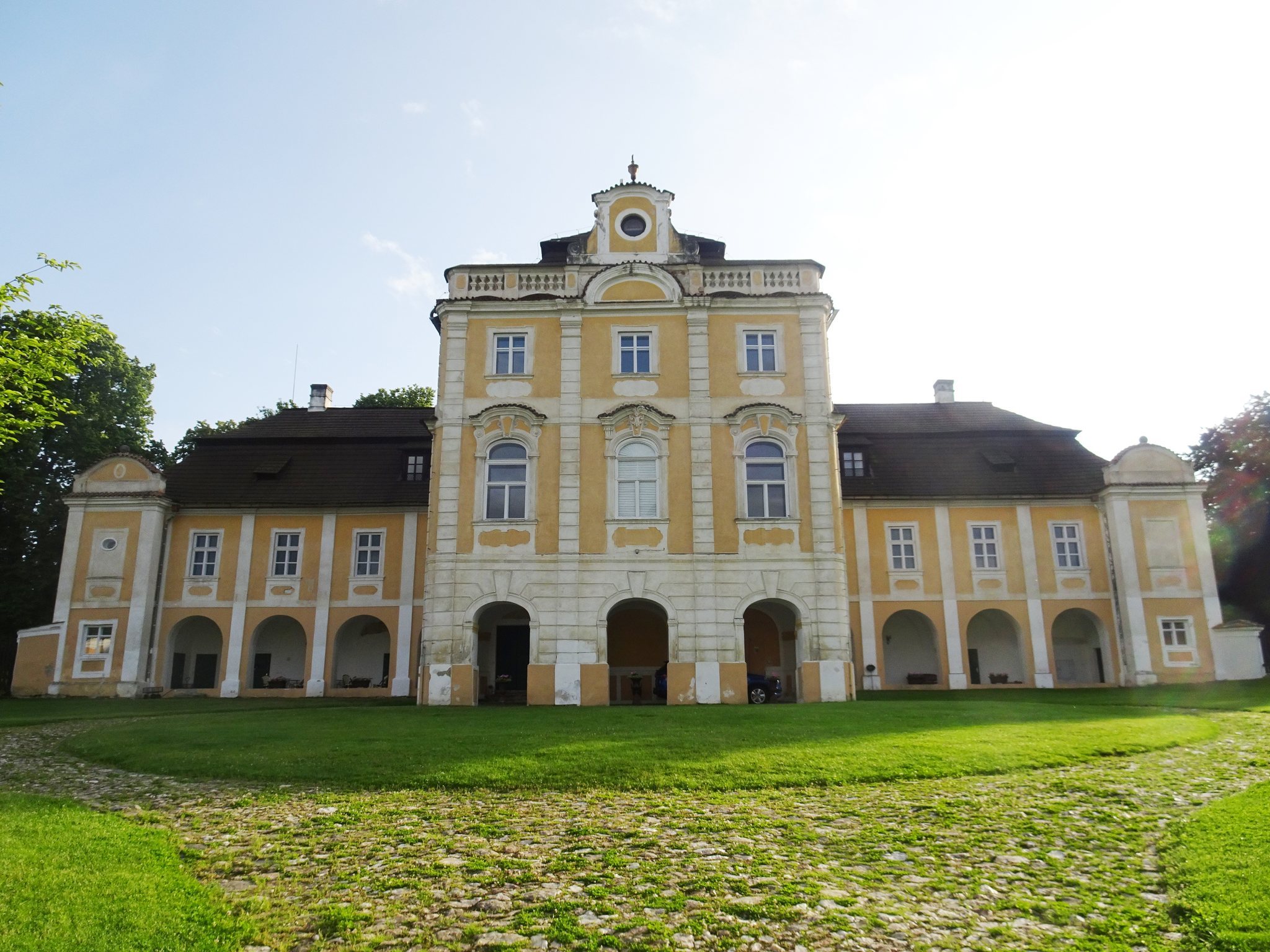
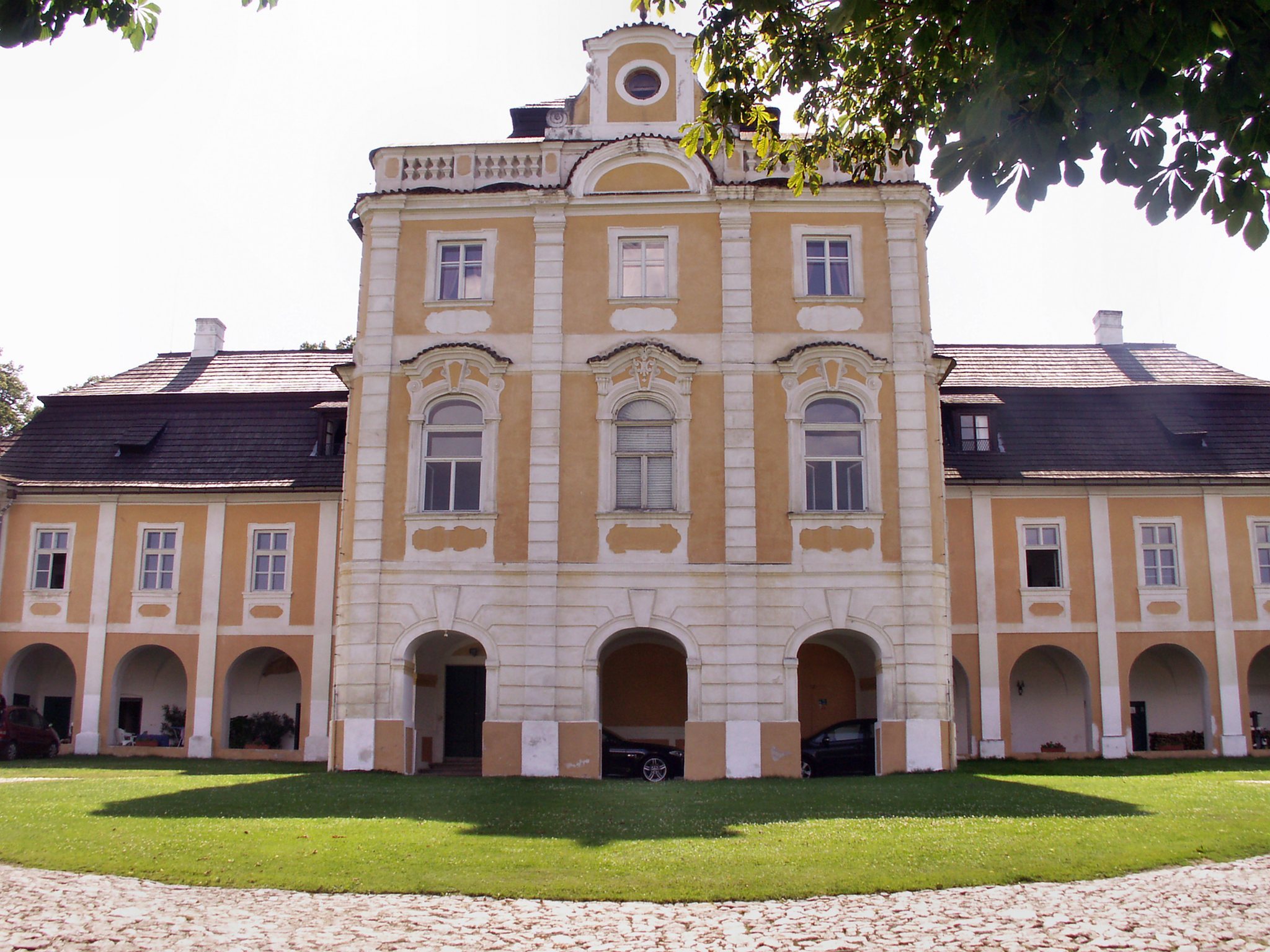
The castle is a rectangular building with one upper floor, projecting end sections, and a central wing that rises one floor higher than the adjoining parts. Its roofs are mansard roofs, each formed with a steep lower slope and a shallower upper slope. The northeast-facing principal facade has three arcades at ground-floor level.
Honorary courtyard
A hexagonal honorary courtyard extends in front of the principal facade. A circular access drive occupies the courtyard, while an entrance gate to the castle complex stands opposite the facade. Together, these elements define the formal approach to the residence.
Former carriage house
A late-Baroque former carriage house stands on the northern side of the complex. Its position and period connect it with the service and estate buildings associated with the castle.
Park and game preserve
Park and garden pavilion
A large park extends southwest of the castle. It was originally arranged as a French garden, with geometric layouts and ornamental beds, but later acquired the freer character of a landscape garden. In the northern corner, beside the enclosing wall, stands the surviving articulated facade and attic gable of a former Baroque garden pavilion. The original pavilion was rebuilt as a lodging facility.
Professor Reiský game preserve
The park adjoins the Professor Reiský game preserve, established around the middle of the eighteenth century and named after Vladimír Reiský. The preserve covers approximately 11 hectares. An avenue of old oaks runs through it and ends at the embankment of a pond.