Megalithic Tombs near Kahlstorf: Neolithic Burial Monuments
Site at a Glance
- Popularity
- Very Low
- Country
- Germany
- Primary era
- Stone Age
- Eras represented
- Stone Age
- Civilizations
- Unclassified
- Site type
- Burial
- Remains
- Necropolis
On this page5 sections
History
The Megalithic Tombs near Kahlstorf are four Neolithic burial monuments in Wrestedt, Germany, dating to 3500–2800 BC and associated with the Funnelbeaker culture. This was a Neolithic tradition named for the funnel-shaped necks of some of its pottery.
Tombs 3 and 4 were destroyed in the late 19th century. Tomb 1 was later reused as a burial ground in the Middle Ages, about 3,500 years after its construction.
Around 1840, chamberlain and antiquarian Georg Otto Carl von Estorff noticed a lower-leg bone partly exposed at the surface of Tomb 1. An excavation he arranged uncovered six skeletons and grave goods. In 1909, prehistorian Curt Schwantes compared these burials with those at a nearby cemetery and identified them as Slavic. Slavic refers to a broad ethnolinguistic grouping of peoples of central, eastern, and southeastern Europe.
Remains
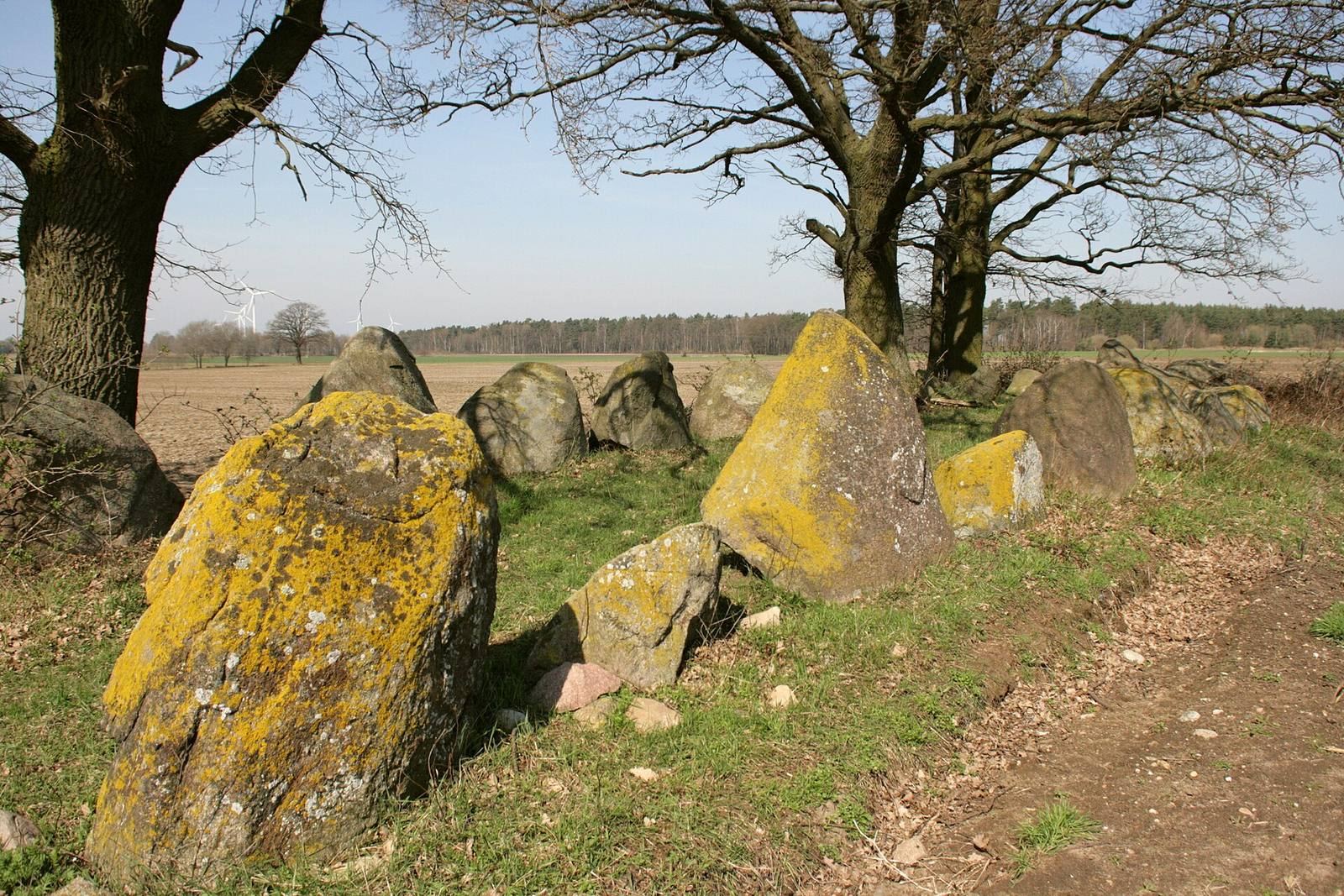
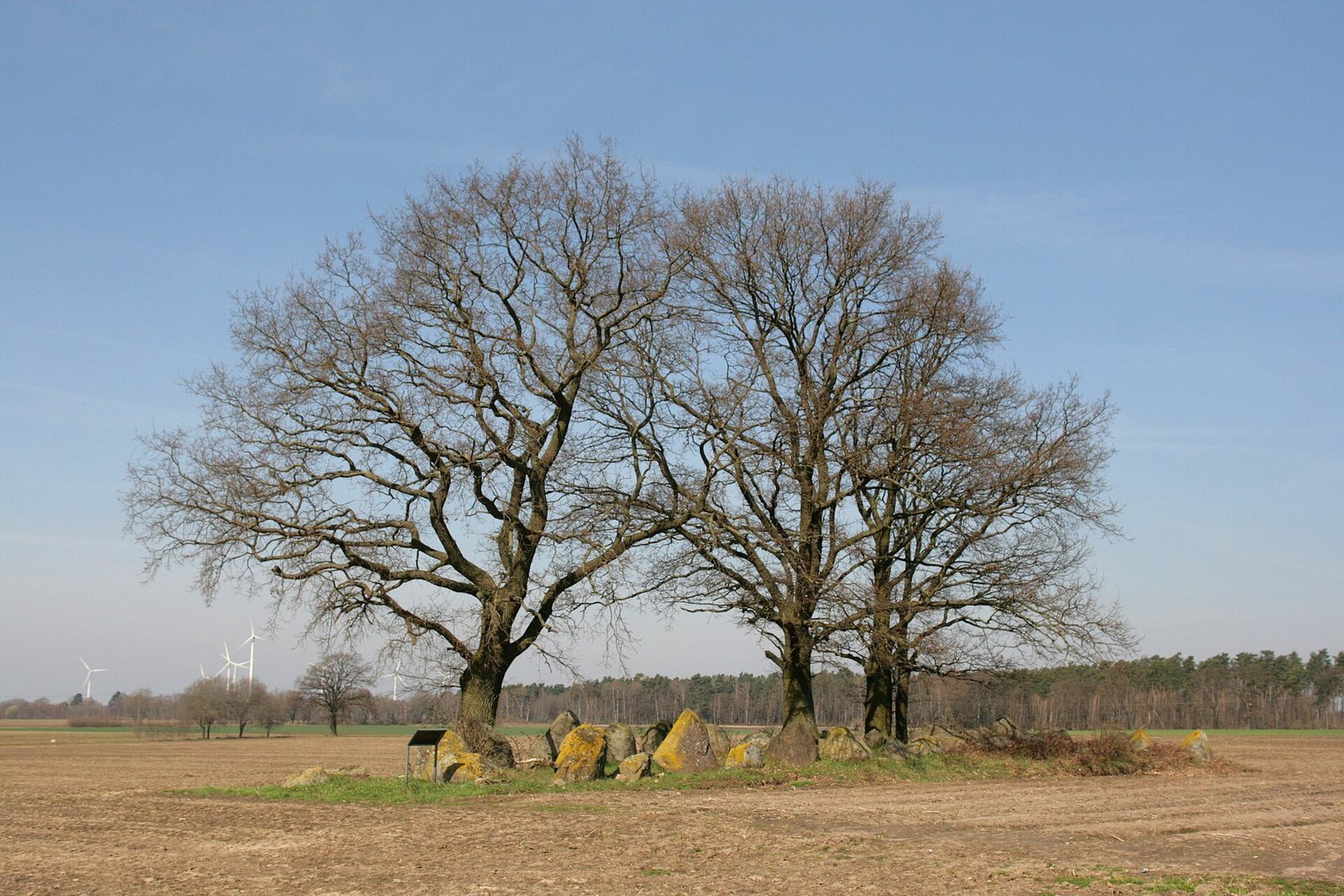
The surviving tombs are separate stone-built chambers in farmland near Kahlstorf. Tomb 1 is enclosed by an elongated earthen mound and a stone boundary, while Tomb 2 is a partly collapsed chamber.
Surviving chambers
Tomb 1
Tomb 1 lies in a field about 500 m north of Kahlstorf. Its passage grave, a chamber tomb reached by a passage, is enclosed by a slightly trapezoidal long barrow, an elongated burial mound, oriented north–south. The stone enclosure measures 26 m long, 7 m wide at its northern end and 5 m at its southern end. Thirty-five boundary stones remain, and the enclosure is relatively complete despite disturbance at the south end. Only the upper parts of four capstones project above ground; the northern stone appears to have shifted from its original position.
Tomb 2
About 500 m southwest of Kahlstorf, Tomb 2 lies among shrubs in farmland. Its chamber is oriented northeast–southwest and measures 5.5 m by 2 m. Ernst Sprockhoff considered it probably a large dolmen, a chamber formed from upright stones and capstones. The original arrangement had four pairs of side stones, an end stone at each short side and four capstones. Four side stones remain in place on the southeast side and three on the northwest. The northeastern end stone has fallen outward, while the opposite one has shifted southwest. All four capstones have fallen into the chamber.