Kladruby Monastery: A Benedictine Monastery in Czechia


Site at a Glance
- Rating
- 4.6
- Popularity
- Medium
- Country
- Czechia
- Primary era
- Early Modern
- External website
- Open
- Eras represented
- Medieval, Early Modern
- Civilizations
- Holy Roman Empire, Kingdom of Bohemia
- Site type
- Religious
- Remains
- Monastery
On this page13 sections
History
Kladruby Monastery is a former Benedictine monastery in Czechia, founded in 1115 by the Bohemian prince Vladislav I and his wife, Richenza of Berg. The Benedictines, a Catholic monastic order shaped by the Rule of Saint Benedict, established the monastery as a Romanesque religious and colonizing institution on the western Bohemian frontier. Monks from Zwiefalten, a Benedictine monastery in the German-speaking lands, settled there. The foundation was dedicated to the Virgin Mary and Saint Benedict, while its church also honored Saint Wolfgang.
Foundation and medieval development
Vladislav I was buried at Kladruby. In 1147, his son Vladislav II granted the monastery the Krašov district and seven villages. Vladislav II’s brothers, Děpolt and Henry, added further estates, and the monastery acquired more villages in 1222. After 1239, Pope Gregory IX confirmed its ownership of 120 communities. During the thirteenth and fourteenth centuries, the convent became one of the largest Benedictine communities in the Czech province.
The surviving foundation charter is dated 1115, although it has also been regarded as a possible forgery made in the late twelfth century to support the monastery’s claims to extensive estates and revenues. Kladruby also became a place for political negotiation. In 1219, secular and ecclesiastical dignitaries met there at the initiative of Přemysl Otakar I, a Přemyslid ruler of Bohemia. Their negotiations produced the Kladruby Settlement.
The original complex was completed in 1233 under Václav I, with the construction of a Gothic basilica. Under Charles IV, the monastery received privileges that included the right to grant indulgences, formal remissions of penalties associated with sin in Catholic practice. An abbatial coat of arms was created in 1347.
Hussite destruction and early modern repairs
Hussite forces destroyed or severely damaged Kladruby in 1421. The Hussite movement was a reforming religious and political movement that emerged in Bohemia, and its wars brought attacks on Catholic monasteries and churches. Later iconoclasts damaged the monastery’s artistic furnishings. Kladruby lost much of its property after the Hussite Wars, although the church was thoroughly repaired in the late fifteenth century and reconsecrated in 1504. The monastic buildings were repaired during the second quarter of the sixteenth century.
A fire in 1590 and military activity during the Thirty Years’ War caused further destruction. During the seventeenth-century re-Catholicization of Bohemia, Kladruby briefly became a Catholic pilgrimage site, but that use did not continue. A general restoration of the convent and church began in 1653, followed by the construction of a new prelature in 1664–1670. A prelature was the residence and administrative seat of the monastery’s abbot.
Baroque Gothic reconstruction
Reconstruction began around 1701 on the initiative of Abbot Maurus Fintzguth, and the monastery recovered the Přeštice estate in 1705. Work on the Church of the Assumption began in 1712 and ended with its consecration in 1726. Jan Blažej Santini transformed the church in the Baroque Gothic style, which combines Gothic structural and spatial forms with the theatrical effects and geometric design of the Baroque. The rebuilding retained much of the earlier Romanesque-Gothic masonry.
After Santini’s death, Kilián Ignác Dientzenhofer designed a new convent south of the church. It was largely completed in 1739, while the entire monastery was not finished until 1770. State restrictions on church administration and finances intensified during the final building work. In 1785, Emperor Joseph II suppressed the monastery during the Josephine reforms, policies that restricted ecclesiastical institutions and dissolved many monasteries considered not to perform practical functions such as teaching or nursing. The interior furnishings were sold or transferred to other churches, except for the altars.
Secular ownership and twentieth-century changes
After its dissolution, the complex housed barracks, a military hospital, an institution for invalids, and a poorhouse. In 1825, Field Marshal Prince Alfred Windischgrätz acquired the Kladruby estate as part of his family fideicommissum, an aristocratic estate legally intended to remain undivided and pass through a designated line of inheritance. Serfdom in the associated villages ended in 1848, and a brewery was established in the former convent in 1864.
The Windischgrätz family created a burial place in the former monastery, and the coffins of Alfred I and his wife were transferred there in 1886. After inheriting the family estates, Ludwig Aladar Windischgrätz moved to Kladruby and established an extensive library and family archive. The family lost substantial lands during Czechoslovak land reform after the First World War. Kladruby belonged to the German Reich from 1938 to 1945.
In 1945, the Windischgrätz property in Czechoslovakia was confiscated under the Beneš decrees, postwar presidential decrees that provided the legal basis for confiscating property belonging to Germans and other designated groups. Monastery property was assigned to the Benedictine order in 1946, but the order did not take possession. In 1948, administration passed to the National Cultural Commission in Prague. After 1960, a state-farm directorate operated at Kladruby, and the complex continued to deteriorate. The ruined monastery was placed under the regional monument-protection authority in Plzeň in 1967 and opened to the public.
Repairs began in the 1980s. After the Velvet Revolution, Kladruby became a national cultural monument. The Czech state now owns the complex, which is administered by the National Heritage Institute. The monastery church remains in use, with Mass celebrated on major feasts including Easter, Christmas, and the Feast of the Assumption of the Virgin Mary.
Remains
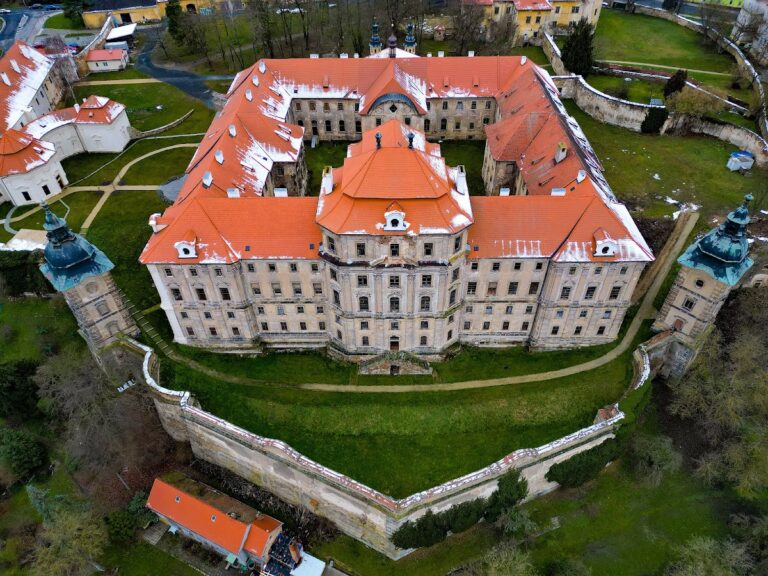
Kladruby Monastery stands on a rise above the Úhlavka River near Kladruby. Its complex developed from a Romanesque group of buildings dating from the twelfth century to the first third of the thirteenth century. The present church dominates the surviving ensemble and incorporates earlier Romanesque-Gothic masonry within its eighteenth-century Baroque Gothic reconstruction. The church is approximately 83–84 metres long, and its dome reaches an interior height of about 39–40 metres.
The monastery church
Medieval church
The medieval church was a three-nave Gothic basilica with a later transept and a western choir. A southern funerary chapel was built for Vladislav I. These medieval elements formed the architectural basis for the later Church of the Assumption, which is dedicated to the Assumption of the Virgin Mary, Saint Wolfgang, and Saint Benedict.
Baroque Gothic interior
The Church of the Assumption was rebuilt between 1712 and 1726 under Jan Blažej Santini. Its three-lobed termination and the crossing dome are central features of the design. The choir extends into a three-lobed apse arrangement, while the vaults carry interwoven geometric ornament. The crossing floor contains an eight-pointed star principally identified as the Marian Star. It has also been interpreted as an emblem associated with Santini and with the geometric ornament used in his buildings. The church is described as the third-largest church in the Czech lands, after Saint Vitus Cathedral in Prague and the Church of the Assumption at Sedlec near Kutná Hora.
Sculpture and painted decoration
Matyáš Bernard Braun was the principal sculptor for the interior. His Prague workshop supplied architecturally designed altars between 1725 and 1728, along with many over-life-size wooden statues of saints. Some have white-painted surfaces with partial gilding, including the statue of Saint Benedict. The workshop also produced the choir stalls and the sculptural decoration of Vladislav I’s mausoleum. Řehoř Theny collaborated in this work, first as an assistant in Braun’s workshop and, after establishing his own practice in 1728, as the creator of works including allegorical statues of Faith and Hope.
Cosmas Damian and Egid Quirin Asam painted the frescoes in the dome vault, the choir, and the spaces between the supports of the main nave. After 1750, Juda Tadeáš Supper added Rococo frescoes to the transept walls, including scenes of the Temptation of Saint Benedict and the Heavenly Jerusalem. Johann Leopold Burkhardt built the church organ between 1726 and 1728.
Convent, prelature, and later remains
Convent and prelature
A surviving section of the former convent and the prelature stands south of the church. The new convent in the same area was designed by Kilián Ignác Dientzenhofer and formed part of the reconstruction that followed Santini’s work. The former convent later incorporated the brewery established in 1864, linking the building’s monastic fabric with its nineteenth-century economic use.
Burial place and archaeological finds
The church contains the surviving Windischgrätz tomb, part of the family burial place created in the former monastery. In 1996, archaeologists discovered an unusual group of approximately 1,400 fragments of marl sculptures and architectural sculpture dating from the second half of the fourteenth century. The fragments add material evidence for the monastery’s medieval artistic furnishings and architectural decoration.
The monastery complex is in poor overall condition, while the Church of the Assumption is the best-preserved part. Its surviving medieval masonry, eighteenth-century reconstruction, sculpture, frescoes, furnishings, and later memorial features preserve the successive religious and secular uses of Kladruby.
Nearby sites