Kirche Höckendorf: A Medieval Protestant Village Church in Germany
Site at a Glance
- Rating
- 5
- Popularity
- Very Low
- Country
- Germany
- Primary era
- Medieval
- External website
- Open
- Eras represented
- Medieval, Early Modern
- Civilizations
- Electorate of Saxony, Holy Roman Empire
- Site type
- Religious
- Remains
- Church
On this page13 sections
History
Kirche Höckendorf is a medieval Protestant village church in Germany, located in Höckendorf, a district of Laußnitz in Saxony. The church belongs to the Königsbrück parish of the Evangelical Lutheran Church of Saxony, the Protestant regional church responsible for Lutheran congregations in the state.
Medieval church and early modern changes
The medieval church was extended westward in 1671, a major alteration that enlarged its existing structure. This phase also brought valuable furnishings, including works that remain part of the church’s interior. The building was restored in 1935, preserving its historic fabric and fittings.
Several of the church’s principal furnishings date from the early seventeenth century. The wooden altar and pulpit were made in 1615, while the painted gallery scenes are said to have been created in 1616 by the Dresden artist Paul Konrad. The altar received additional elements in 1673, when its crowning crucifix and side scrolls were added.
The baroque organ
Andreas Mager and Johann Christoph Pfützner built the church’s baroque organ in 1754–1755. The instrument has ten stops, one manual, and a pedal. A stop is a selectable group of pipes producing a particular sound, while the manual is played by the hands and the pedal by the feet.
The organ underwent repeated repairs during the nineteenth century, particularly to its bellows, which supply wind to the pipes. A 1935 inspection by Horst Schneider, the Bautzen cathedral organist, found the instrument in neglected condition. In 1936, Eule Orgelbau of Bautzen replaced wood pipes destroyed by woodworm in the Gedackt 4′ stop with tin pipes and repositioned the bellows.
In 1956, Jehmlich lowered the organ’s pitch by a semitone by rehanging the action, the mechanism connecting the keys with the pipes. This change resulted in the loss of the lowest C in both the manual and the pedal. A magazine bellows and a centrifugal blower were installed at the same time. Julius Jahn & Son cleaned and tuned the organ in 1911, while further repairs took place in 1991 and 2014. The documented specification includes an I/P coupler and a playing aid identified as a valve, possibly originally a tremulant, a device that creates a vibrato-like fluctuation in the wind supply.
Remains
Exterior and interior structure
Church building
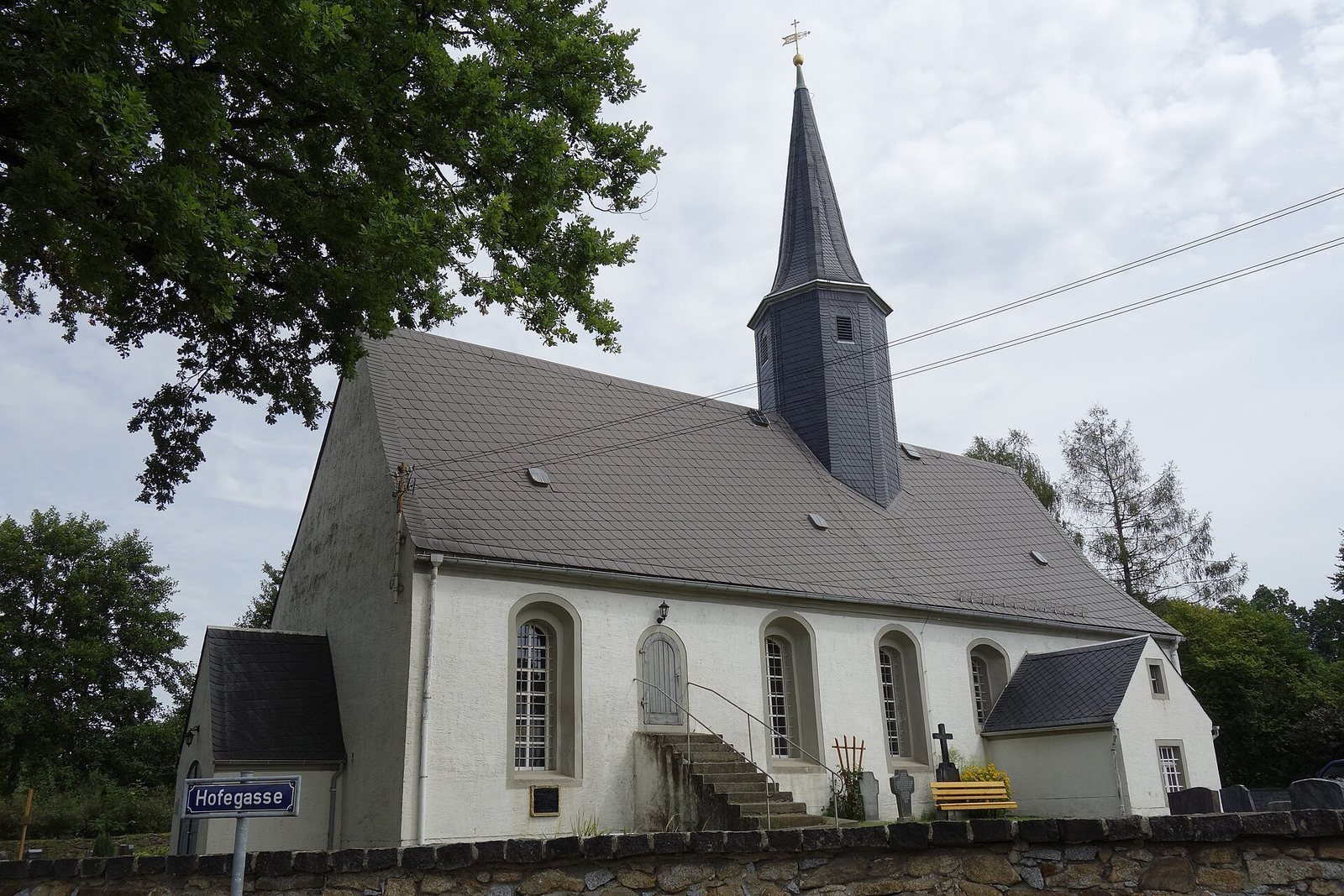
Kirche Höckendorf is a long, plastered hall church, meaning that its main worship space is arranged as one hall rather than a central nave with separate aisles. Its terminal end has a three-eighths-ended form, a polygonal shape made from three sides of an imagined eight-sided figure. A gabled roof carries an octagonal roof turret topped by a pyramidal cap, while round-arched windows punctuate the exterior. On the south side, a ramp-like staircase leads to a former patron’s box, a reserved viewing area for a church patron and household.
Galleries and ceiling
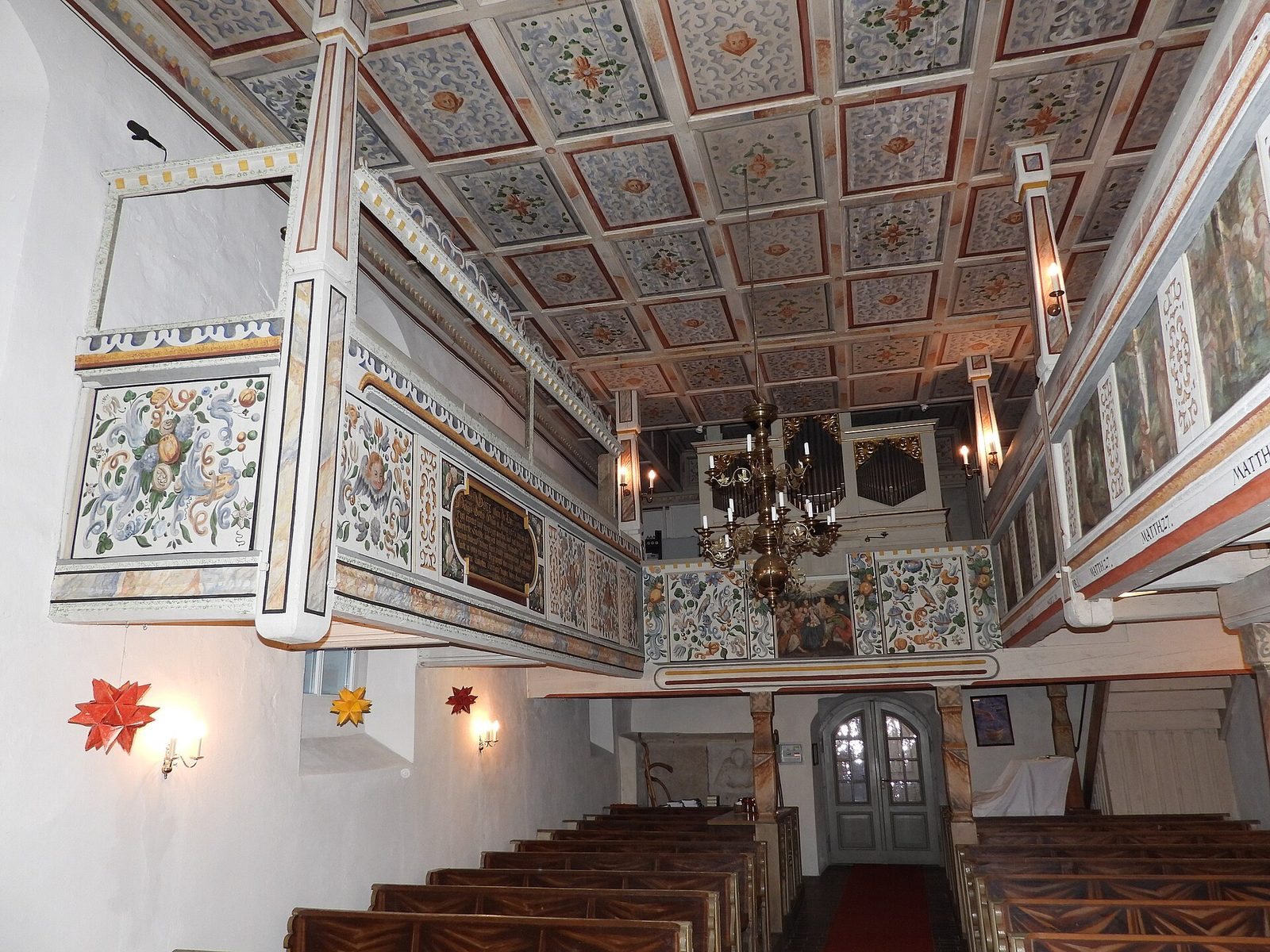
Inside, the hall has a flat roof and a coffered ceiling with ornamental painted decoration. Galleries on the north, west, and western south sides are suspended from the ceiling. Their divisions are formed by profiled parapet and foot beams. Painted scenes from the Old and New Testaments fill the gallery parapets, separated by strapwork ornament resembling interlaced bands. The organ gallery is especially decorated with painted angels’ heads, birds, and flowers.
Furnishings and memorials
Altar and pulpit
The wooden altar from 1615 has a carved relief of the Last Supper within a broad frame decorated with diamond-shaped blocks. Columns flank the relief and carry an unbroken cornice. The crowning crucifix and side scrolls date from the addition made in 1673. The wooden pulpit, also from 1615, has painted parapet panels showing Aaron, Moses, Salvator mundi, the Christian image of Christ as “Saviour of the World,” and Ecclesia, the personification of the Christian Church. A painted dove decorates its sounding board.
Baptismal font and funerary monuments
The cuboid wooden baptismal font depicts the Baptism of Christ and Christ blessing the children. Strapwork ornament completes its decoration, and its cover has a superstructure supported by eight turned balusters.
Several sandstone funerary monuments from the seventeenth and eighteenth centuries include figural representations. In the southeast corner, monuments commemorating members of the Uschner family carry the dates 1648 and 1656.
Organ and bells
Baroque organ
The baroque organ has one manual, a pedal, and ten stops. Its later physical changes include the shortening of the central case tower and the installation of new ornamental grille boards in 1991. A further overhaul followed in 2014, continuing the sequence of repairs that has shaped the instrument’s present form.
Bronze bells
The church has two bronze bells. Their installation includes an oak bell frame and oak yokes, which form the supporting wooden structure and the components from which the bells are suspended.