Korskirken: A Historic Church in Bergen, Norway


Site at a Glance
- Rating
- 4.2
- Popularity
- Low
- Country
- Norway
- Primary era
- Medieval
- External website
- Open
- Eras represented
- Medieval, Early Modern, Modern
- Civilizations
- Denmark–Norway, Norwegian
- Site type
- Religious
- Remains
- Church
On this page17 sections
History
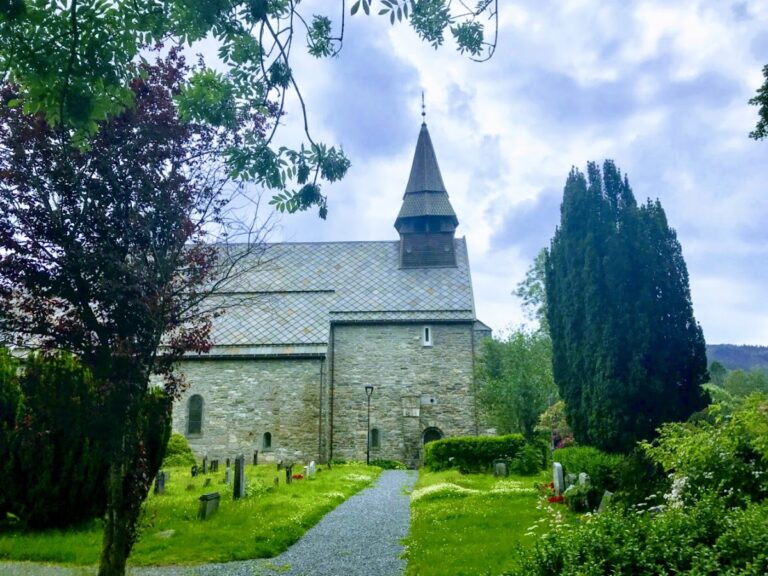
Korskirken is a historic stone church in Bergen, Norway, founded and consecrated around 1150 in the Romanesque architectural tradition. Its oldest surviving phase dates from the second half of the twelfth century. Built on the shore of Vågen, the church probably marked the southern boundary of Bergen’s settlement and was first documented late in that century.
Medieval foundation and dedication
The name Korskirken means Church of the Cross and refers to the True Cross, the Christian relic traditionally identified as part of the cross on which Jesus was crucified. The church possessed a relic associated with the True Cross until it was stolen by the Danish king during the Reformation. Its early position beside Vågen placed it at the edge of the developing town, while its dedication connected the church with an important Christian tradition.
The building was damaged or destroyed by fires in 1198, 1248, 1413, 1582, 1623, 1640, and 1702. These repeated disasters produced successive changes to the church, including the loss of its earlier tower arrangement. A medieval practice of ringing the bells every morning at 7:00 continued until 1992.
Early modern rebuilding
The original church had a straight rectangular plan. During the early seventeenth century, north and south transepts were added. A transept is a wing projecting across a church’s main axis, creating a cross-shaped plan. The south wing was endowed by Knud Urne, while Jens Juel endowed the north wing and portal. The monogram of King Christian IV, the Danish-Norwegian king who reigned from 1588 to 1648, was placed above the entrance.
The fire of 1582 destroyed a tower or towers, and the original arrangement was not rebuilt in its former shape. Instead, reconstruction produced the Renaissance-style tower that survives today. After the destructive fire of 1702, the church was renovated again. Later restoration campaigns took place in 1856–1857 under Chr. Christie and in 1896 under Schak Bull. Most of the present church inventory dates from the 1896 restoration.
Parish and civic history
Korskirken served as the parish church of Holy Cross parish in central Bergen from 1320 until 2002. In 1814, it was used as an election church and polling station during Norway’s first national elections. Those elections selected electors for the assembly that drafted the Constitution at Eidsvoll Manor.
Several religious figures were associated with the church. Hans Egede, the Danish-Norwegian Lutheran missionary later known for his mission in Greenland, served there as parish priest before travelling to Greenland. Johan Nordahl Brun became parish priest on 14 April 1774 and held the position until his appointment as bishop in 1804. From 1801 to 1804, the lay preacher and religious reformer Hans Nielsen Hauge belonged to the congregation while living in Bergen as a merchant.
The Bergen writer Ludvig Holberg made the church’s bell-ringer Niels Klim the principal character of his 1641 novel Niels Klim’s Journey Underground. Klim and his wife donated a chalice and paten to Korskirken in 1673, and the two vessels remain in use.
Changes since 2002
In 2002, several central urban parishes were merged into Bergen domkirke parish, and Korskirken ceased to function as a regular parish church. It remains affiliated with the Church of Norway, Norway’s national Lutheran church, and belongs to the Bergen domkirke parish within the Bergen domprosti deanery of the Diocese of Bjørgvin. It holds special-parish-church status, meaning that it remains within parish administration while no longer operating as an ordinary parish church.
Since 2002, the Church City Mission has used Korskirken as a special church within the urban parish. The church operates as an open church for silence, candle lighting, conversation, community activities, services, and music. The Church City Mission also carries out social work and religious outreach in the surrounding urban area. Korskirken has protected cultural-heritage status as an automatically protected Norwegian cultural heritage site.
Remains
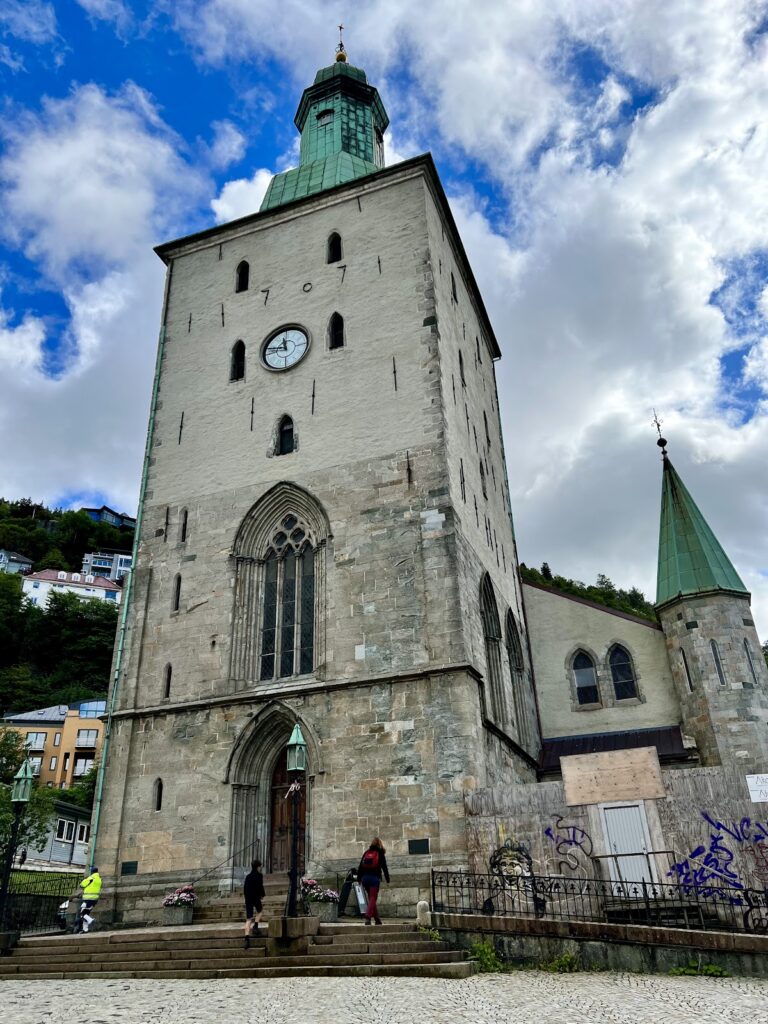
Korskirken stands in central Bergen near the head of Vågen bay, at the intersection of Kong Oscars gate and Nedre Korskirkeallmenningen. It is a large stone church with a cruciform plan and seating for approximately 600 people. The rectangular medieval core measures about 39 by 11.5 metres, while the later transepts extend from its main axis. The building combines the masonry of its medieval foundation with the Renaissance-style tower and later interior elements.
Church layout and exterior
Medieval core and transepts
The earliest surviving structure belongs to the second half of the twelfth century and follows a straight rectangular plan. The original Romanesque church was built of substantial stone masonry and measured approximately 39 by 11.5 metres. The north and south transepts, added in the early seventeenth century, changed the building into the cross-shaped form visible today.
Renaissance-style tower and portal
The church later acquired twin towers, but the 1582 fire destroyed the tower arrangement. The rebuilding created the Renaissance-style tower that remains. Above the portal, the monogram of King Christian IV identifies the royal connection associated with the early modern rebuilding.
Interior features
Altarpiece and pulpit
Parts of the 1727–1731 altarpiece survive in the sacristy. A historic pulpit from Korskirken is preserved in Bergen’s historical museum, while a Baroque six-armed chandelier from the church is held at Akershus Fortress in Oslo. A stained-glass window designed by Frøydis Haavardsholm was installed in the east wall of the choir in 1928.
Organ
The church organ was built in 1892 by the German organ builder Albert Hollenbach. It originally had 38 stops on three manuals and a pedal. An organ stop is a set of pipes producing a particular tone, while a manual is a keyboard played by the hands and the pedal is operated by the feet. The instrument was later enlarged by three stops and restored in 1981. An earlier organ had been built by Claus Jensen.
Liturgical vessels
The chalice and paten donated by Niels Klim and his wife in 1673 are still used in the church. Their continued liturgical use connects a surviving pair of objects with the church’s early modern history and with the literary association created by Ludvig Holberg’s novel.
Grounds and commemorative features
Former cemetery
A small number of graves survive from the former church cemetery, providing physical remains of the burial ground that once belonged to Korskirken.
Standing stone
On the east side of the church stands a stone erected in 1893. It commemorates those who fell in the naval battle off Alvøen.
Memorial reliefs
A bronze relief of Hans Egede and his wife, Gertrud Rasch, created by Johan B. Hygen, is mounted on the west wall of the church tower. A separate relief commemorating Hans Nielsen Hauge, created by Sofus Madsen, was unveiled in 1971.