Kikuchi Shrine: A Shinto Shrine Honoring the Kikuchi Clan

Site at a Glance
- Rating
- 4.2
- Popularity
- Low
- Country
- Japan
- Primary era
- Modern
- External website
- Open
- Eras represented
- Modern
- Civilizations
- Japanese
- Site type
- Religious
- Remains
- Sanctuary
On this page13 sections
History
Kikuchi Shrine is a Shinto shrine in Kikuchi, Kumamoto Prefecture, Japan, established in 1870 at the former Kikuchi Castle site during the early Meiji period. It commemorates the Kikuchi clan, which supported the Southern Court during the Nanboku-cho period, the fourteenth-century conflict between Japan’s Northern and Southern Imperial Courts, and served as one of the Southern Court’s principal supporters in Kyushu.
Origins and establishment
The shrine project began in 1868, when Nagaoka Moriyoshi, a Kumamoto-domain figure who later entered the Meiji government, proposed shrines honoring the Kikuchi clan and Kato Kiyomasa. The new government accepted the proposal on July 18 and ordered the Kumamoto domain to conduct the two rites. The domain established Kikuchi Shrine at the former Kikuchi Castle site, while a shrine for Kato Kiyomasa was placed inside Kumamoto Castle and later became Kato Shrine.
The enshrinement ceremony took place on April 28, 1870. Kikuchi Taketoki, a clan leader who supported Emperor Go-Daigo’s campaign against the shogunate, was the principal deity. His eldest son, Kikuchi Takeshige, and the later clan leader Kikuchi Takemitsu, who also supported the Southern Court, were enshrined alongside him. Twenty-six additional members of the Kikuchi clan are also enshrined at the shrine.
Recognition and institutional change
Kikuchi Shrine became a village shrine in May 1873 and a prefectural shrine in July 1875. On January 10, 1878, it was elevated to the status of a Bekkaku Kanpeisha, a state-recognized shrine honoring people regarded as having rendered distinguished service to Japan. At that time, Kikuchi Takeshige, Kikuchi Takeuji, Kikuchi Takemitsu, Kikuchi Takemasa, Kikuchi Tomotomo, and other warriors associated with the Kikuchi cause were included among the enshrined figures. Its order within the Bekkaku Kanpeisha system was fixed in 1879, immediately after Go-o Shrine in Kyoto.
The annual festival date was set on June 3, 1878, as May 5 in the solar calendar, calculated from the date on which Kikuchi Taketoki was killed. The shrine currently lists annual festivals on April 5 and October 15. In 1923, Kikuchi Takeshige and Kikuchi Takemitsu were elevated from associated deities to principal deities.
Modern development
Emperor Showa visited Kikuchi Shrine on November 12, 1931, while attending the Army Special Maneuvers in Kumamoto Prefecture. The shrine buildings were rebuilt in September 1938 with financial assistance from the emperor. After the Religious Corporation Law was promulgated in 1951, Kikuchi Shrine became a religious corporation on September 13, 1952.
The shrine is one of the Fifteen Shrines of the Kenmu Restoration, Emperor Go-Daigo’s attempt to restore direct imperial rule between 1333 and 1336 after the fall of the Kamakura shogunate. Formerly classified as a Bekkaku Kanpeisha, it is now a shrine in the Beppyo category of the Association of Shinto Shrines. A Kumonoe-gū building and a historical museum were added to the grounds in 1970.
Remains
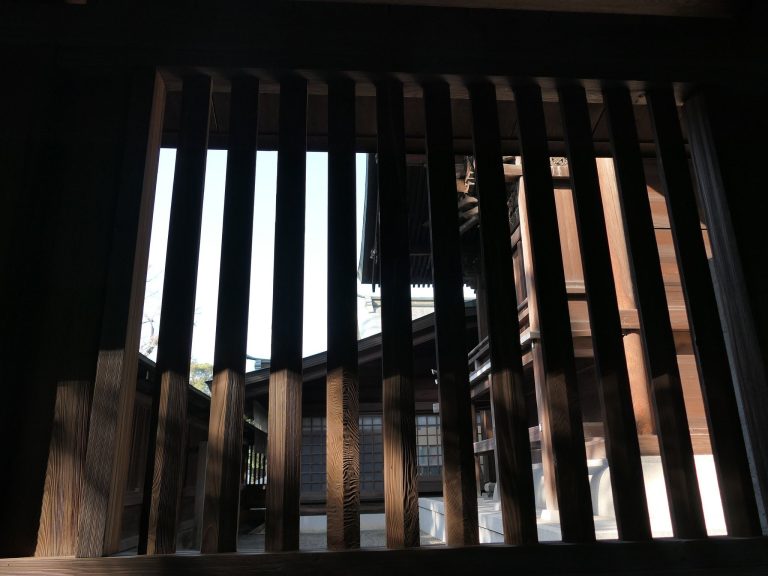
The shrine complex occupies the former Kikuchi Castle site. Its principal buildings combine traditional shrine forms with copper-sheet roofing, while associated sanctuaries and museums extend the grounds’ religious and historical functions. Cherry blossoms are also associated with the shrine landscape.
Principal shrine buildings
Main sanctuary
The main sanctuary is a three-bay nagare-zukuri structure, a shrine form with a long, smoothly curved roof extending over the front. Its roof is covered with copper sheet, and the ridge carries chigi, forked finials projecting above the roof, together with katsuogi, short cylindrical billets placed across the ridge.
Worship hall
The worship hall is five bays wide and three bays deep. It has an irimoya roof, which combines a central gable with hipped roof surfaces on the sides. The entrance is on the eave side, and a three-bay porch projects from the center. The roof is clad in copper sheet.
Associated sanctuaries and museums
Shiroyama Shrine
Shiroyama Shrine is associated with Kikuchi Takefusa and Kikuchi Shigeatomo, extending the complex’s commemoration of figures connected with the Kikuchi clan.
Kumonoe-gū
Kumonoe-gū is associated with Prince Kaneyoshi and Prince Yoshinari, imperial princes active during the Nanboku-cho period. Its building was added to the shrine grounds in 1970.
Subsidiary shrines
The grounds also contain subsidiary Inari Shrine and Ikime Shrine.
Kikuchi History Museum
The Kikuchi History Museum presents material from approximately five centuries of Kikuchi clan history. Its displays include the Kikuchi Thousand Spears, a weapon made from shortened spears mounted on long bamboo poles. The museum was added to the grounds in 1970 together with the Kumonoe-gū building.