Hōkai-ji Temple: A Tendai Buddhist Memorial Temple in Kamakura


Site at a Glance
- Rating
- 4
- Popularity
- Low
- Country
- Japan
- Primary era
- Medieval
- External website
- Open
- Eras represented
- Medieval
- Civilizations
- Ashikaga shogunate
- Site type
- Religious
- Remains
- Monastery
On this page12 sections
History
Hōkai-ji Temple is a Tendai Buddhist temple in Kamakura, Japan, established in 1335 as a memorial and funerary temple for the Hōjō clan after the destruction of the Kamakura shogunate. Its principal deity is Jizō Bosatsu, a bodhisattva associated with protecting and saving beings, especially children and the dead. Formally known as Kinryūzan Shakuman-in Endon Hōkai-ji, it is one of only two Tendai temples in Kamakura, the other being Sugimoto-dera.
The Hōjō funerary tradition
Hōkai-ji’s origins lie in the final crisis of Hōjō rule. The Hōjō were the hereditary regent family that exercised effective political control over the Kamakura shogunate for much of its existence. Their family funerary temple, Tōshō-ji, had been founded in 1237 by Hōjō Yasutoki in memory of his mother. Every Hōjō regent was buried there, and the temple remained the family’s bodaiji, a temple where ancestors were commemorated and buried, until the end of the shogunate.
On July 4, 1333, Nitta Yoshisada’s forces brought down the Kamakura shogunate. Nitta Yoshisada was the military commander who led the attack on Kamakura. About 870 Hōjō men, women, and children died by suicide at Tōshō-ji, bringing the family’s political era to a violent end. The former Hōjō residence in Komachi, where Hōkai-ji was later established, was also burned during the invasion.
Foundation and construction
Emperor Go-Daigo ordered Ashikaga Takauji to create a new Hōjō funerary temple, transfer the clan’s remains there, and build it on the site of the former Hōjō residence. Takauji later became the first Ashikaga shogun. A 1335 donation document associated with Hōkai-ji states that Go-Daigo founded the temple there to memorialize Hōjō Takatoki, the final Hōjō regent.
The temple’s traditional foundation date is 1335, although its construction was carried out principally by Takauji and his supporters after the Kenmu Restoration had collapsed. The restoration was Go-Daigo’s attempt to re-establish direct imperial rule after the fall of the Kamakura shogunate. Its failure enabled Takauji to establish the Ashikaga shogunate, while Go-Daigo subsequently died. A second donation document, dated 1352, records lands assigned to finance Hōkai-ji’s construction, showing that the building program was then becoming substantial.
Hōkai-ji’s second abbot, Shokei, conducted the first recorded Buddhist empowerment ceremony at the temple in 1354. By that time, the complex was probably sufficiently complete for formal religious activity. Its seven-hall layout, a formally organized Buddhist precinct containing principal buildings for religious and institutional use, was completed by the middle of the 1350s. Tōshō-ji was rebuilt on its original site, while Hōkai-ji continued the Hōjō family’s memorial tradition at the former residence.
Fire, institutional ties, and continuing remembrance
Hōkai-ji was completely destroyed by fire in 1538. It later became a branch temple of Kan’ei-ji and subsequently a branch of Enryaku-ji, the institutional center of the Tendai school on Mount Hiei. At the beginning of the Edo period, Tenkai, the founder of Kan’ei-ji, asked Tokugawa Ieyasu to provide state support for Hōkai-ji’s maintenance.
Belief that Hōjō spirits continued to haunt the area led to the creation of the Tokusō Gongen shrine within the temple precincts. The shrine was intended to pacify the dead and still stands near the Main Hall. Hōkai-ji was recognized as a constituent cultural property of Japan Heritage in 2016. Its historical associations also connect it with the Kamakura Seven Lucky Gods, the Kamakura Kannon pilgrimage, and the Kamakura Jizō pilgrimage.
Remains
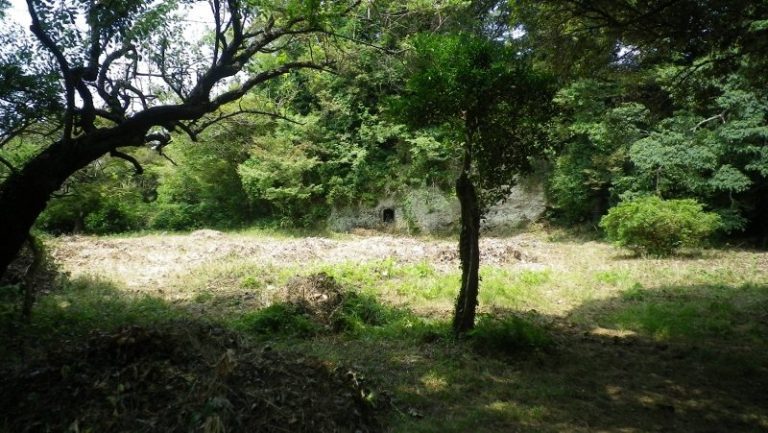
Hōkai-ji occupies the area traditionally identified as the former Komachi residence of the Hōjō regents. The residence site is associated with Hōjō Yoshitoki, the second Hōjō regent, and later members of the Hōjō line. It lies near the road leading from the third torii of Tsurugaoka Hachimangu. An entrance stele identifies the former residence and explains its connection with Hōkai-ji. The inscription states that the regents normally lived there from Yoshitoki’s time, describes Hōjō Takatoki’s lavish entertainments and rewards to dengaku performers, and recalls the residence’s destruction during Nitta Yoshisada’s 1333 invasion.
Archaeological evidence
Excavations at the former Tōshō-ji site have revealed the temple’s basic structural layout, fragments of Chinese pottery, and roof tiles carrying the Hōjō family crest. Heat-altered stones and other fire-damaged surfaces confirm that the site underwent a major fire. These remains provide physical evidence for the earlier Hōjō funerary complex and its destruction, while the entrance stele links the former residence to the foundation of Hōkai-ji in 1335.
The Main Hall
The Main Hall houses Hōkai-ji’s principal object of worship, a seated wooden image of Jizō Bosatsu made around 1365 by the sculptor Sanjō Hōin Ken’en. The statue is designated a national Important Cultural Property. It is accompanied by figures of Bonten and Taishakuten, Buddhist deities corresponding broadly to Brahma and Indra. Both images date from the Nanboku-chō period and are designated prefectural Important Cultural Properties.
Other figures in the Main Hall include the Ten Deva Kings, Enma, the judge of the dead, and a seated image of Enkan, the Tendai monk traditionally regarded as Hōkai-ji’s founding abbot. The hall also contains a wooden portrait statue of Shokei, the temple’s second head priest. Made in 1372 during Shokei’s lifetime, it is designated a national Important Cultural Property.
Religious buildings and precinct features
Kankiten-dō
The Kankiten-dō is a small structure to the right of the Main Hall. It enshrines Kangiten, a Buddhist deity associated with joy and prosperity. The image is approximately 1.5 meters tall and represents an embracing male and female pair of elephant-headed human figures. Because of its sexual symbolism, the hall is not open to the public.
Tokusō Daigongen shrine
The Tokusō Daigongen shrine and a nearby torii form the shrine complex established for the Hōjō dead. The shrine building was rebuilt in 1992 and contains a statue of Hōjō Takatoki. Its presence preserves the precinct’s connection with the belief that the spirits of the defeated Hōjō continued to require ritual pacification.
Taishi-dō
The Taishi-dō, or Prince’s Hall, stands near the entrance and is dedicated to Prince Shōtoku, an early Japanese imperial prince traditionally associated with the promotion and institutional development of Buddhism in Japan. Chrysanthemum motifs, the symbol of the Imperial Household, appear on its doors. An annual memorial service for carpenters, plasterers, and blacksmiths is held there on January 22.
The bush-clover garden
Abundant bush clover characterizes Hōkai-ji’s garden and gives the temple its traditional name, Hagidera, meaning “bush-clover temple.” The garden’s vegetation remains one of the features most closely associated with this name and with the temple’s identity within Kamakura’s religious landscape.