Jōkōmyō-ji Temple: A Medieval Buddhist Temple in Kamakura, Japan


Site at a Glance
- Rating
- 4.1
- Popularity
- Low
- Country
- Japan
- Primary era
- Early Modern
- Eras represented
- Medieval, Early Modern
- Civilizations
- Ashikaga shogunate, Kamakura shogunate, Tokugawa
- Site type
- Religious
- Remains
- Monastery
On this page18 sections
History
Jōkōmyō-ji Temple is a Buddhist temple in Kamakura, Japan, traditionally founded around 1251 by Hōjō Tokiyori and Hōjō Nagatoki during the Kamakura period. It belongs to the Sennyūji branch of the Shingon school, and its first abbot was Shin’a, later honored as Shinshō Kokushi. The temple became associated with the Hōjō family, the Kamakura kubō, and the Ashikaga rulers, while also developing a tradition of study across several Buddhist schools.
Foundation and Hōjō patronage
An earlier hermitage is traditionally said to have stood on the site. According to this tradition, the monk Mongaku established it on the orders of Minamoto no Yoritomo, although the claim remains uncertain. A transfer document issued by Shin’a in 1296 names Tokiyori and Nagatoki as the temple’s founders. Nagatoki, the sixth Hōjō regent, died in 1264 at the age of 36 and was buried at Jōkōmyō-ji. The temple then became the family temple of the Akahashi branch of the Hōjō clan.
Shin’a had ties to the Jōdo tradition, but Jōkōmyō-ji practiced the study of several Buddhist schools from its beginning. Under its third abbot, the temple adopted a system known as fourfold learning. This approach continued into the early modern period and could include Shingon, Tendai, Jōdo, Kegon, Zen, and Ritsu teachings.
Imperial and Ashikaga connections
In 1333, under the third abbot, Emperor Go-Daigo granted Jōkōmyō-ji estates in Yamanobe District of Kazusa Province and at Hatano Estate in Sagami Province. Go-Daigo led the movement that overthrew the Kamakura shogunate that year. Jōkōmyō-ji also became a prayer site for his son, Prince Nariyoshi.
The temple received continued patronage from the Ashikaga family and the Kamakura kubō, the Ashikaga family’s military governor based in Kamakura. From 1338, Ashikaga Takauji and his brother Ashikaga Tadayoshi donated estates at Kaname in Sagami, Yamanobe in Kazusa, and Mitsu in Izu. Tadayoshi also gave Buddhist relics to the temple in 1344 and 1351. Tradition further holds that Takauji confined himself at Jōkōmyō-ji in 1335, shortly before raising troops against Go-Daigo, to show that he did not intend to rebel against the emperor.
In 1399, Ashikaga Mitsukane, the Kamakura kubō, divided and enshrined at Jōkōmyō-ji the remains of his father, Ujimitsu, and his grandfather, Motouji. The temple thereafter served as a family temple of the Kamakura kubō. In 1591, Tokugawa Ieyasu granted it an income of 4 kan 800 mon.
Decline, rebuilding, and modern recognition
Jōkōmyō-ji once had nearly ten subtemples, but its buildings deteriorated after the beginning of the Edo period, reportedly including the loss of the main hall. In 1668, fundraising by monks and assistance from Genkyō, a senior monk of the Jōshōin subtemple of Tsurugaoka Hachimangū-ji, made it possible to rebuild the Buddhist hall and maintain the temple tradition. By the end of the Edo period, only Jion-in remained among the subtemples.
Jion-in had been established by Ashikaga Tadayoshi for prayers for the spirit of Prince Morinaga, whose death Tadayoshi had ordered. The standing Jizō image known as the Arrow-Picking Jizō is traditionally said to have come from Jion-in.
The Jōkōmyō-ji Estate Map is thought to have been made between 1333 and 1335, after the fall of the Kamakura shogunate, to seek confirmation of the temple’s estates from the new government. Its date is narrowed by the stylized signature of the Ashikaga retainer Uesugi Shigeyoshi and by the fact that he had left Kamakura by 1335. The map disappeared for a long period before being found in an old Kamakura family residence in 2000 and returned to Jōkōmyō-ji. It became an Important Cultural Property in 2005. Its discovery also demonstrated the preservation of the medieval precinct, which was added in 2007 to the national historic-site designation for the Reizei Tamesuke tomb.
Jōkōmyō-ji and associated historic remains became component cultural properties of Japan Heritage on April 25, 2016. The temple is also included in several religious pilgrimage networks, including the Kamakura Thirty-Three Kannon pilgrimage as site 25, the Kamakura Jizō pilgrimage as sites 16 and 17, the Kamakura Thirteen Buddhas pilgrimage as site 9 for Seishi Bosatsu, and the New Shikoku Eastern Japan Eighty-Eight-Temple pilgrimage as site 82.
Remains
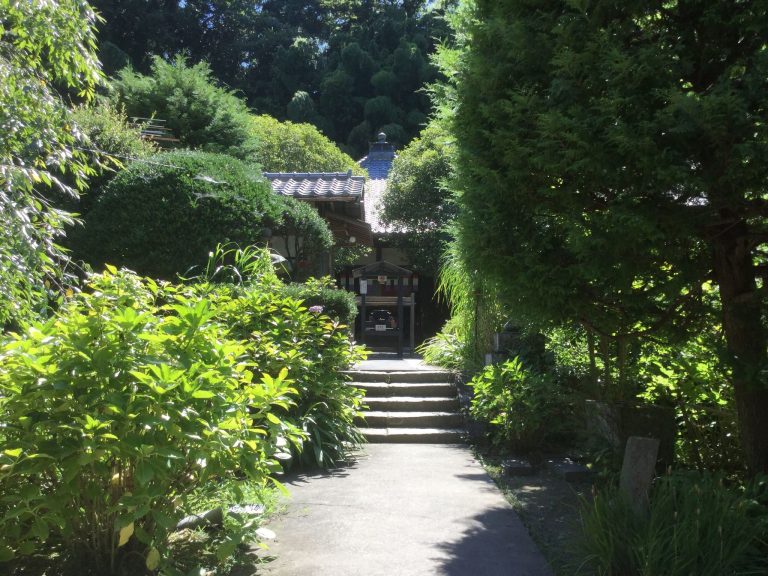
Jōkōmyō-ji occupies Izumigayatsu, a side valley of Ogigayatsu in Kamakura, between the Kamegayatsu and Kesho passes. The name Senkokuzan comes from the valley’s name. The precinct retains the form of a medieval temple complex arranged on a series of terrace-like platforms within the valley. Beyond the mountain gate are the guest hall, monks’ quarters, and Fudō Hall. The Amida Hall and a repository stand on higher ground behind them, while a narrow stairway continues from the rear of the Amida Hall toward rock-cut and funerary remains.
Temple buildings
Mountain gate and lower precinct
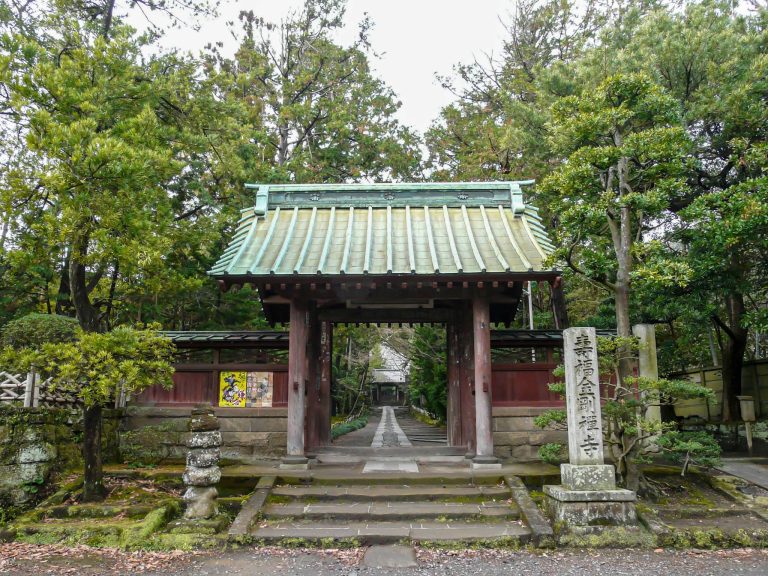
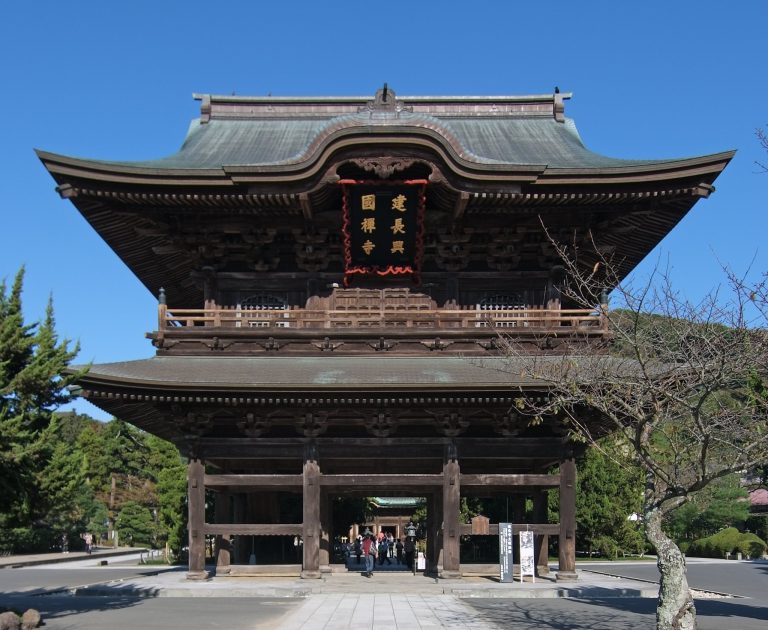
The wooden mountain gate originally served as the outer gate of Eishō-ji and is thought to date from the Kan’ei era, when that temple was founded. It entered private ownership for a time before being donated to Jōkōmyō-ji in 1926. The guest hall, monks’ quarters, and Fudō Hall occupy the lower part of the present precinct, beyond the gate.
Amida Hall
The wooden Amida Hall was built in 1668 on the site of the former founder’s quarters, using reused materials. Its architecture follows a Chinese-style manner. Genkyō of Tsurugaoka Hachimangū-ji financed the building for memorial services for his mother. It became known as the Amida Hall because the Amida Triad was first enshrined there; the hall now houses a newer triad representing the Buddhas of the Three Ages.
Inside the hall is a shumidan, the raised altar platform for Buddhist images, bearing an inscription dated 1468. At the rear left, the patriarchs’ hall contains a medieval wooden image of Shinshō Kokushi, the founding abbot Shin’a, together with memorial tablets for successive abbots. At the rear right, an earth-deity hall contains a medieval wooden image of Hōjō Nagatoki.
Repository and Buddhist images
The principal Amida Triad and other major images are kept in the repository. Made in 1299, the wooden triad consists of seated figures of Amida Nyorai, Kannon Bosatsu, and Seishi Bosatsu. Amida raises both hands before his chest in the preaching mudra and wears a crown. Raised appliquéd decoration on the shoulders, sleeves, and legs was produced using the domon technique, in which earth is pressed into molds to create floral and other patterns that are attached to the sculpture.
The attendant Kannon and Seishi figures sit with their legs relaxed rather than crossed in full meditation posture. Both incline their heads slightly toward Amida. Their naturalistic robes and lifelike expressions show a pronounced influence from the Chinese Song dynasty.
Rock-cut and memorial remains
Net-Hauled Jizō
Above the rear of the Amida Hall, a narrow stairway reaches a yagura, a rock-cut funerary or devotional chamber characteristic of medieval Kamakura. Inside is a seated stone Jizō called the Net-Hauled Jizō. Tradition says that fishermen pulled the image from the sea in their net. An inscription on its back records a memorial dedication made in 1313 by the temple’s third senior monk, and the image is also traditionally attributed to Reizei Tamesuke.
Reizei Tamesuke tomb
A further ascent from the yagura leads to the tomb of Reizei Tamesuke, a Kamakura-period poet, grandson of Fujiwara no Teika, and son of Abutsu-ni. The tomb consists of a hōkyōintō, a Buddhist memorial pagoda, dating from the Northern and Southern Courts period. The tomb and the temple precinct together form the protected historic remains associated with Jōkōmyō-ji.
Five-element monument
Northeast of the Reizei Tamesuke tomb stands a stone five-element monument, another form of Buddhist memorial pagoda. An urn with an inscription dated 1306 was found inside it. The monument occupies the site of Taho-ji, a temple founded by the monk Ninshō, and is identified as the memorial tower of a senior monk of Taho-ji.
Map, paintings, and cemetery
Jōkōmyō-ji Estate Map
The Jōkōmyō-ji Estate Map portrays the medieval precinct, its buildings, the surrounding landscape, and the residential compounds of nearby warrior families. It is regarded as the only surviving map depicting Kamakura during the Kamakura period. The map is currently deposited at the Kamakura Museum of National Treasures.
Mutual Images
Two silk paintings, one showing the Hachiman deity in monk-like form and the other showing Kōbō Daishi, date from approximately the Northern and Southern Courts period. Kōbō Daishi is the posthumous name of Kūkai, who established the Shingon tradition in Japan. Tradition says that the two figures painted each other’s portraits, giving the works their name, the “Mutual Images.” They are deposited at the Kamakura Museum of National Treasures.
Ōtomo cemetery
The cemetery of the Ōtomo hereditary chief priests of Tsurugaoka Hachimangū lies beside the Amida Hall. The Ōtomo family began placing its graves at Jōkōmyō-ji from the Muromachi period onward.
Historic trees
A large Japanese nutmeg-yew stands in front of the Amida Hall. Tradition says it was planted when the temple was founded, and its age is estimated at about 750 years. A large Japanese juniper grows over the cut slope behind the guest hall; its age is unknown.