Kemény Castle in Brâncovenești, Mureș: A Transylvanian Renaissance Castle


Site at a Glance
- Rating
- 4.5
- Popularity
- Low
- Country
- Romania
- Primary era
- Early Modern
- External website
- Open
- Eras represented
- Medieval, Early Modern, Modern
- Civilizations
- Hungarian, Principality of Transylvania
- Site type
- Military
- Remains
- Castle
On this page14 sections
History
Kemény Castle in Brâncovenești, Mureș, Romania, is a medieval and Renaissance castle whose present form developed through successive building campaigns under Hungarian and Transylvanian rule. The settlement stands on the right bank of the Mureș River, at the foot of the Călimani Mountains, and was first recorded in 1228 as castrum Wecheu. The castle is protected as a monument of national significance in Romania and is regarded as a notable example of Renaissance architecture in Transylvania, particularly the Hungarian Renaissance.
Roman and medieval foundations
A Roman fort once occupied a high terrace above the Mureș near the present castle. Its associated settlement served the military population. Recent research describes the fort as relatively small, with room for several hundred soldiers. Its duties included checking incursions and communicating conditions along the frontier. The name Ala Nova Illyricorum is associated with inscribed stones found in the ground.
A medieval fortress was later raised from stones taken from the Roman remains, probably through royal initiative, and had been completed by 1228. It may have been destroyed during the Mongol invasion of 1242. After that period, the surrounding estate came into the possession of the Tomaj kindred and the Losonc branch descended from it. In 1319 Brâncovenești formed part of their estate at Reghin, and from 1319 to 1467 the fortress belonged to the Bánffy family of Losoncz.
Changes of ownership in the fifteenth and sixteenth centuries
The Bánffys lost the estate in 1467 after joining a conspiracy against Matthias Corvinus, the king of Hungary. Matthias confiscated the property and granted it to John Ongor, a court soldier from Hunyad County. In 1507 it passed to Michael Szobi. After Szobi died in 1527, the estate went to his son-in-law and personal secretary, Stephen Werbőczy. The castle is traditionally linked with the preparation of Werbőczy’s Tripartitum, a sixteenth-century compilation of Hungarian customary law, although this connection remains a possibility rather than a certainty.
Werbőczy later transferred the fortress to John I Szapolyai, a king of Hungary during the kingdom’s period of political division. Szapolyai granted it to Paul and Balázs Ártándi. After their execution in 1532, Werbőczy recovered the fortress, then pawned it to Ferenc Kendy in 1533 for 6,000 gold pieces. Kendy’s estate was confiscated after his execution for treason in 1558 and granted to Kristóf Hagymási. Following Hagymási’s death, his widow Judit Kerecsényi held the property. It later passed to Prince Sigismund Báthory of Transylvania and then to his uncle, István Bocskai.
Princely grants and the Kemény family
When Sigismund Báthory abdicated in favour of his brother András in 1599, he retained Vécs Castle and compensated Bocskai with Deva Castle. Bocskai later recovered Vécs Castle and left it by testament to Miklós Bocskai, but the Diet invalidated the testament and awarded the estate to István Wesselényi.
During the 1610s the estate came into the possession of Prince Gabriel Bethlen, who granted it to his nephew Peter Bethlen, described as ispán of Hunyad and Máramaros. It subsequently passed to George I Rákóczi. George II Rákóczi eventually bequeathed the castle and its associated villages to Prince John Kemény of Transylvania and his wife, Zsuzsanna Kállai. John Kemény was still a princely councillor and head of the chancellery when he acquired the estate.
On 28 November 1648, the castle and five villages were formally granted to John Kemény and his descendants. The property remained in the Kemény family for almost three centuries. During an earlier period of Bethlen and Rákóczi ownership, the estate was associated with seven villages and part of another settlement. An inventory from 1648 listed an orchard, kitchen garden, and apiary beside the fortress, while extensive pine and oak woodland surrounded the estate.
Destruction, rebuilding, and literary life
John Kemény died at the Battle of Nagyszőllős in 1662, after which the estate suffered major destruction and the northern tower burned. The castle was damaged again during the Rákóczi War of Independence, a conflict associated with the struggle for political autonomy in Hungary and Transylvania. The Kemény family rebuilt the building, adding a second storey and incorporating late Baroque elements.
During the interwar period, John Kemény (XI), a twentieth-century Hungarian writer, made the castle a centre of literary activity. He founded the Erdélyi Helikon literary association, and from 1926 to 1944 the castle and garden hosted gatherings of Hungarian, Saxon, and Romanian writers. They worked in the spirit of Transylvanianism, a cultural and political outlook that emphasized Transylvania’s distinct regional identity and cooperation among its communities. The association eventually had 55 members, including Lajos Áprily, Károly Kós, Miklós Bánffy, Jenő Dsida, Sándor Reményik, Aladár Kuncz, Áron Tamási, József Nyirő, Sándor Makkai, Károly Molter, Mária Berde, Lajos Olosz, and Géza Tabéry.
War, nationalization, and renewed family ownership
At the end of the Second World War, local inhabitants looted the building and removed its valuables. After nationalization, the castle successively housed a reformatory, a prison, and a home for children and women with disabilities. It remained inaccessible for a long period during this institutional use.
The monument was restored between 1968 and 1974 according to plans by Gyula Keresztes. After the fall of communism, Miklós Kemény, the youngest son of John Kemény, reclaimed the castle, which continued for a time to be used by the Brâncovenești Rehabilitation Centre. He envisaged a “New Helikon” cultural centre devoted to Hungarian culture in Transylvania and registered the Helikon–John Kemény Foundation in 2000. In 2013, Géza Nagy Kemény founded the Kemény Augusta Cultural Association to maintain the castle and organize cultural activities.
The Kemény family took possession again on 30 September 2014, after approximately seventy years of state and institutional use. Descendants of villagers returned some furniture and valuables removed after the war, and these objects are displayed in the castle. The restored building now hosts exhibitions, concerts, commemorative events, dance gatherings, creative workshops, and other activities connected with the Kemény family and Erdélyi Helikon.
Remains
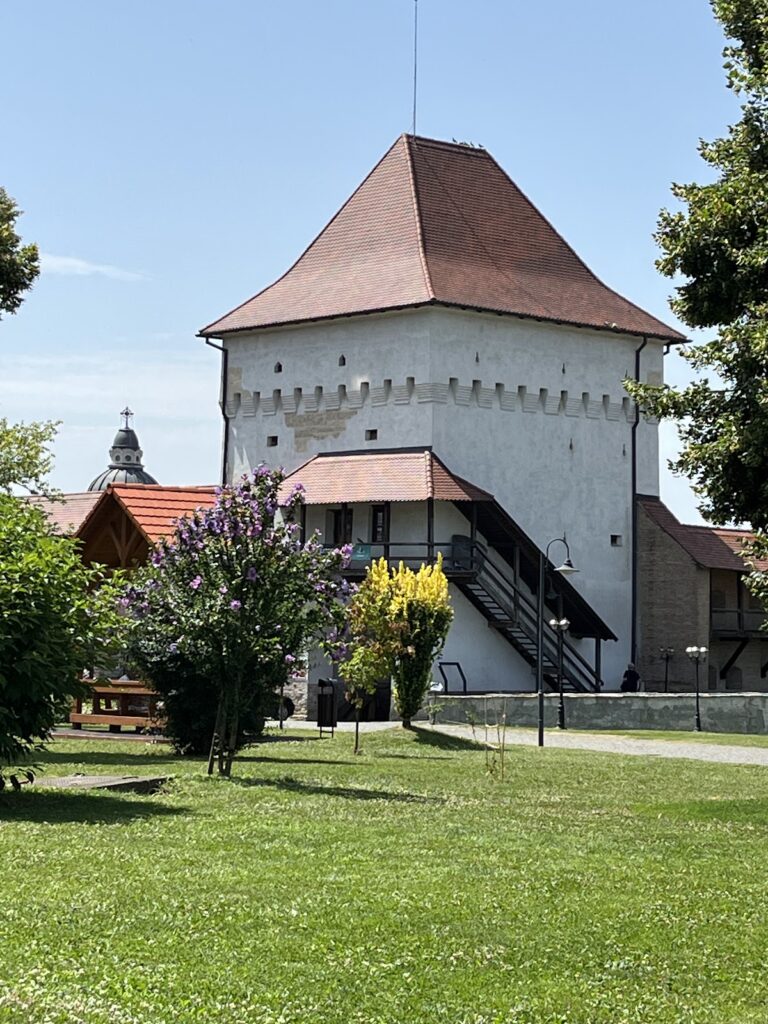
Kemény Castle is a square, enclosed building with two storeys and four corner towers, arranged as two larger and two smaller towers. Its regular plan surrounds a courtyard measuring 20 by 20 metres, with two-storey palace wings around it. The appearance visible today reflects several rebuilding campaigns, especially the substantial alterations made around the turn of the nineteenth and twentieth centuries.
The enclosed castle
Early fabric and Renaissance alterations
The earliest version of the present castle dates to the mid-fifteenth century and was commissioned by the Losonc Dezsőfi family. The eastern corner tower and the adjoining section of façade survive from that phase. Between 1537 and 1558, Ferenc Kendy remodelled the castle in late Gothic and Renaissance forms. Renaissance window and door surrounds remain from this work.
The Gothic main gate carries a carved quotation attributed to Cicero: “Always be vigilant. Matthew 25. O how fortunate the city or fortress that devises war in peacetime.” A carved door frame bears the Kendy coat of arms and an inscription naming Ferenc Kendy as voivode of Transylvania and count of the Székelys, with the date 1555.
Towers, moat, and entrance
The castle was formerly encircled by a water-filled moat, a defensive ditch, and was approached by a drawbridge that could be raised to restrict access to the gate. The entrance lies on the northern side, reached by a bridge over the outer ditch. Earlier defenses also included walls and towers below the plateau. Those lower defensive remains were destroyed during post-war reconstruction.
After the northern tower burned following John Kemény’s death in 1662, its surviving one-storey remnant was later given a viewing terrace. The damage suffered during the Rákóczi War of Independence was followed by rebuilding for the Kemény family, including the addition of the second storey and late Baroque elements. In the late nineteenth and early twentieth centuries, architect István Möller designed the present arcaded bastion, a projecting defensive structure, and most of the roof was replaced. This rebuilding introduced substantial new structures and altered earlier parts of the castle.
Courtyard and interior arrangement
The ground floor was chiefly occupied by rooms serving economic functions. The first floor held the owners’ residential and representational rooms, while the later second floor included bedrooms and a dining room. These wings enclose the central courtyard within the square plan.
Park and memorial features
Garden and former earthwork fort
The castle garden contains an extensive park. The orchard, kitchen garden, and apiary recorded in 1648 formed part of the estate’s productive grounds. Latin labels attached to several unusual trees indicate that part of the park once functioned as an arboretum. Grass-covered earthworks of the former earthwork fort survive west of the castle, and the surrounding pine and oak woodland has remained comparatively intact.
Kemény burial place and Helikon table
The Kemény family burial place lies in the garden and contains the graves of John Kemény, his wife Augusta Paton (1900–1989), and their daughter, the opera singer Klió Kemény. Beside it stands the Helikon table, a stone table designed by Károly Kós. Sándor Makkai presented it in 1935 on behalf of the writers of Erdélyi Helikon to John Kemény and his wife, and it commemorates Aladár Kuncz.
The nearby park also contains the grave of the writer Albert Wass (1908–1998). Together with the restored castle, these memorial features preserve the connection between the Kemény family estate and the literary life associated with Erdélyi Helikon.
Nearby sites