Kbal Spean: An Angkorian Hindu River Sanctuary in Cambodia
Site at a Glance
- Rating
- 4.4
- Popularity
- Low
- Country
- Cambodia
- Primary era
- Medieval
- External website
- Open
- Eras represented
- Medieval
- Civilizations
- Khmer
- Site type
- Religious
- Remains
- Sanctuary
On this page10 sections
History
Kbal Spean is an Angkorian-period Hindu archaeological site in the western Kulen Hills of Cambodia, within Phnom Kulen National Park northeast of Angkor. Associated with the Khmer Empire, it belongs to the Baphuon architectural type and was developed mainly during the eleventh century under Kings Suryavarman I and Udayadityavarman II.
The Eleventh-Century Sanctuary
The carving programme began during the reign of Suryavarman I, who ruled from 1002 to 1050, and continued under Udayadityavarman II, who ruled from 1050 to 1066. A minister of Suryavarman I is associated with the creation of the thousand lingas, while hermits living in the area carried out the carvings. A donation connected with Suryavarman I dates to 1054, and inscriptions indicate that much of the remaining sculptural work was completed during Udayadityavarman II’s reign.
An inscription states that Udayadityavarman II consecrated a golden linga at Kbal Spean in 1059. The river was understood to become holy as it flowed over the sacred lingas before continuing toward Angkor. Its water later divided into the Siem Reap and Puok rivers and eventually reached Tonle Sap Lake, linking the sanctuary’s religious purpose with the wider landscape around the Angkorian capital.
The religious programme expresses Hindu ideas of creation, preservation, and destruction through representations of Brahma, Vishnu, Shiva, and related mythological figures. Brahma is associated with creation, Vishnu with preservation, and Shiva with destruction and transformation. The site’s river, carvings, and downstream course together formed a sacred setting rather than a collection of isolated images.
Rediscovery and Later Protection
Ethnologist Jean Boulbet discovered the archaeological site in 1969. Further exploration was interrupted by the Cambodian Civil War, and safe visitation recovered during the late twentieth century. Although the reliefs have suffered vandalism and damage, archaeological supervision has supported the reproduction of portions of missing carvings by graduates of Artisans d’Angkor.
Remains
Kbal Spean occupies roughly 150 metres of the Stung Kbal Spean River. Reliefs are carved into natural sandstone in the river bed and along the banks, extending from about 150 metres upstream of a natural bridge to the waterfall downstream. The river passes through a sandstone arch or bridge, while falling water levels after the monsoon reveal more of the carved surfaces.
The Linga River Bed
Lingas and Yoni Designs
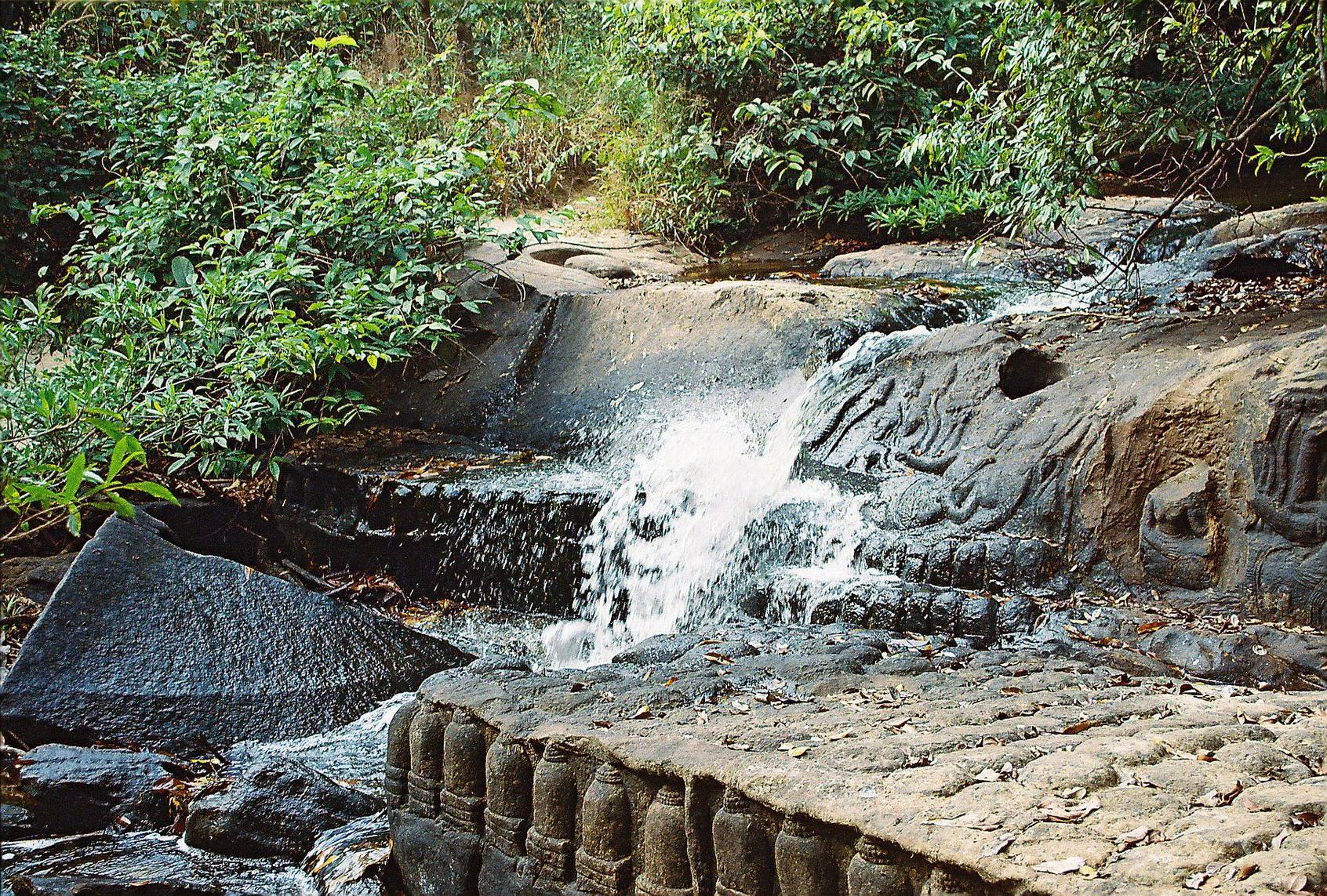
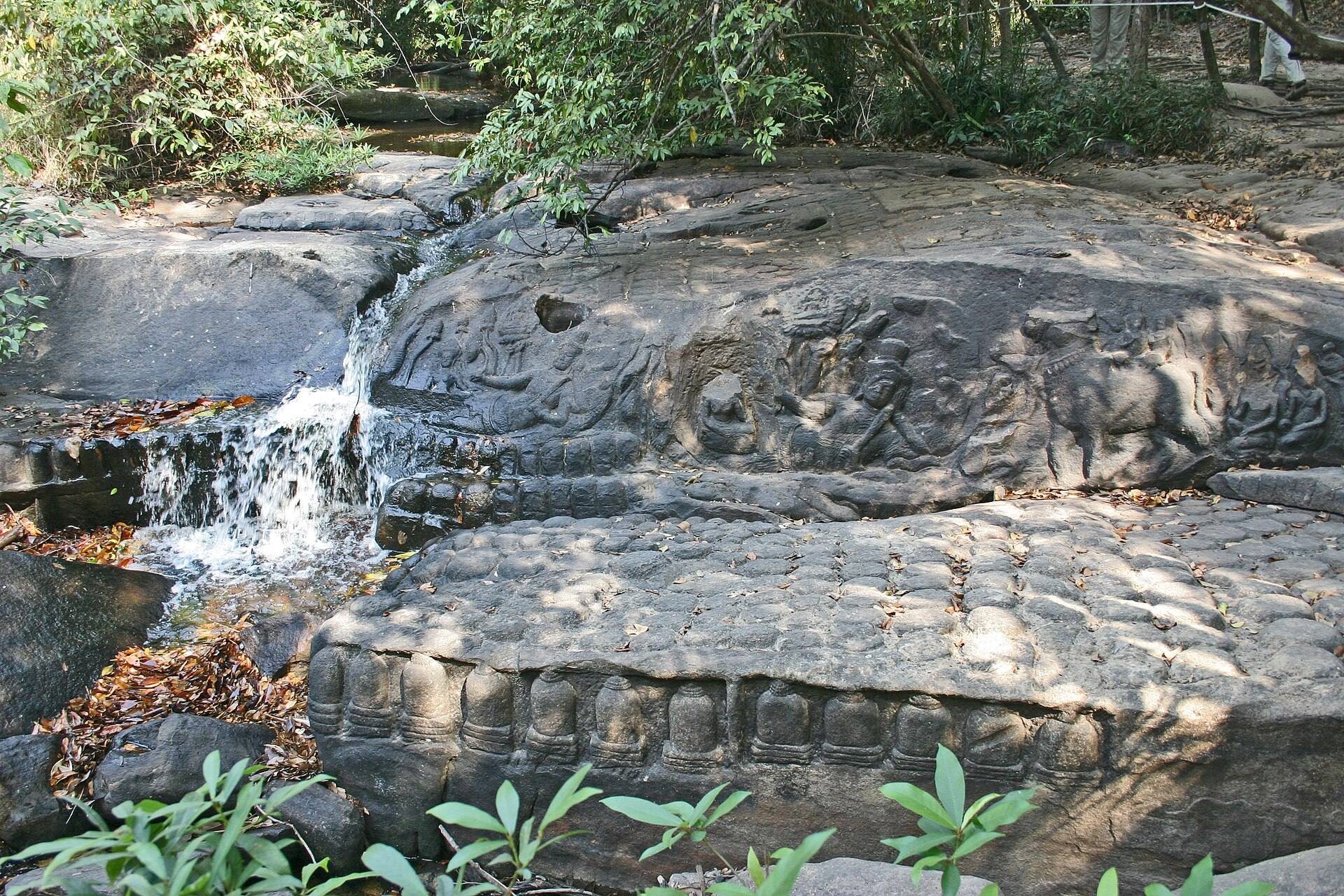
The principal feature is a field of raised lingas carved across the sandstone bedrock. A linga is a Hindu symbol especially associated with Shiva. The first examples begin about six metres downstream of the bridge, with some arranged in a regular grid approximately 25 centimetres square and 10 centimetres deep. Flowing water can cover them by about five centimetres. Some lingas may date as early as the ninth century, although the wider programme belongs mainly to the eleventh and early twelfth centuries.
The visible lingas lie within a rectangular enclosure with an outlet channel. Its arrangement is interpreted as a yoni, a symbol of the feminine principle that forms a complementary relationship with the linga. Water passes over these sacred forms before continuing downstream. Inscriptions become visible in parts of the river bed when the water level falls.
Vishnu and Other Deity Reliefs
Several carvings show Vishnu reclining with Lakshmi at his feet. In other compositions, Vishnu rests upon Ananta, the cosmic serpent, with Lakshmi beside him. One scene places Brahma on a lotus rising from Vishnu’s navel. The river bed and banks also contain images of Brahma, Vishnu, Shiva or Maheshvara, Lakshmi, Rama, Hanuman, sacred beings, cows, and frogs.
Upstream of the bridge, Shiva and Uma, also known as Parvati, ride the bull Nandi. Nandi is Shiva’s bull and vehicle, while Uma is his consort. Another group of Vishnu sculptures lies about 30 metres downstream of the bridge, and a further composition of Shiva and Uma appears on a small island farther along the river.
Lower River and Water Features
Island, Waterfall, and Rock Reliefs
After crossing the carved area, the river drops approximately 15 centimetres into a clear-water pool. Beyond the linga field, a 40-to-50-metre stretch contains a small rocky island and ends at a waterfall and pool. Bas-reliefs, a form of carving in which figures project slightly from a surface, appear on rock faces along this lower section.
One badly damaged relief has been interpreted, though not securely identified, as Shiva in an ascetic form resembling a carving at Angkor Wat. The meaning of a crocodile carving in the lower river remains uncertain. Nearby, a boulder takes the form of a frog.
Rectangular Pond
A rectangular pond that remains filled with water has walls carved with numerous reclining figures of Vishnu. Its imagery also includes a pair of crocodiles whose tails are held by female figures. Together with the river carvings, these reliefs preserve the site’s combination of sacred water, Hindu mythology, and sculpted natural rock.
Many carved deities retain much of their original visual character despite damage and vandalism. Graduates of Artisans d’Angkor have reproduced portions of missing bas-reliefs under archaeological supervision, while the surviving carvings remain integrated with the river bed, banks, pools, and waterfall.