Salzburg Catacombs: The Cave Hermitage of St Peter’s Abbey
Site at a Glance
- Popularity
- High
- Country
- Austria
- Primary era
- Medieval
- Eras represented
- Medieval, Early Modern, Modern
- Civilizations
- Austrian Empire, Habsburg, Holy Roman Empire, Prince-Archbishopric of Salzburg
- Site type
- Religious
- Remains
- Chapel
On this page9 sections
History
Origins and early Christian use
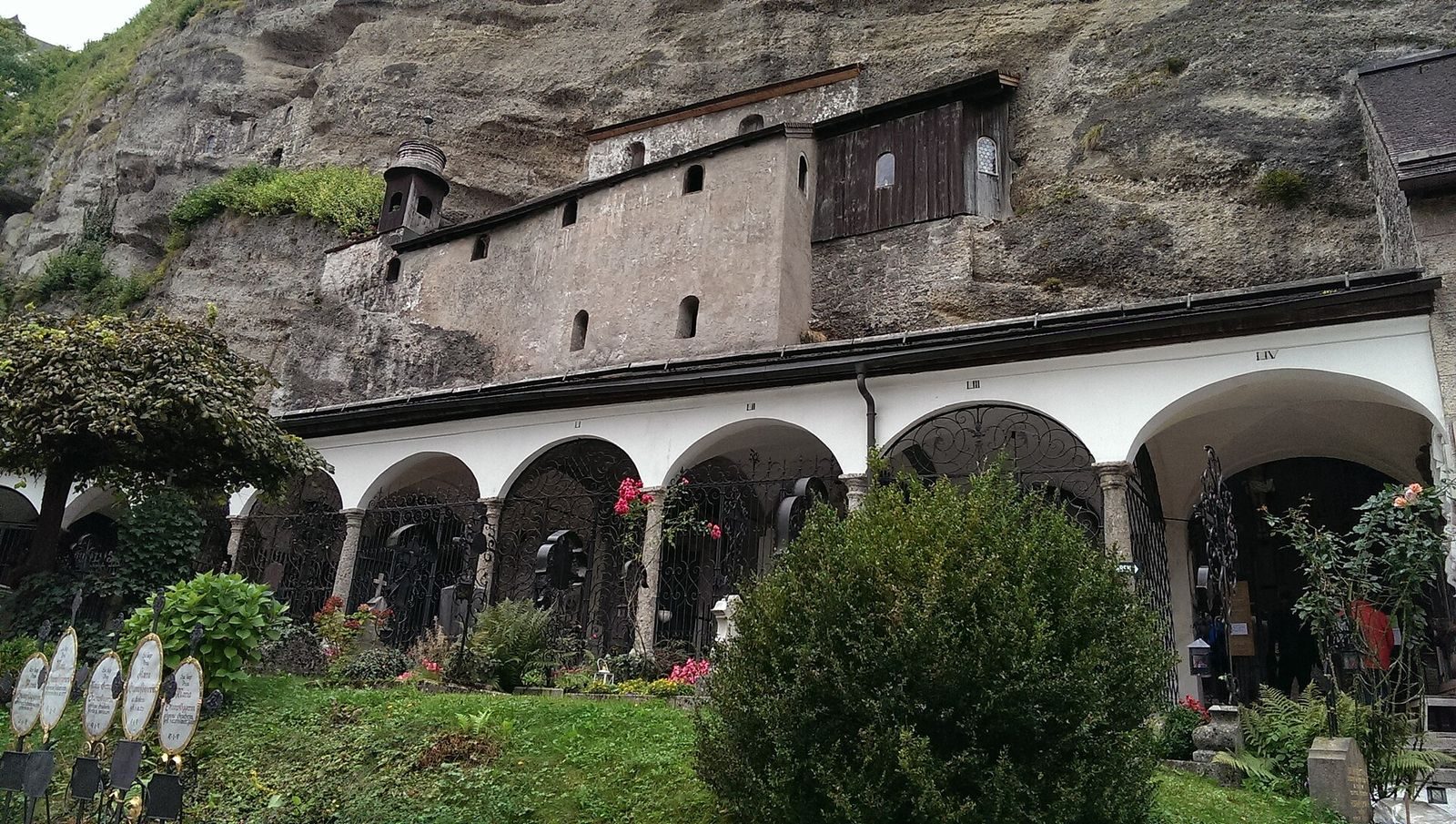
The Salzburg Catacombs are a cave complex above St Peter’s Cemetery in Salzburg, Austria. Their beginnings are traditionally linked to Iuvavum, the Roman city on the site of modern Salzburg. The caves are generally placed in the early Romanesque period, though their origins are also thought to reach back to late antiquity or the early Christian era.
Despite the name, the caves were probably places for Christian gatherings rather than burial chambers. They are identified with the hermitage of St Peter’s Abbey, where hermits sheltered in the rock. The cemetery beside them may be among Salzburg’s oldest Christian burial places, together with the cemetery of Nonnberg Abbey.
Twelfth-century dedications
In 1178, Cardinal Konrad III of Wittelsbach, who was also Archbishop of Salzburg, requested that the Gertrude Chapel be dedicated to Thomas Becket. Becket, the Archbishop of Canterbury, had been murdered eight years earlier. Konrad also associated the chapel with St Gertrude of Nivelles, an early medieval abbess venerated as a saint. The chapel continues to be used for worship.
The Maximus Chapel was consecrated by Konrad in 1178. Its dedication to St Maximus arose from a mistaken connection with St Maximianus of Ioviacum, a Roman fort at Schlögen on the Danube.
The Maximus legend
Between 1525 and 1535, Kilian Püttricher, abbot of St Peter’s, promoted a story that placed a martyrdom in the caves in 477. He claimed that the priest Maximus and his companions remained there as Roman forces withdrew from Noricum, a Roman province in the eastern Alps and nearby parts of central Europe. According to the tale, Severinus of Noricum warned them to leave, but Maximus stayed with 55 companions. After a Germanic siege, they supposedly leapt to their deaths from the caves.
The story is now discredited. Püttricher confused Ioviacum with Iuvavum, and Maximus with Maximianus of Ioviacum. The account of Severinus’s life places Ioviacum at Schlögen, not Salzburg. Püttricher also commissioned a memorial tablet to establish the tale as part of Salzburg’s early Christian history.
Remains
The cave system occupies the conglomerate rock of Mönchsberg. Conglomerate is rock formed from rounded stones cemented together. Three chapels are identified: Aegidius, Gertrude, and Maximus. Small openings in the rock admit light, while a lower area exposed by a rockfall was later closed with a wall.
Access and layout
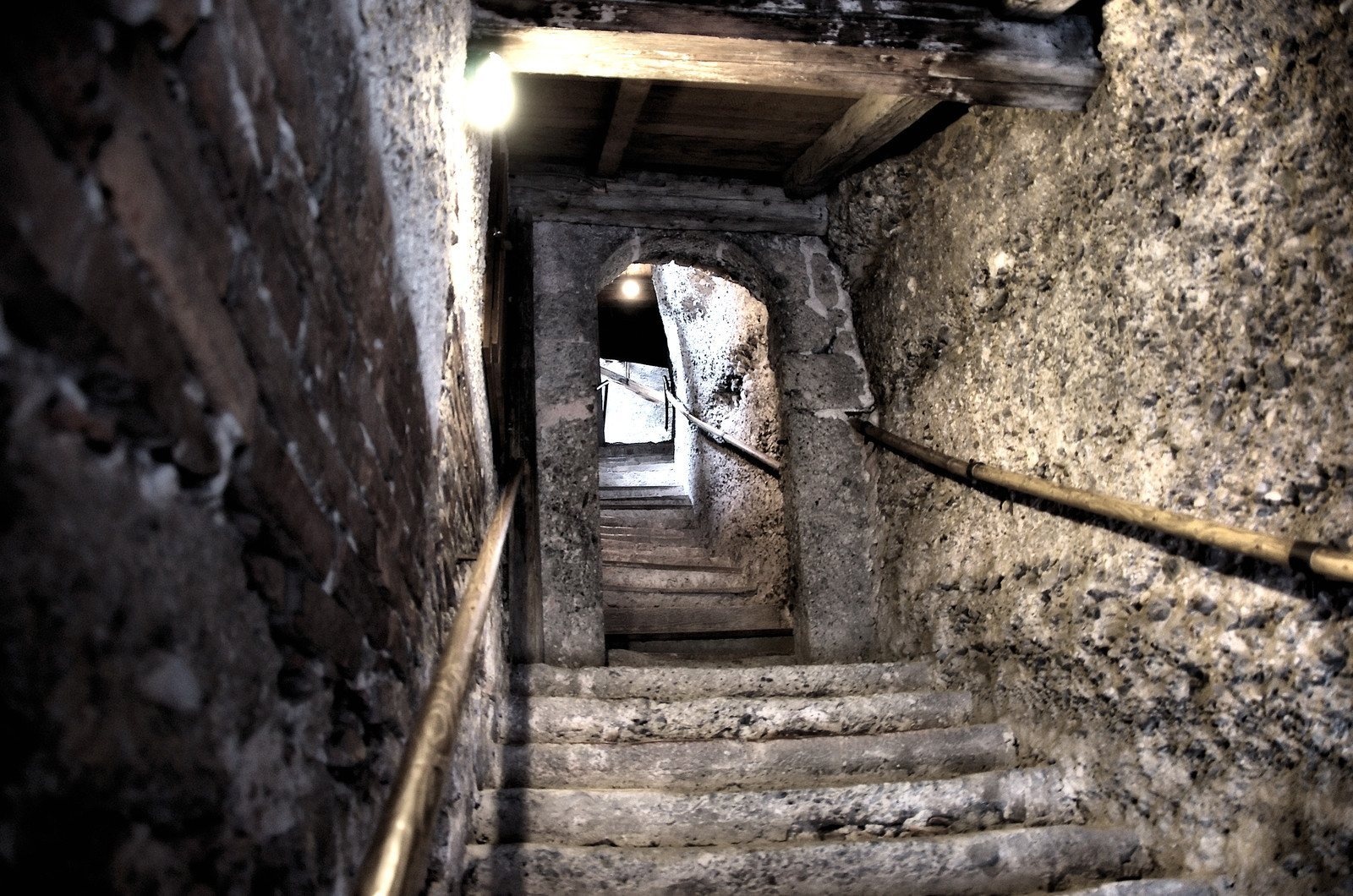
The entrance passes through the raised communal crypt, where Mozart’s sister Nannerl, composer Michael Haydn, and architect and master builder Santino Solari are buried. From there, a marble doorway leads through a Baroque nave (the main hall of a church) and a Romanesque choir (the area used by clergy during worship) to the Aegidius Chapel. A flight of 48 irregular steps reaches the first cave. The Gertrude Chapel lies to the right, toward the northwest; a path to the left leads to a small platform overlooking the Old Town. From the platform, 36 further steps, cut into the rock in 1659, ascend to the Maximus Chapel. Before these steps were made, access to that chapel was by a narrow rock path. A small door at the stairway’s top remains from the earlier arrangement.
The cave chapels
Gertrude Chapel
The Gertrude Chapel occupies a natural cave, whose sagging ceiling preserves its rocky character. A small pitched roof and bell turret stand on the side facing away from the mountain. The roof is above a cave exposed by a rockfall in the monastery precinct during the twelfth century.
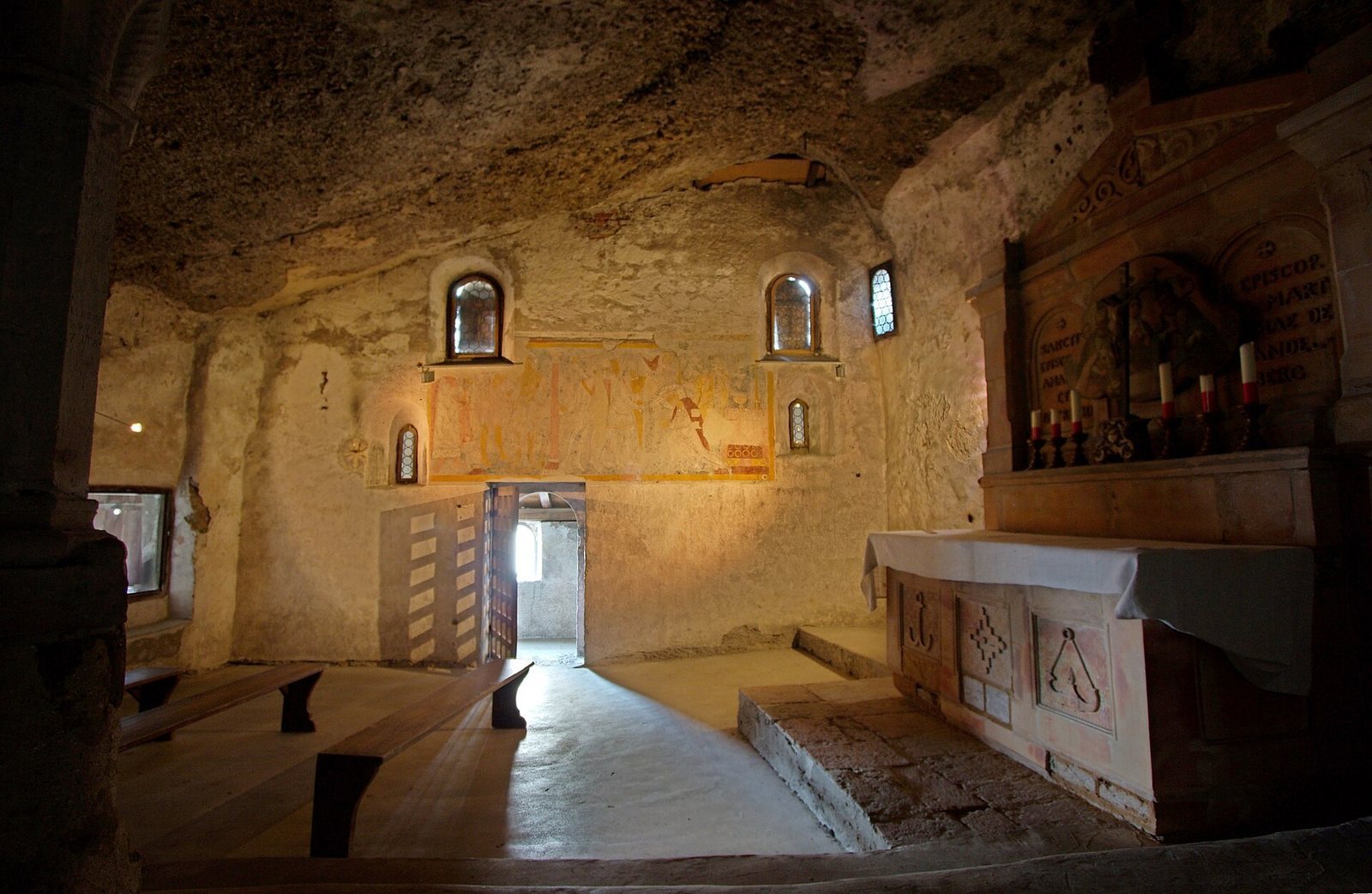
Six round-arched niches were added in 1865 to designs by Salzburg monument conservator Georg Pezolt. They follow a historicizing style, reviving forms from earlier periods. Pezolt also designed a Romanesque-Gothic altar of clay tiles, installed in 1862 and blending two medieval architectural styles. A Romanesque-Gothic pillar inserted in the seventeenth century stands at the room’s center. Though it appears to support the structure, it is decorative.
Maximus Chapel
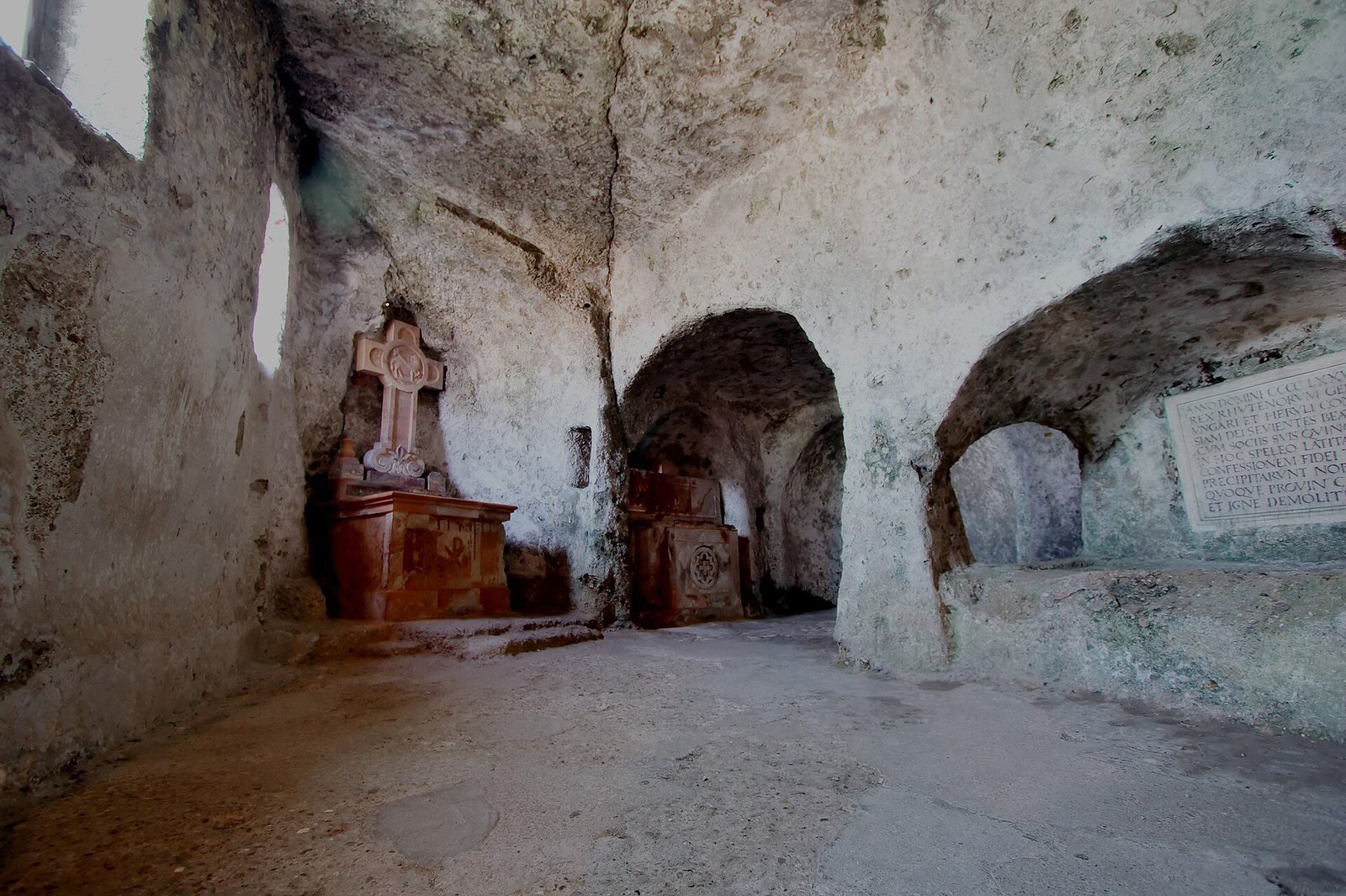
The Maximus Chapel, also called the Maximus Cave, is the highest of the three chapels. An arched grave above which the memorial tablet was placed served hermits as a place to lie. Abbot Kilian had the tablet installed to commemorate the supposed martyrdom. Its inscription dates the event to 477, claims that Maximus and fifty companions leapt from the cave for their faith, and says that Noricum was devastated by fire and sword. It describes Odoacer as king of the Ruthenians, Gepids, Goths, Hungarians, and Heruli. Odoacer was a Germanic ruler who became king of Italy in the late fifth century.
After a rockfall, a wall was built across the cave’s outward-facing opening. It contains three round-arched windows. Inside are a niche and a round apse, a recess at the end of a church. The clay altars were made in 1860 to Pezolt’s designs.