Grzybnica Cemetery: A Wielbark Culture Burial Ground in Poland
Site at a Glance
- Rating
- 4.8
- Popularity
- High
- Country
- Poland
- Primary era
- Classical
- Eras represented
- Classical
- Civilizations
- Unclassified
- Site type
- Burial
- Remains
- Necropolis
On this page14 sections
History
Grzybnica Cemetery is a burial ground near Grzybnica in Manowo municipality, Poland, dating from the first to third centuries AD. Its grave furnishings are assigned to the Wielbark culture, an archaeological culture associated with Gothic presence in Pomerania from the late first century through the late second or early third century AD. The cemetery’s stone monuments are attributed to the Goths, a people of Germanic origin.
Use and interpretation
The purpose of the stone circles is uncertain. The prevailing interpretation sees them as places for local gatherings, while another proposes that the stone pavements were used for sacrifices. The burial mounds are interpreted as elite graves.
Rediscovery and archaeological work
Local people knew the area before the Second World War but mistakenly regarded it as a Jewish cemetery. Polish archaeologist Ryszard Wołągiewicz identified the archaeological site in April 1974 and led work there from 1974 to 1986, covering about three hectares. After excavation, the badly deteriorated burial mounds were restored to their earlier condition. An archaeological reserve was established in 1979; preparation included lowering the ground to its original level, thinning the trees, and installing information boards.
A buttercup in the Ranunculus auricomus group, found at a nearby West Pomeranian locality, was named in honor of Amalasuntha, a Gothic queen, because of its proximity to the cemetery.
Remains
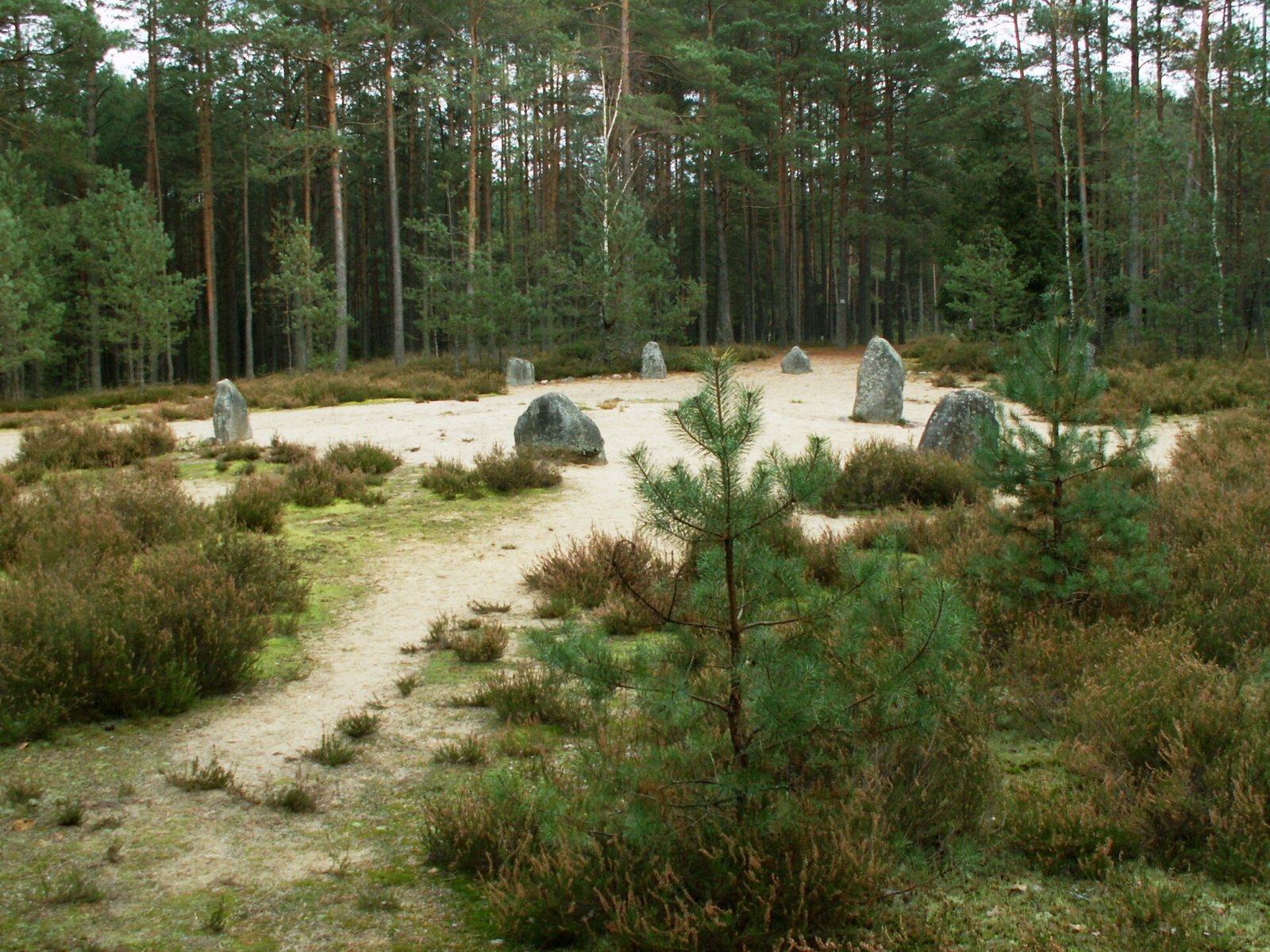
Set on a plain enclosed by the Radew River valley and surrounded by coniferous woodland, the cemetery combines circles of upright boulders with stone-covered mounds, ground-level pavements, graves, and cremation structures. It lies about 2.5 km north of Grzybnica village, 3 km east of Mostowo, and 20 km southeast of Koszalin. The remains also include a double ring of fieldstones and grooves containing traces of burning.
Stone circles
Circles 1 and 2
Circle 1 measures 36 m across. Of its original 33 upright boulders, 20 survive; they stand 1.2 to 1.5 m high and are spaced about 3.5 m apart. Some show signs of shaping, and small fieldstones ring each boulder’s base. Inside the circle were a stele, an upright stone marker, a triangular pavement, and two cremation pyres.
Circle 2 is also 36 m in diameter, with 16 surviving boulders set about 3.5 m apart. Small stones encircle each boulder, with further stones placed between the larger ones along the ring. A stone-covered mound, about 5 m across, stands at the center and contains a pit cremation burial. Four stelae and a cremation pyre were found nearby.
Circles 3 and 4
Circle 3 is 13 m in diameter. Four of its original 13 boulders remain, surrounded by small stones; at the center are a shaped stele and an inhumation grave, meaning a burial of an uncremated body. Circle 4 is 7 m across and originally had six boulders spaced about 3.5 m apart, with a central stele.
Circle 5
Circle 5 is 15 m in diameter and originally comprised 12 boulders. It lies about 200 m north of the other circles.
Mounds and pavements
Burial mounds
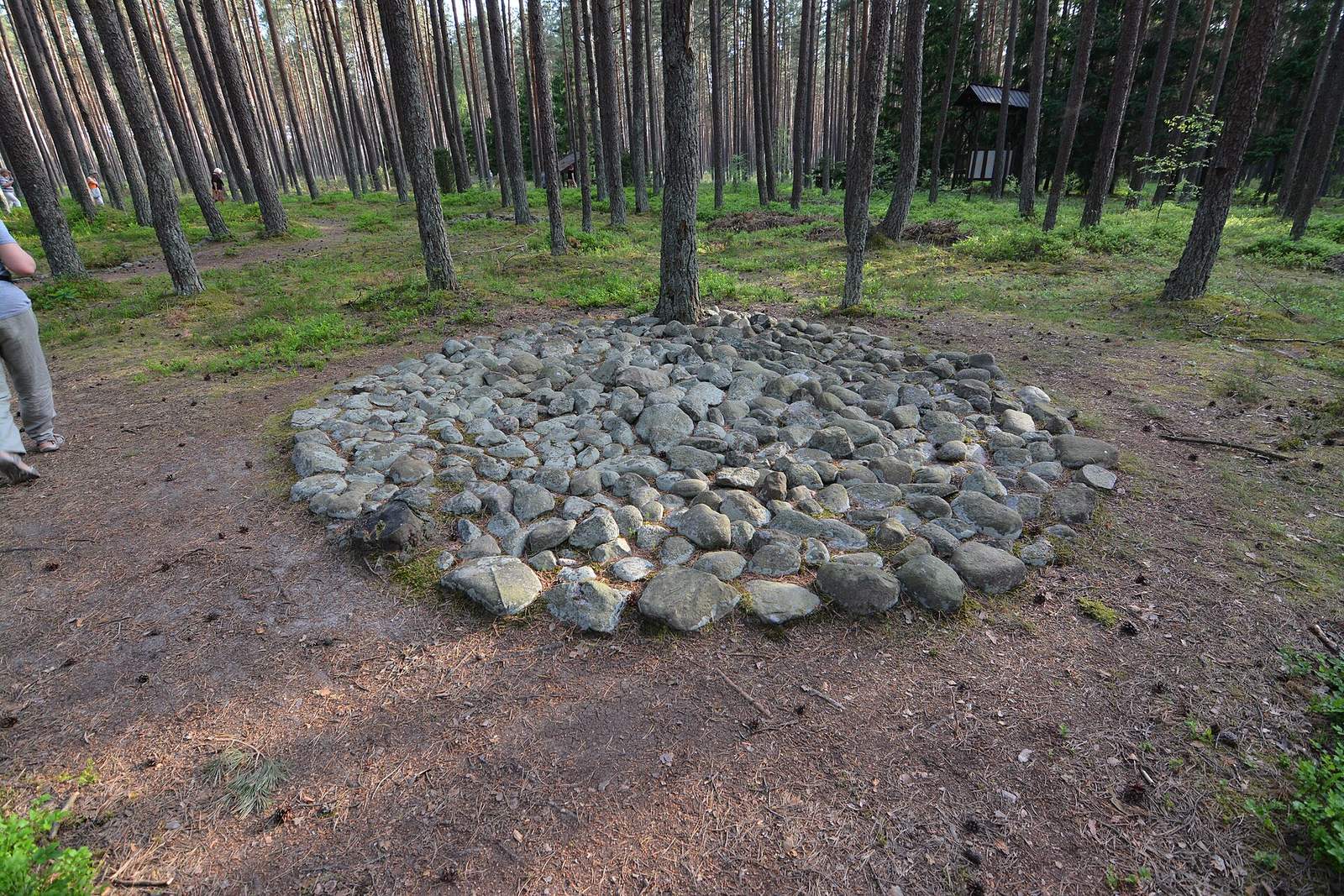
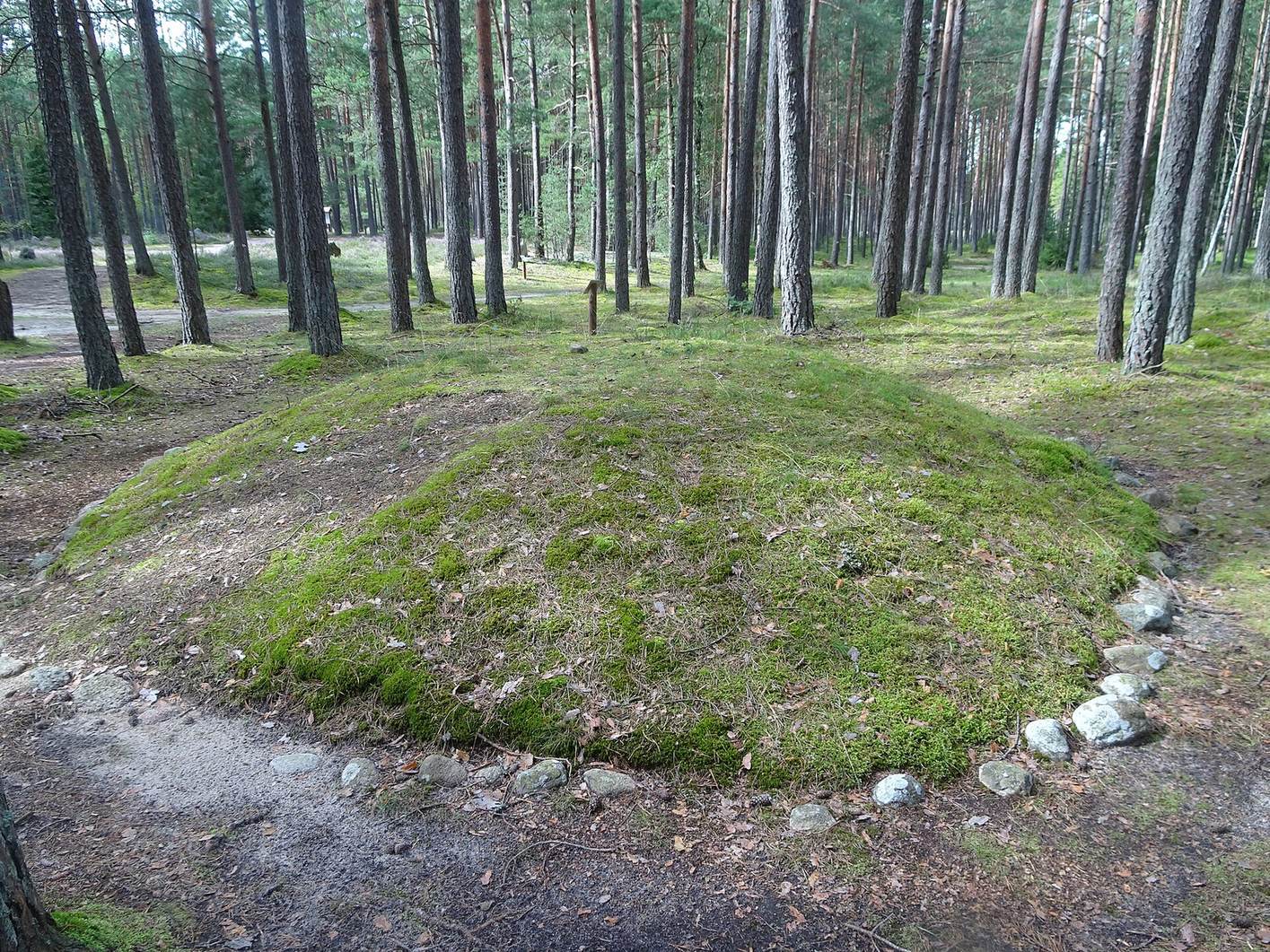
Two burial mounds survive. One, 6 m wide at its base, was built over a single-layer stone pavement. Beneath the pavement was an inhumation grave containing a woman, dated to the last quarter of the first century AD. The other mound used a natural rise about 0.5 m high. A grave was dug into the rise, and the whole feature was covered with stone paving.
Flat and triangular pavements
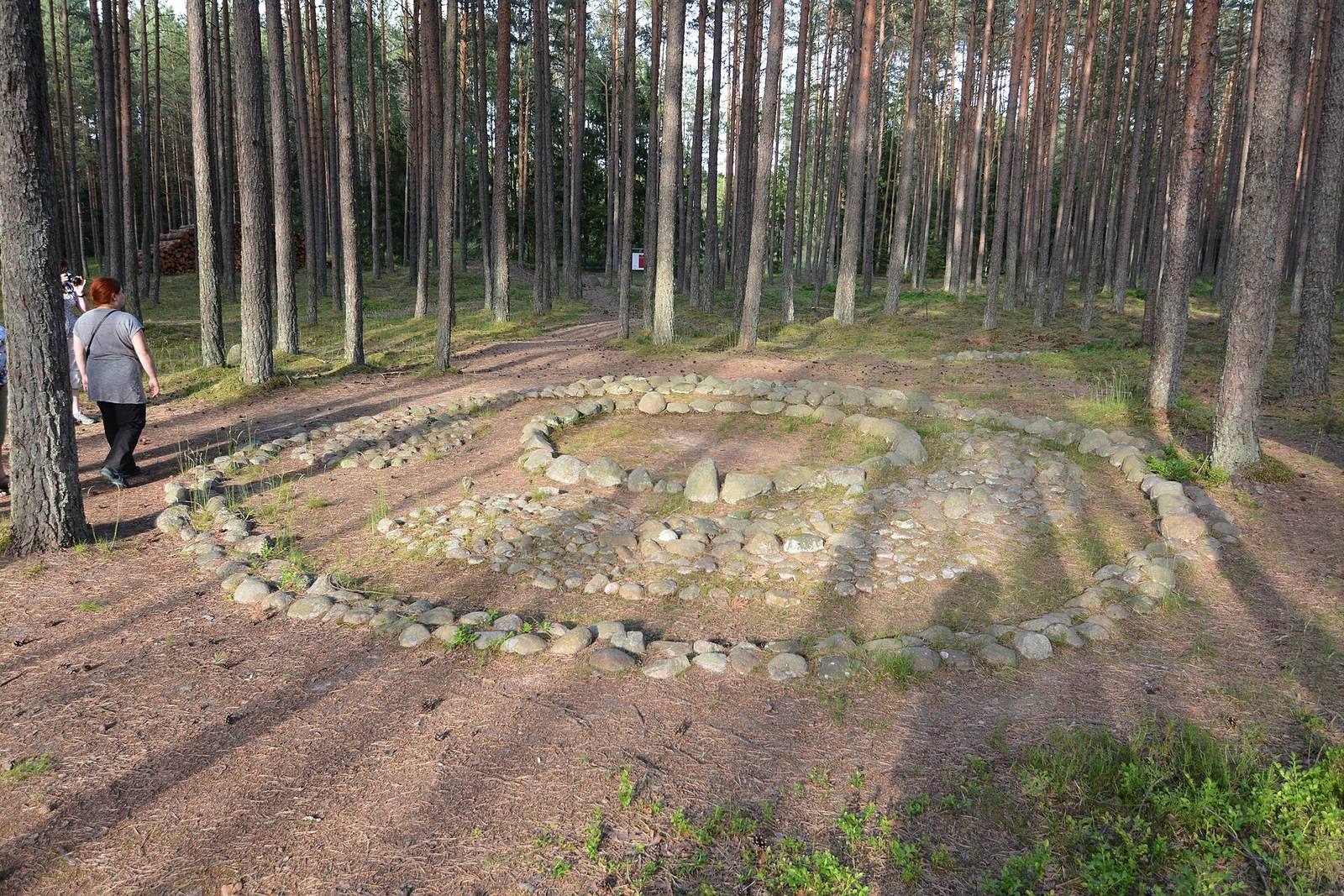
The 14 flat circular pavements measure 5 to 12 m across. Built in a manner resembling stone-and-earth burial mounds, they remain level with the surrounding ground. Some have two concentric inner stone rings and an outer ring, joined by radial stones in a spoke-like pattern. The 12 smaller flat pavements lie over cremation and inhumation graves. Those above inhumation graves are rectangular and match the dimensions of the grave pits.
The two triangular pavements have two equal sides of about 3.5 m. Their bases measure 2.3 m and 3 m respectively.
Burials and cremation features
Burials
The cemetery contains 101 inhumation and cremation burials. Inhumations often used hollowed tree trunks, while cremated remains were most commonly placed in pits without urns. Female graves contain substantially richer furnishings than male graves. Finds include brooches, buckles, glass or amber beads, bracelets, hairpins, combs, needles, and clay vessels.
Cremation pyres
The six cremation pyres measure about 2.5 by 1.5 m. Three were within stone circles and three outside them. Each structure, on which a body was burned, was covered by stones ritually thrown over it.