St Peter’s Archabbey Salzburg: A Benedictine Monastery in Austria


Site at a Glance
- Rating
- 4.6
- Popularity
- Medium
- Country
- Austria
- Primary era
- Medieval
- External website
- Open
- Eras represented
- Classical, Medieval, Early Modern
- Civilizations
- Duchy of Austria, Duchy of Bavaria, Holy Roman Empire, Roman
- Site type
- Religious
- Remains
- Monastery
On this page17 sections
History
St Peter’s Archabbey Salzburg is a Benedictine monastery in Salzburg, Austria, with origins around 696 and a present abbey church that retains a Romanesque core. Traditionally regarded as the oldest continuously existing monastery of the Austrian Benedictine Congregation and of the wider German-speaking area, it remains a principal house of the congregation. Its monks follow the Rule of Saint Benedict, the sixth-century code governing communal prayer, discipline, and work.
Late Antique foundations and the early monastery
Saint Rupert, a missionary bishop traditionally regarded as the founder of Salzburg’s Christian ecclesiastical centre, founded or renewed St Peter around 696 as a base for missionary work in the Eastern Alps. Beneath the altar of the present church are wall remains dated to the fifth century. They indicate that a church and probably a small monastic community already occupied the site during the period associated with Saint Severinus, a late-antique Christian missionary connected with the Noricum region. Rupert is said to have renewed and enlarged this earlier foundation.
Until 987, Salzburg’s bishop and the monastery’s abbot were the same person, an arrangement known as a personal union. Although the offices were separated in that year, St Peter continued to serve as the residence of Salzburg’s archbishops until 1110. This connection placed the monastery at the centre of the ecclesiastical government of Salzburg during its formative centuries.
Medieval learning and expansion
During the Middle Ages, St Peter developed an important school and a scriptorium, a room where manuscripts were copied and produced. The abbey also held extensive possessions and occupied a central position in the religious and economic life of the region. It became the mother house of Admont Abbey in Styria, sending twelve monks there in 1074 to establish monastic life.
The present church grew from a new building constructed between 1125 and 1143 and consecrated in 1147. From 1130 to 1583, the women’s convent known as the Petersfrauen formed a double monastery with St Peter. In the fifteenth century, the abbey adopted the Melk Reform, a movement that sought stricter Benedictine observance, discipline, and communal religious life.
Early modern institutions and reform
St Peter belonged to the Salzburg Congregation from 1641. That congregation was incorporated into the present Austrian Benedictine Congregation in 1930, of which St Peter is the principal house. The monastery’s educational role also continued into the early modern period. Archbishop Paris von Lodron founded the Benedictine University of Salzburg in 1622, and the university remained closely connected with St Peter through its institution and its Benedictine professors until it was dissolved in 1810.
The abbey’s intellectual and religious work expanded again in the twentieth century. In 1926, Abbot Petrus Klotz promoted the foundation of Kolleg St. Benedikt, a Benedictine study college at St Peter. The college formed part of the efforts that eventually led to the re-establishment of the University of Salzburg. In 1927, the monastery was elevated to the rank of archabbey, an abbey whose abbot is an archabbot and normally has precedence within a monastic congregation.
Economic, musical, and liturgical life
St Peter also played a major economic role in Salzburg. Between 1137 and 1143, the abbey and Salzburg’s cathedral chapter excavated a tunnel through the Mönchsberg. Together, and later with the archbishop, they administered the Alm Canal. The abbey participated in the development of the salt works around Salzburg and operated in mining and metal production. Its activities over time included salt production, mining, agriculture, forestry, wine estates, gardening, a bakery, a water mill, publishing, and property management.
The Stiftskulinarium within the monastery walls is named in a deed of 803 and consequently claims to be the oldest restaurant in Central Europe. Music has likewise remained part of the abbey’s institutional life. The Stiftsmusik and Stiftskantorei contribute to liturgical celebrations and perform works by Haydn, Mozart, and other composers. Mozart’s Great Mass in C minor was probably intended for a first performance at the abbey on 26 October 1783, with Constanze Mozart as soprano soloist, but he left the work incomplete.
Twentieth-century disruption and continuing work
Under Nazi rule, the monastery was seized on 6 January 1941 and progressively expropriated. Almost all of the monks were expelled, but the community was not canonically dissolved. Most of the monks returned in 1945, allowing monastic life to resume after the war.
In 2000, the Salzburg Abbots’ Conference established the Institute for Benedictine Studies at St Peter to research the Rule of Saint Benedict and provide monastic courses for German-speaking Benedictines. Michaela Puzicha directed the institute until it closed after her retirement in 2022. St Peter had already been an early centre of the liturgical revival in Austria, and its Liturgical Institute was affiliated with the Austrian Bishops’ Conference in 2001 and based at the archabbey.
Korbinian Birnbacher was elected archabbot on 30 January 2013 and received the abbatial blessing on 21 April that year. Prior Jakob Auer, his predecessor’s deputy, was elected archabbot on 15 February 2025 and took office on 12 April 2025. The community comprised 23 monks in April 2025. The entire complex, covering the buildings numbered 1 to 10 in St Peter District, is under national monument protection. Since 2014, selected holdings and artworks from the abbey, library, and archive have been presented in Museum St Peter within the DomQuartier Salzburg museum complex.
Remains
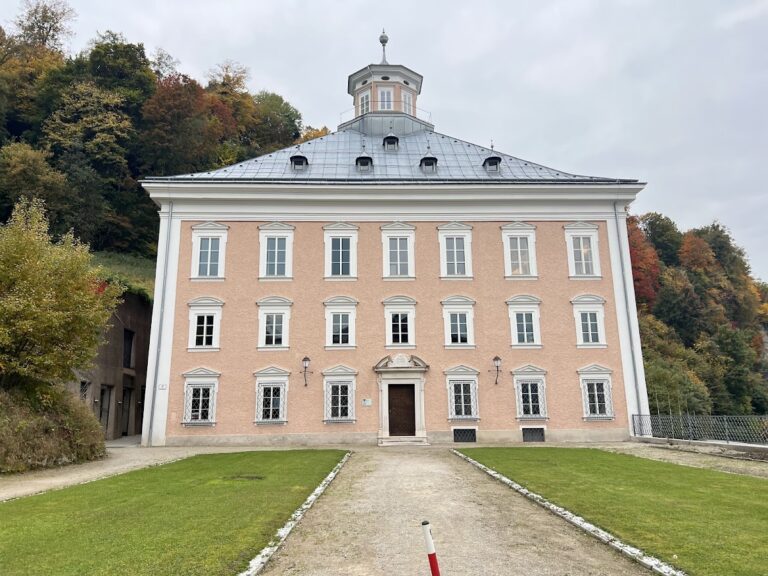
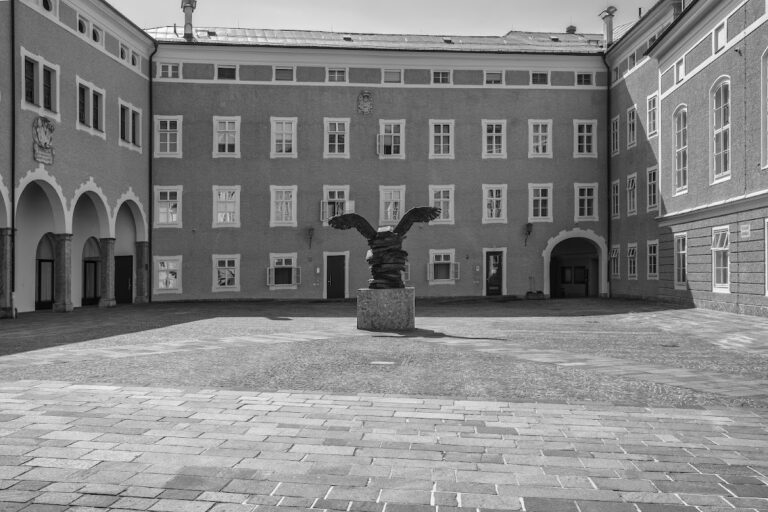
St Peter’s surviving complex stands at the northern foot of the Mönchsberg and combines a Romanesque church core with later Gothic, Renaissance, Baroque, and Rococo additions. The precinct includes the abbey church, chapels, the Petersfriedhof cemetery, rock-cut worship spaces, a cloister, an interior courtyard, a fountain, and a sundial on the courtyard facade. The monastery’s library, archive, collections, and economic premises preserve further evidence of its long institutional history.
Abbey church and chapels
Abbey church
The first abbey church was built around 696 when Rupert renewed the late-antique community and its church. The present structure retains the core of the church built between 1125 and 1143 and consecrated in 1147. Its massive tower contains a ninth-century core and was raised in Romanesque form around 1400. Heinrich Traxdorf of Mainz installed the main organ on the rood screen, the partition between the nave and sanctuary, in 1444, while Gothic rib vaults survive in the narthex, the entrance hall at the western end.
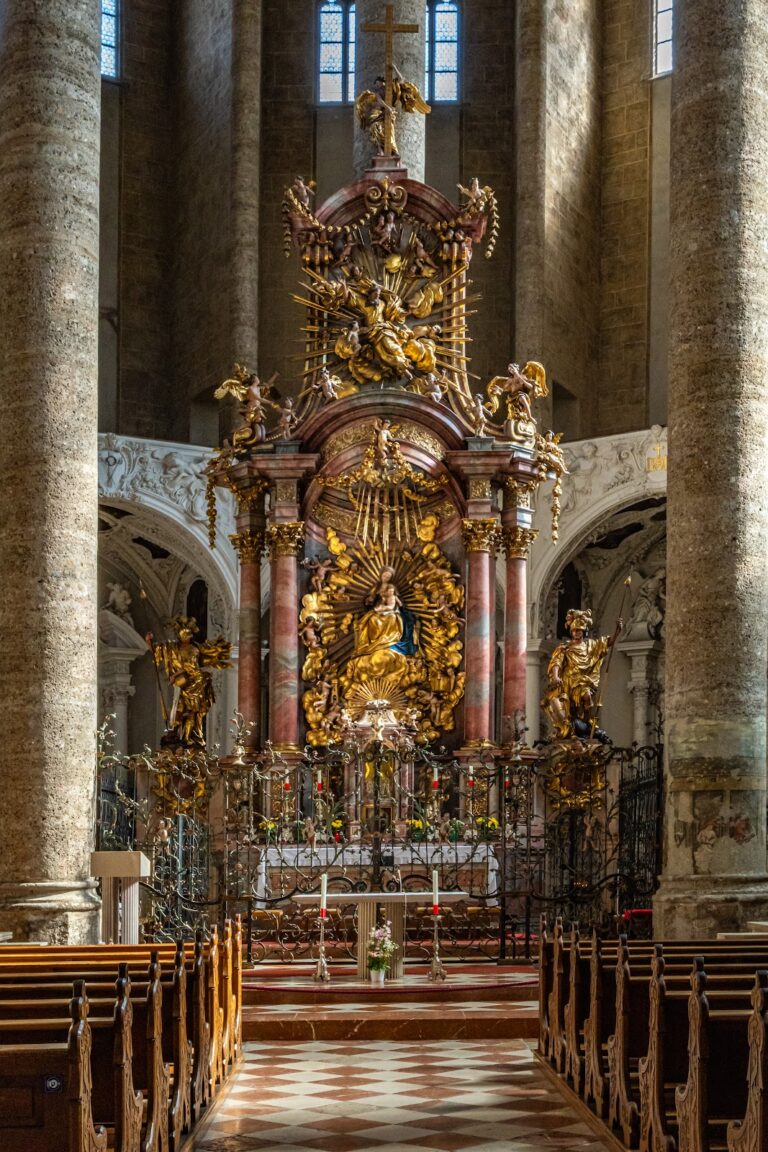
The church was remodelled in Renaissance style in 1605 and 1606, vaulted in 1619 and 1620, and given a slender crossing dome in 1622. In 1756, under Abbot Beda Seeauer, the tower received its distinctive Rococo or Baroque onion-shaped roof. Between 1760 and 1766, Franz Xaver König, Lorenz Härmbler, Johann Högler, Benedikt Zöpf, and others redecorated the interior with Rococo stucco and ceiling paintings. The Romanesque structural form remains legible beneath this later decoration. Philipp Hinterseer made the elaborate Rococo grille.
The two high altars are substantially the work of Martin Johann Schmidt, known as Kremser-Schmidt. The Marian Column altar contains a Madonna dated 1425. The church also includes the Wolfgang Chapel, where the Holy Sepulchre is installed, and the Chapel of the Holy Spirit, now used as a candle chapel.
Catherine Chapel
The small Catherine Chapel, also called the Mariazell Chapel, was founded by Duke Leopold VI in 1215. Attached to the southern arm of the church’s transept, it was consecrated in 1227. Its groin vaults and Rococo stucco, executed by Peter Pflauder in 1792, show how the medieval chapel was adapted to later decorative taste.
Mary Chapel
The nearby Mary Chapel, formerly the St Vitus Chapel, is incorporated into the monastery precinct and retains its Gothic character. It is described as probably the oldest surviving Gothic building in Salzburg. The monks use it for the Liturgy of the Hours, and the tomb of Abbot Johannes Staupitz, an Augustinian friar and theologian who died in 1524, is located there.
Petersfriedhof and rock-cut chapels
Petersfriedhof
The Petersfriedhof, the cemetery associated with the abbey, was probably established around the foundation of the monastery and was first documented in 1139. Its oldest preserved graves date from 1288 and 1300. The cemetery contains chapels, arcades, monuments, and maintained graves, including the burials of Maria Anna Mozart and Johann Michael Haydn.
Rock-cut worship spaces
The cemetery’s so-called catacombs are prayer and worship spaces carved into the conglomerate rock of the Festungsberg. The term is not strict in its archaeological sense, since these spaces are not underground catacombs. The rock complex probably preserves traces of a Late Antique early Christian place of assembly and hermitage. It includes the St Gertrude Chapel, whose altar was consecrated in 1178, and chapels associated with Saint Gertrude and the Christian martyr Maximus, consecrated by Archbishop Conrad of Wittelsbach in 1172 and 1178.
Library, archive, and collections
Library and archive
St Peter has the oldest library in Austria. Its approximately 800 manuscripts include the Verbrüderungsbuch, or Liber Confraternitatum Sancti Petri, created in 784 by Bishop Virgil. The library has grown to approximately 100,000 volumes, with major holdings on Benedictine monasticism, medieval Church history, art history, and Salzburg history. Its special collections include incunabula, books printed in Europe before 1501, early printed works, devotional images, graphic works, and maps.
The Upper Library opened to students in 1653 above the medieval Vitus or Mary Chapel, and a second adjoining hall followed in 1660. Around 1700, the seven-room Zellenbibliothek was established one floor below in the passage at Chapter Square. Completed in 1772, it was decorated with ceiling paintings, emblems, mottoes, and abbatial coats of arms. In 1793, the Upper Library held 17,000 volumes and the Lower Library 14,000. Parts of the library were redecorated in Rococo style under Abbot Beda Seeauer in 1768 and restored in 1999.
The archive contains written records from the eighth to the twenty-first centuries. These include approximately 4,300 deeds up to 1700, along with chronicles, diaries, chapter minutes, visitation records, endowments, necrologies, inventories, account books, estate records, administrative files, photographs, maps, and plans.
Art and music collections
The music archive preserves manuscripts and autograph works written in the composers’ own hands by Johann Ernst Eberlin, Anton Cajetan Adlgasser, Leopold and Wolfgang Amadeus Mozart, Johann Michael Haydn, Sigismund von Neukomm, Robert Führer, and Karl Santner. St Peter’s wider collections include paintings, church treasures, artworks, minerals, furniture, musical instruments, coins, natural-history objects, devotional images, photographs, and graphic works. More than 35 paintings by Kremser-Schmidt are preserved at the abbey, together with liturgical vessels, pontifical objects, and reliquaries.
The tenth-century Bursa Reliquary, formerly part of the abbey treasury, was sold during the global economic crisis and is now held by the Metropolitan Museum in New York. Within the monastery walls, the Stiftskulinarium occupies its historic premises, while a bakery and other economic installations preserve the material setting of the abbey’s continuing and historical operations.
Nearby sites