Castle of Serpa: A Frontier Fortress in Portugal
Site at a Glance
- Rating
- 4.5
- Popularity
- Medium
- Country
- Portugal
- Primary era
- Medieval
- Eras represented
- Medieval, Early Modern
- Civilizations
- Portuguese
- Site type
- Military
- Remains
- Castle
On this page15 sections
History
The Castle of Serpa is a fortified complex in Serpa, Portugal, whose medieval reconstruction began under King Dinis in 1295 after an earlier Muslim fortification. The site had already been occupied in prehistoric times and was later Romanized, when Serpa lay beside the road from Beja to southern Hispania. Its position made it part of a frontier landscape shaped by successive military powers and by the changing boundaries of Portugal.
From prehistory to Muslim rule
Serpa was occupied before the Roman period and was already known by that name when it became part of the Roman world. A Roman fortification is believed to have guarded this section of the road. After the fall of the Roman Empire, the area passed successively through the hands of the Alans, Vandals, Sueves, and Visigoths. From the eighth century onward, Muslim rulers occupied Serpa and strengthened its defenses.
The Christian reconquest and royal rebuilding
During the Reconquista, the prolonged Christian conquest of territories ruled by Muslim powers in the Iberian Peninsula, Serpa was captured in 1166 during an incursion beyond the Guadiana. The attack was led either by Afonso Henriques, Portugal’s first king, or by Geraldo Sempavor. Almohad forces, belonging to the North African Muslim dynasty that controlled parts of Iberia during the twelfth and thirteenth centuries, restored Muslim control in 1191. Sancho II’s forces reconquered the town in 1232, and its domains were assigned to Fernando, the king’s brother.
After Afonso III completed the conquest of the Algarve, Serpa and the lands beyond the Guadiana became the subject of a dispute with Alfonso X of Castile and León. The territory was ceded to Alfonso X in 1271 and transferred in 1283 to his daughter Beatrice, the widow of Afonso III and mother of Dinis. Following the rectification of the frontier, Serpa received its first charter in 1295, with privileges equivalent to those of Évora.
The rebuilding of the former Muslim fortification began under King Dinis, who ruled Portugal from 1279 to 1325. The new work incorporated sections of the earlier rammed-earth walls. In 1320, the Order of Avis, a Portuguese military-religious order, assigned one-third of the revenues from the churches of Moura and Serpa to the rebuilding and maintenance of the castles. The chronicle of Rui de Pina places Serpa among the towns whose citadel and castle Dinis built from their foundations.
Frontier warfare and royal administration
During the crisis of 1383–1385, which settled the Portuguese succession and brought the Master of Avis to the throne as King John I, Serpa and its castle supported the Master’s cause. The town served as a base for Portuguese military incursions into Castilian territory.
At the Portuguese Cortes, representative assemblies convened by the monarch, in 1455, the inhabitants attributed a decline in population to wars and epidemics. They requested that future residents be exempted from military and municipal services for twenty years. Afonso V granted the privilege only to foreigners and reduced its duration to ten years.
Under Manuel I, Duarte de Armas portrayed Serpa in the Book of Fortresses, compiled around 1509. His drawings show cylindrical and quadrangular towers, a prominent keep, and the settlement below enclosed by two lines of walls. In 1513, Manuel granted the town a new charter and assigned Serpa and its castle to his son Luís, Duke of Beja.
Spanish occupation and early modern fortification
During the Portuguese succession crisis of 1580, a weakly garrisoned Serpa and its castle fell to Spanish forces commanded by Sancho Dávila. After Portugal restored its independence in 1640, João IV granted the town and castle to the Infante Pedro in 1641. They thereby entered the House of the Infantado, a royal apanage associated with members of the Portuguese royal family.
During the Restoration War, the conflict surrounding Portugal’s renewed independence, Serpa was modernized under a project by the architect Nicolau de Langres. The planned bastioned fortress, a defensive system using projecting angular platforms for artillery, was never completed. Its partial realization was the Fort of São Pedro de Serpa, completed in 1668.
Serpa was occupied during the War of the Spanish Succession. When Spanish forces commanded by the Duke of Osuna withdrew in 1707, the castle’s powder magazine exploded and destroyed one of its towers. By 1870, deterioration had caused major collapses in the masonry of the walls and towers.
Protection and conservation
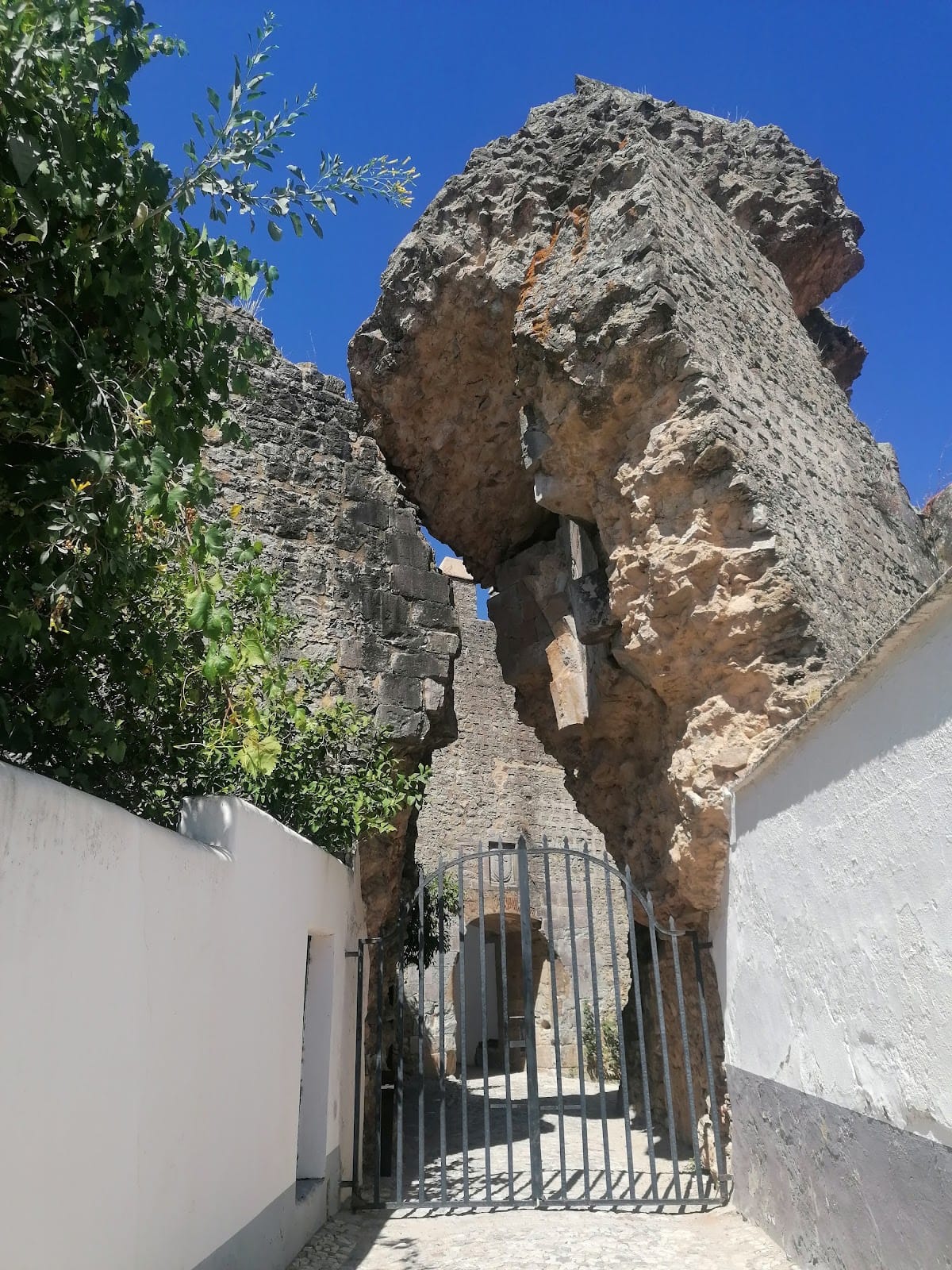
The castle and town walls were designated a National Monument by decree on 30 January 1954. That year, the Portuguese state acquired a section of the walls from the Countess of Cuba. Conservation work began with consolidation of the aqueduct near the Beja Gate in 1958. Buildings were acquired and demolished in 1973 to clear further sections of the walls, while another section on Rua das Varandas was recovered in 1973–1974. Work near the Moura Gate and repairs to the Clock Tower followed in 1974, with further wall repairs in 1977 and interventions in the castle area between 1980 and 1988. Severe storms in 2000 caused the collapse of a section of the walls.
Remains
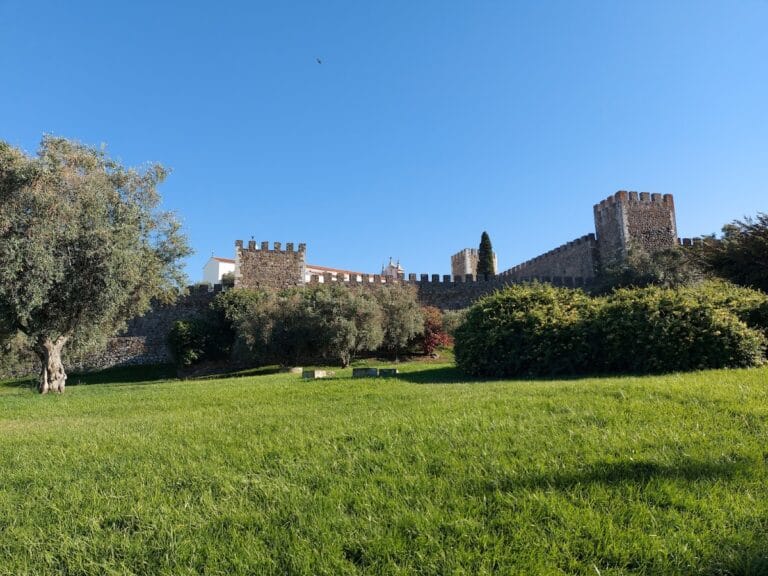
The castle occupies the highest part of Serpa’s historic center, at approximately 230 meters above sea level, in a dominant position over the settlement on the left bank of the Guadiana. Its defensive landscape is associated with the castles of Moura, Mértola, and Noudar. The surviving complex combines a high inner citadel, an oval town enclosure, towers, gates, an aqueduct, and later buildings incorporated into the defenses.
Citadel and town defenses
Alcáçova
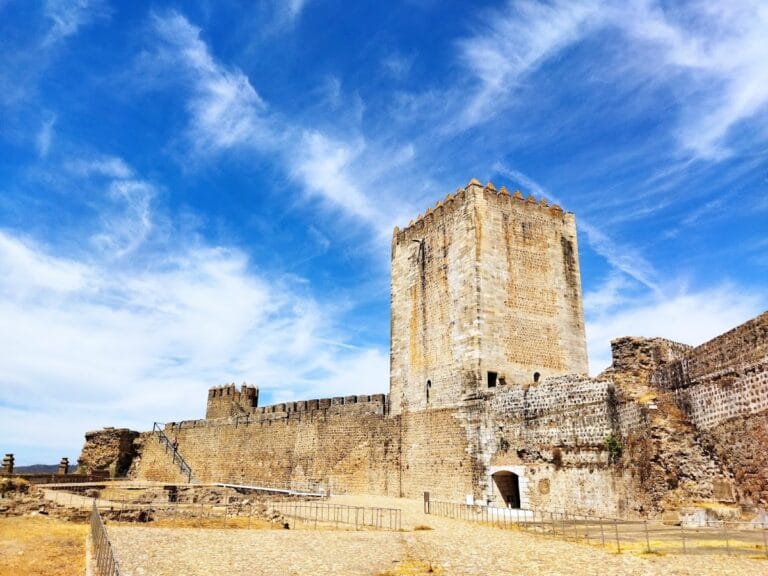
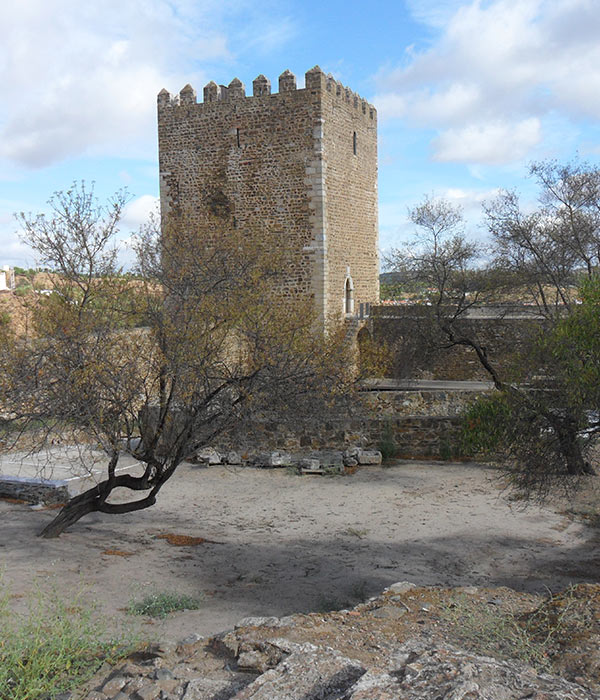
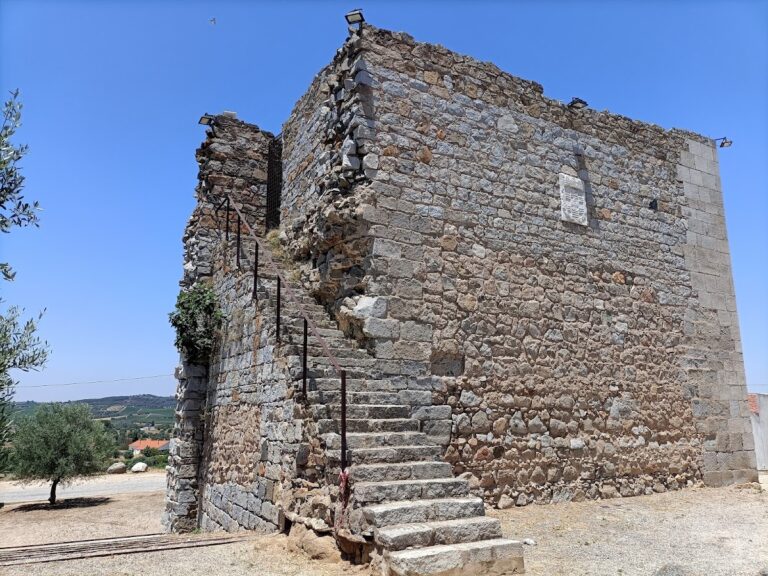
The alcáçova, or fortified inner castle, occupies the highest ground beside the northern wall and has a quadrangular plan. Its defenses include the lower surviving part of a quadrangular keep attached to the southern curtain wall, a semicircular tower on the same side, and a rectangular tower at the southeast corner. Part of the outer defensive work, or barbican, surrounding the southeast tower remains visible.
Town enclosure and gates
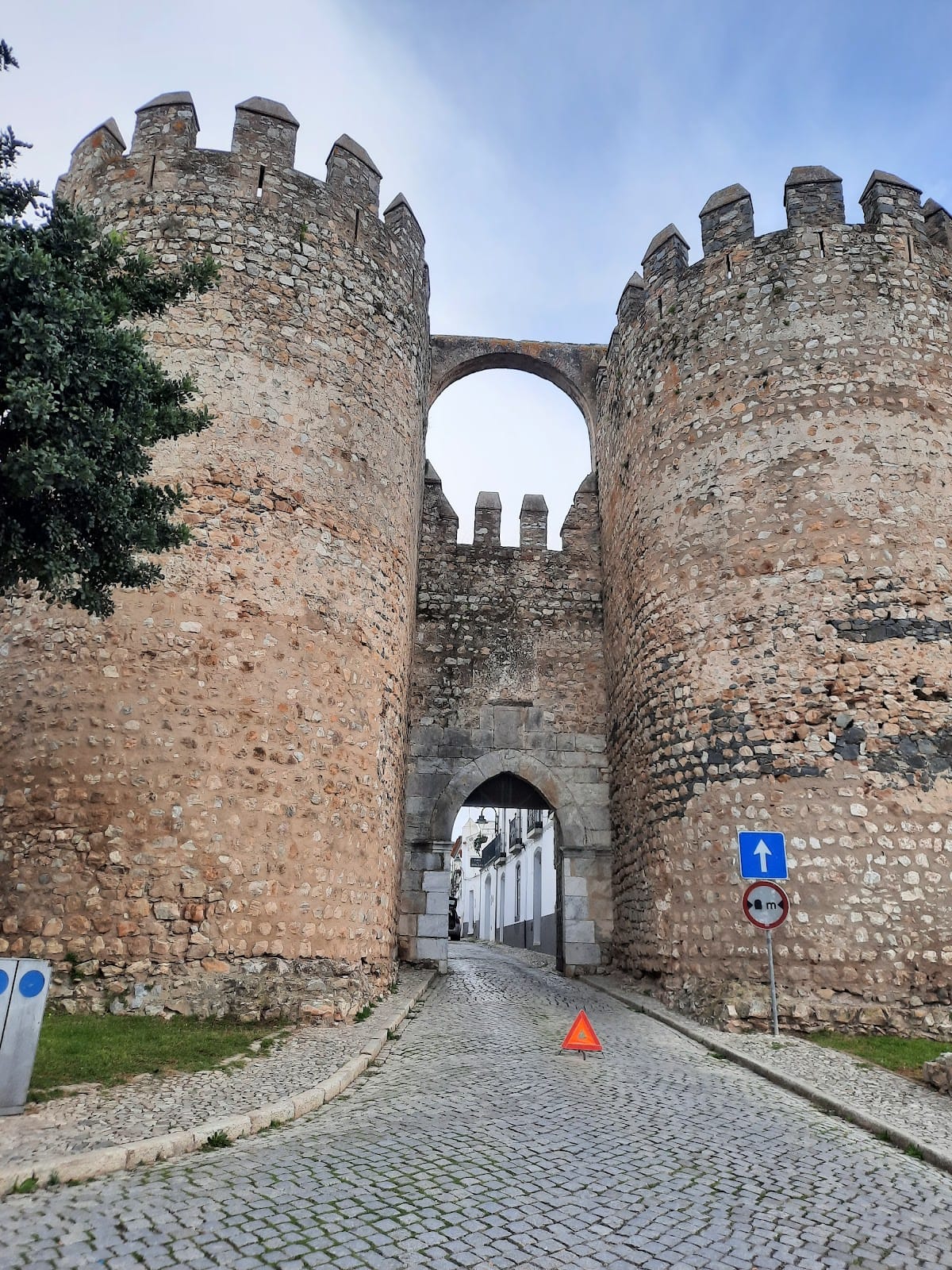
The town enclosure follows an oval plan and is strengthened by square and semicircular towers together with wall turrets. The battlements are crowned with prismatic merlons, the raised solid sections between openings. The original monumental gates were the Moura Gate to the northeast, the Beja Gate to the northwest, and the Seville Gate to the south. The Moura and Beja gates were flanked by pairs of chamfered cylindrical towers whose ends carried pentagonal merlons. The Corredoura Gate and the New Gate were opened later.
Aqueduct and waterwheel
An aqueduct crowns the western wall on a round-arched arcade. It links the Palace of the Counts of Ficalho on the northern side with a large waterwheel positioned over a well near the southeast corner. Built in the seventeenth century, the waterwheel supplied the palace and forms part of the later hydraulic infrastructure integrated with the fortifications.
Buildings within and beside the enclosure
Clock Tower
The Clock Tower stands in the square opposite the Church of Santa Maria, a former Muslim mosque. Square in plan, it incorporates a belfry with conical pinnacles surrounded by chamfered merlons. It originally formed part of the town wall and was converted into a clock tower in 1440. It is described as Portugal’s third-oldest clock tower.
Palace of the Counts of Ficalho
The Palace of the Counts of Ficalho is incorporated into the town walls and was built in the Mannerist style. Construction began under Francisco de Melo, Serpa’s chief castle governor in the late sixteenth century, and continued under his sons, Pedro de Melo and António Martim de Melo.
Archaeological museum
The Serpa Archaeological Museum is installed within the castle enclosure beside the surviving barbican area. Its displays include archaeological remains recovered in the municipality from the Paleolithic, Neolithic, Metal Ages, and Roman periods, extending the history of the fortified site into the earlier occupation of the surrounding area.
Nearby sites