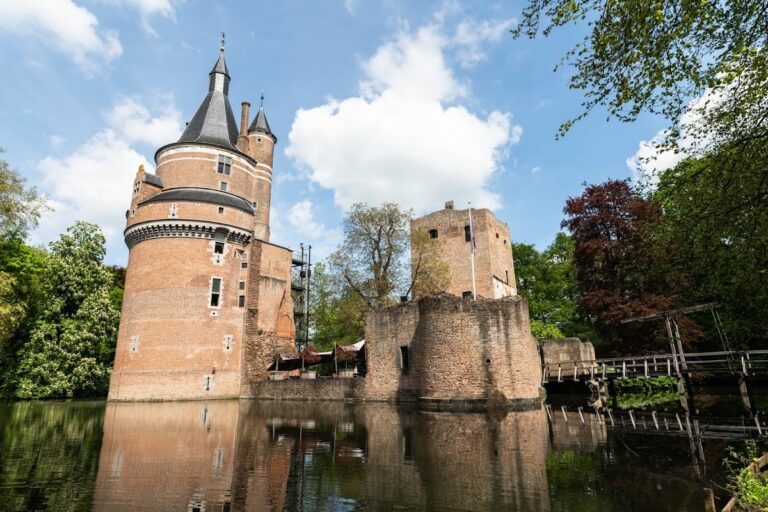
Kasteel Sterkenburg: A Historic Ridderhofstad in the Netherlands


Site at a Glance
- Rating
- 4.5
- Popularity
- Low
- Country
- Netherlands
- Primary era
- Medieval
- External website
- Open
- Eras represented
- Medieval, Modern
- Civilizations
- Holy Roman Empire
- Site type
- Domestic
- Remains
- Castle
On this page9 sections
History
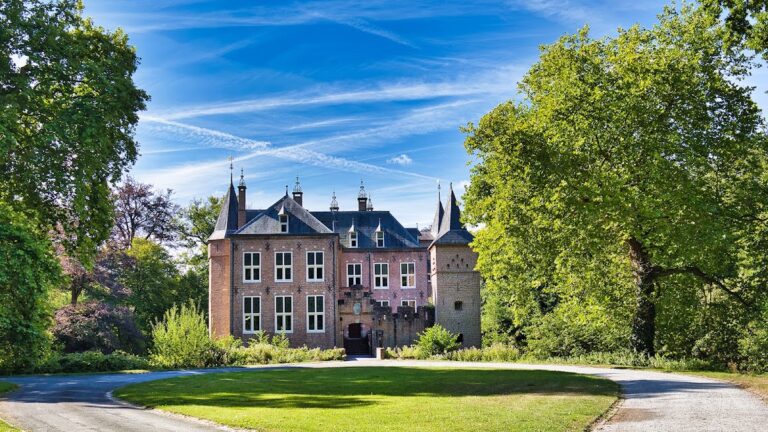
Kasteel Sterkenburg is a historic ridderhofstad in the Netherlands, located in Driebergen-Rijsenburg within the municipality of Utrechtse Heuvelrug. A ridderhofstad was a fortified or defensible manor recognized as the seat of a knightly lord and associated with noble status and landed rights. Sterkenburg is dated to around 1196, although the details of its earliest construction remain uncertain.
Medieval origins and feudal connections
Sterkenburg first appears in written history in 1261. In that year, Count Otto II of Guelders was to receive the castrum Langebruch, meaning the castle in Langbroek, from Bishop Hendrik van Vianden of Utrecht. The castle remained a fief of Guelders for many centuries. A fief was a holding granted by a superior lord to a vassal in return for obligations. At Sterkenburg, the castle and the surrounding lands were linked to different overlords: the castle belonged to the feudal sphere of Guelders, while the surrounding territory was held from the bishop of Utrecht.
The earliest lords of Sterkenburg belonged to the Van Wulven family, a powerful local noble lineage associated with the beginnings of several regional ridderhofsteden. Ernst van Sterkenburg is the first lord directly recorded under that name, appearing in documents between 1307 and 1324. He may have been the same man as Ernst van Wulven, who is mentioned between 1286 and 1311. A likely reconstruction of the early family history places the beginning of the building work with the knight Gijsbrecht van Wulven and its completion with his son, the knight Ernst van Wulven.
Ernst’s three sons later adopted the name Van Sterkenburg. In 1309, Ernst van Sterkenburg was recorded alongside his brothers Hendrik and Gijsbrecht. Both Ernst van Wulven and the man presumed to be Ernst van Sterkenburg also held half of the lordship of Berkel in Holland. These connections place Sterkenburg within the network of local noble families whose property and titles were closely tied to landholding and feudal authority.
Inheritance and noble ownership
The Van Sterkenburg line ended in the fifteenth century with Catharina van Sterkenburg. At her marriage to Wouter van Isendoorn in 1456, her father Gijsbrecht transferred the house, lordship, and associated estate of Sterkenburg to her. The property had already been recognized as a ridderhofstad in 1536, confirming its standing as a noble residence with the associated regional rights of that status.
Through later inheritance, Sterkenburg passed into the Van Isendoorn family. Catharina’s great-granddaughter Mechteld van Isendoorn married the Guelders nobleman Reinier van Aeswijn in 1564. The Aeswijn family remained connected with the estate into the seventeenth century. In June 1647, Anthonis van Aeswijn was murdered several months after marrying Margaretha Torck. His body was found in the woods of Sterkenburg, and despite substantial rewards, the crime was never solved.
Anthonis’s daughter Antonetta van Aeswijn was born after her father’s death and became the heiress of Sterkenburg. In 1666 she married Gijsbrecht van Mathenesse. Following inheritance disputes and several premature deaths, the estate passed in 1681 to Florentina van Mathenesse, who was married to Johan baron van Hardenbroek.
In 1725, Florentina sold the ridderhofstad and lordship to Catharina van Heusden, acting for her son, mr. Johan Frederik de Mamuchet van Houdringe. Johanna Catharina de Mamuchet van Houdringe inherited Sterkenburg from her unmarried brother in 1740. She had married mr. Jan Jacob van Westrenen in 1709, and the property remained with this Utrecht regent family into the nineteenth century.
The nineteenth-century transformation
After mr. Jan Jacob van Westrenen van Sterkenburg died unmarried in Florence in 1827, his half-sister Anna Maria Cornelia van Westrenen and her husband Pieter Anthony Hinlópen bought the estate from his inheritance in 1829. They leased Sterkenburg from 1841 to Johanna Maria Kneppelhout-de Gijselaar, whose son, mr. Karel Jan Frederik Cornelius “Kees” Kneppelhout, purchased the property in 1848.
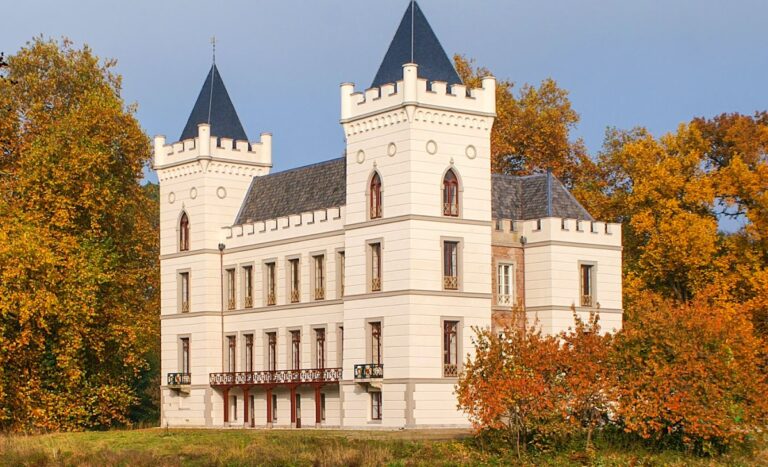
Kees Kneppelhout initiated major remodeling that gave the castle its present external appearance. During the early part of his ownership, Sterkenburg served mainly as a country residence. The family spent winters in Leiden and summers on the estate. From 1870, Kneppelhout lived at Sterkenburg permanently with his family and staff. His period of ownership also brought several additions to the grounds, including a square dovecote in 1862 and a square western tower in 1867.
Twentieth-century use and conservation
The Kneppelhout family continued to occupy Sterkenburg until the end of the 1920s. From 1948, as the property became seriously run-down, the castle was successively used as a boarding school, an educational institution operated by Stichting Jeugdland, and a conference center.
In 1959, Sterkenburg became jointly inherited by the Kneppelhout heirs, including Anna Rutheria Steengracht van Oostcapelle-Kneppelhout and her children. From 1970, the entire estate belonged to the Steengracht family. In 1978, the family sold the castle, associated buildings, and more than five hectares of land to Hendrik de Groot of Utrecht. The sale included the gardener’s house and the partly burned western coach house. During De Groot’s ownership, the castle and gardener’s house were divided into several residential units.
After De Groot’s death in 2000, the castle passed to Stichting “De Kiem,” which sold it in 2004 to the current owner. The estate was placed in an NSW-BV, a Dutch legal structure used for the preservation and tax-favoured management of designated historic estates. Management of the castle and estate was assigned to Stichting Behoud Sterkenburg, which coordinated extensive restoration work. Recent restoration was partly supported by subsidies from the Rijksdienst voor Archeologie, Cultuurlandschap en Monumenten. Kasteel Sterkenburg now functions as a residence and is protected as a Rijksmonument, a building or site legally safeguarded in the Netherlands for its national historical or cultural significance, under monument number 511806.
Remains
Castle and historic grounds
The castle
The surviving estate comprises the castle and a group of associated grounds and buildings. The castle was substantially remodeled in 1848, and that intervention established its present external appearance. A square tower was added on the west side in 1867. It incorporated a modern bathroom for its time together with a water system, combining a visibly historicizing addition with contemporary domestic facilities. The castle was later divided into several residential units during Hendrik de Groot’s ownership.
Estate buildings and landscape features
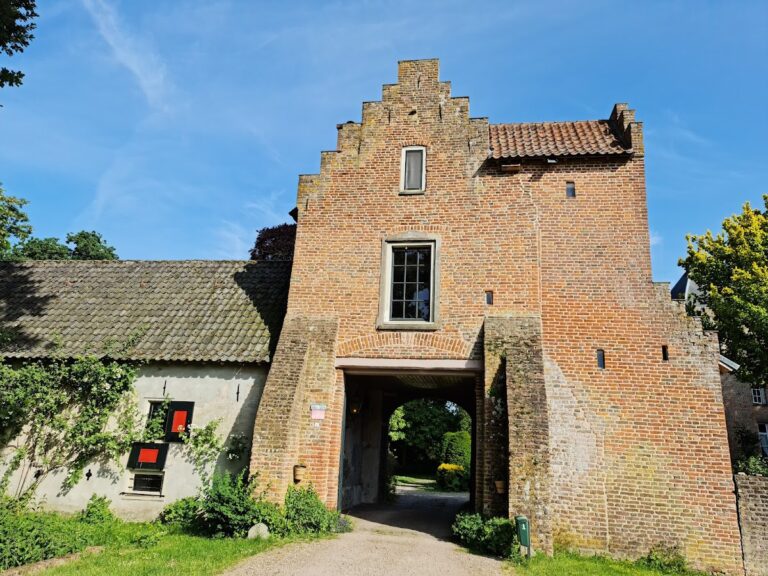
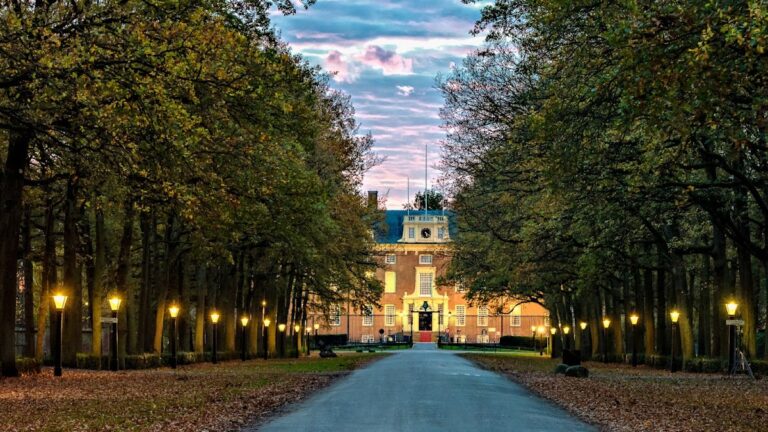
The grounds include a park, gardener’s house, coach house, orangery, dovecote, two bridges, and a kitchen garden. Other surviving elements include protective posts along the entrance drive, a wrought-iron entrance gate, meadow gates, garden vases, and a plinth beside the orangery. The western coach house was partly burned before or during its sale in 1978. The gardener’s house was divided into multiple residential units along with the castle.
The freestanding square dovecote was built in 1862 in a medievalizing style. Together with the tower, orangery, coach house, and garden structures, it forms part of the nineteenth-century estate ensemble shaped during the Kneppelhout period. Restoration work has contributed to the continued preservation of the castle and its associated buildings.