Kasteel Radboud: A Medieval Water Castle in the Netherlands


Site at a Glance
- Rating
- 4.4
- Popularity
- Medium
- Country
- Netherlands
- Primary era
- Medieval
- External website
- Open
- Eras represented
- Medieval, Early Modern
- Civilizations
- Holy Roman Empire
- Site type
- Military
- Remains
- Castle
On this page12 sections
History
Kasteel Radboud is a medieval fortified water castle in Medemblik, Netherlands, built under Floris V, count of Holland, in the late thirteenth century. Its construction is generally dated to 1288, although the castle was already standing during the Saint Lucia flood of 13 December 1287, suggesting that work may have begun around 1283 or earlier. It formed part of Floris V’s network of strongholds against Frisian incursions and served as a base for controlling the recently subdued population of West Friesland.
Foundation under Floris V
Floris V expanded and defended the authority of the counts of Holland during the thirteenth century. Kasteel Radboud was the last in a series of fortifications established for this purpose. Its position beside the harbor at Medemblik allowed the castle to function as both a defensive site and a place of refuge. The building’s name reflects a later tradition rather than a confirmed earlier phase of construction.
According to a legend recorded by the Dutch chronicler Cornelius Aurelius in his Divisiekroniek of 1517, the castle stood on the foundations of an earlier stronghold belonging to Radboud, or Radbod, an eighth-century Frisian king associated in later tradition with a royal residence at Medemblik. The existence of that earlier stronghold remains a possibility or legendary claim, rather than an established fact.
Medieval and early modern use
During the fourteenth and fifteenth centuries, the counts of Medemblik maintained guards at the castle. In 1517, it protected Medemblik’s inhabitants during an attack associated with the Second Siege of Medemblik. Frisian rebel forces led by Pier Gerlofs Donia, known as Grutte Pier, and his military associate Wijerd Jelckama besieged the castle during the same year.
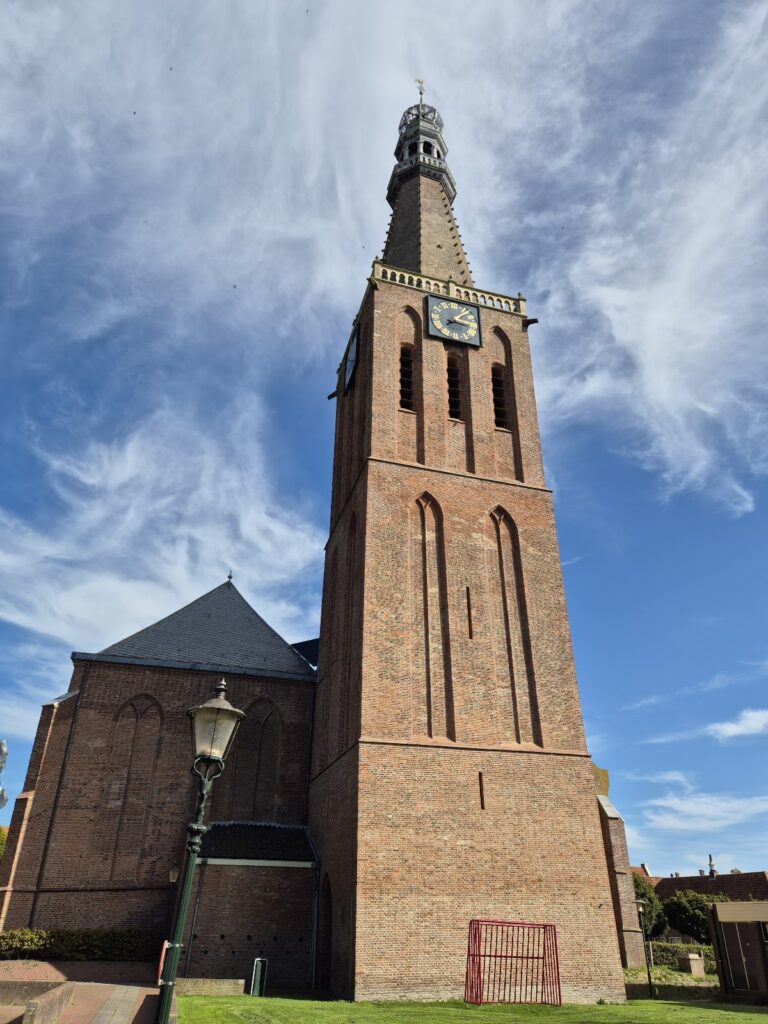
The castle’s defensive and refuge functions declined after Medemblik’s town walls were constructed or raised after 1578. It gradually fell into ruin, and no noble family subsequently made it a residence. From 1661 to 1734, however, the great hall in the southwestern wing served as a Protestant church. During this period, the square tower in the western wing was rebuilt and converted into a bell tower.
Demolition, restoration, and changing functions
Demolition began in 1848. The entrance and three towers were removed in 1850, followed by two further towers in 1870. The ruins became state property in 1889 and 1890. Between 1890 and 1897, a major restoration was carried out by the architect Jacobus van Lokhorst under the supervision of Pierre Cuypers. The restored building served as a courthouse from 1897 until 1934.
A fire in an external building in 1931 led to the identification of an older tower in the northern part of the castle area. The moat was re-established in 1936, and further restoration in 1964 sought to recover the appearance of the medieval castle. On 4 September 1939, during the early stages of the Second World War, Rembrandt’s The Night Watch was temporarily secured at Kasteel Radboud as a wartime safeguarding measure. In May 1940, it was moved to a bunker in the dunes near Castricum.
The Dutch state owned the castle from 1889 until 15 January 2016, with responsibility held under the Rijksgebouwendienst, the government agency responsible for state buildings. On that date, ownership passed to Monumentenbezit, and the castle is now used as a museum. Kasteel Radboud is protected as a Dutch rijksmonument, a monument listed under the national heritage system for its cultural or historical importance. Its designation, monument number 28386, dates from 23 November 1965.
Remains
Kasteel Radboud stands in or beside the water on the eastern side of Medemblik’s harbor. The original fortress had a roughly quadrangular plan with round corner towers, broadly comparable to the plan of the Muiderslot, a medieval castle in the Netherlands. The surviving fabric includes two residential wings, two square towers, and one round corner tower, while the outlines of the original castle remain visible. The surrounding moat, re-established in 1936, helps express the castle’s original water-bound defensive setting.
Residential wings and principal spaces
Southwestern wing and great hall
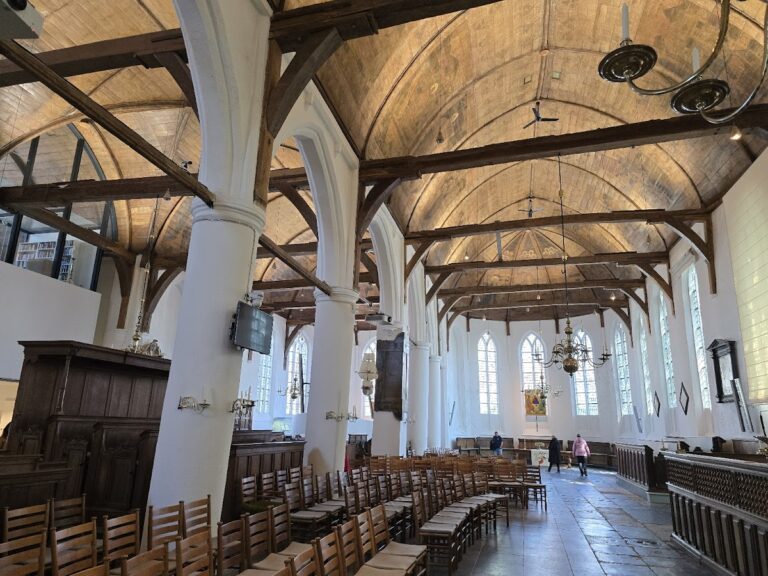
The southwestern wing contains the great hall, a principal interior space that later served as a Protestant church between 1661 and 1734. Its position within the residential wing preserves the connection between the castle’s domestic accommodation and its later religious use.
Western wing and bell tower
The western wing contains a square tower that was rebuilt during the church period and converted into a bell tower. This alteration reflects the building’s early modern transformation after its original defensive and refuge functions had declined.
Towers and archaeological evidence
Round corner tower
One round corner tower survives as part of the castle’s medieval fabric. It belongs to the original defensive arrangement, which placed round towers at the corners of the roughly quadrangular fortress.
Northern tower
A further old tower was identified in the northern part of the castle area after the 1931 fire in an external building. Its discovery added evidence for the earlier organization of the castle grounds, although the surviving material does not establish that the tower remains above ground.
Later representations
The castle is also represented in Nicolaas Bastert’s painting Kasteel Radboud te Medemblik, held by the Stedelijk Museum in Amsterdam. Rembrandt’s The Night Watch is connected to the site through its temporary wartime storage there in 1939, before its transfer to the bunker near Castricum in 1940.
Nearby sites