Grote of Sint-Bonifaciuskerk, Medemblik: A Dutch Protestant Church


Site at a Glance
- Rating
- 4.3
- Popularity
- Very Low
- Country
- Netherlands
- Primary era
- Medieval
- External website
- Open
- Eras represented
- Medieval, Early Modern, Modern
- Civilizations
- Habsburg, Holy Roman Empire
- Site type
- Religious
- Remains
- Church
On this page12 sections
History
The Grote of Sint-Bonifaciuskerk is a Dutch Protestant church in Medemblik, Netherlands, built in 1404 in the medieval Christian tradition. Its robust tower had already begun construction in 1350, and the church occupies the site of an earlier building mentioned in an account of the Utrecht cathedral works from 1118. That predecessor had burned shortly before the new church was built, and its ruins were reused in the construction. Originally dedicated to Saint Boniface, the early medieval missionary and bishop, the church later also became associated with Saint Martin of Tours.
Medieval churches and destruction
The church completed in 1404 was the second building on the site. It burned during the Second Siege of Medemblik in 1517, an episode associated with Grote Pier, the Frisian rebel leader active in the early sixteenth century. A third church was completed in 1524, but it too was destroyed by fire during the Great Fire of Medemblik in 1555. A fourth church was built in the same year.
The fires did not destroy the entire structure. Much of the present church survived these disasters, carrying elements of its medieval fabric into later periods. The building’s religious identity changed during the Reformation, the sixteenth-century movement that created Protestant churches and altered the administration and patronage of many European religious foundations. After 1572, the name Bonifaciuskerk continued to be used for the Protestant church, while Saint Martin became the principal patron of Medemblik’s Roman Catholic parish.
Alterations, decline, and rebuilding
The church was altered during the eighteenth century and was reduced in size in 1859 because of structural deterioration. The eastern end was shortened by approximately 20 metres around 1860. During this work, the roof turret, a small tower rising from the church roof, was removed, and the organ was transferred to the western side against the tower wall.
The tower experienced a separate period of serious decline. Neglect during the nineteenth century left it in poor condition, and demolition was discussed in 1855. Part of the structure eventually collapsed, while stones from it were sold to farmers. The rebuilding brought further danger when the scaffolding collapsed and five people died. Work was completed in 1900, when a weathercock was placed on the tower.
A lightning strike damaged the tower in 1861, and falling masonry subsequently damaged the organ. The organ builder Van Dam repaired the instrument, made minor changes to its specification, and retuned it using equal temperament. A major restoration in 1993 returned the interior to its nineteenth-century condition. The organ was restored in 1994 and 2000, while the tower’s rebuilding and later repairs preserved the church’s most prominent historic structure.
Continuing religious and civic use
The church remains in use by the Protestant congregation of Medemblik, which belongs to the Protestant Church in the Netherlands. Its northern aisle has also served as a theater under the name BON-Theater. Jan Pieterszoon Sweelinck, the Dutch composer, organist, and music educator, was married in the church in 1590.
The building is protected as a Rijksmonument, a national monument legally protected by the Netherlands. Its history therefore combines religious change, repeated rebuilding after fire, municipal responsibility for the tower, and continued community use.
Remains
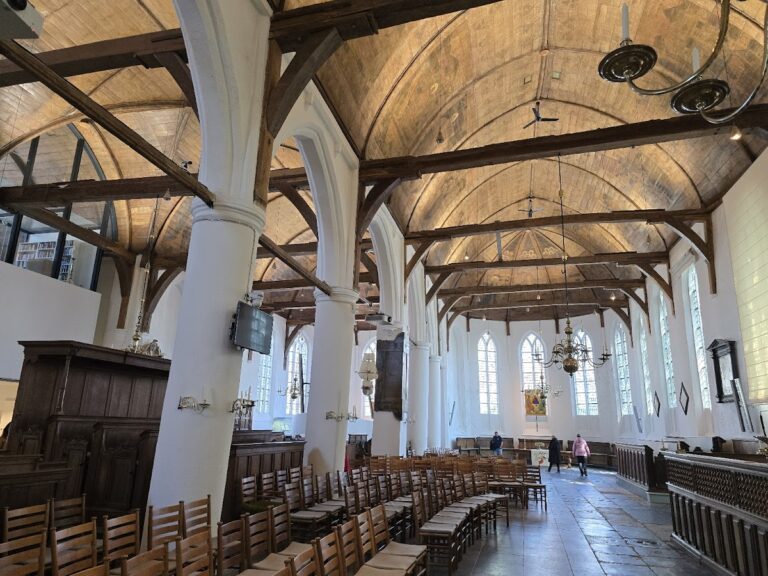
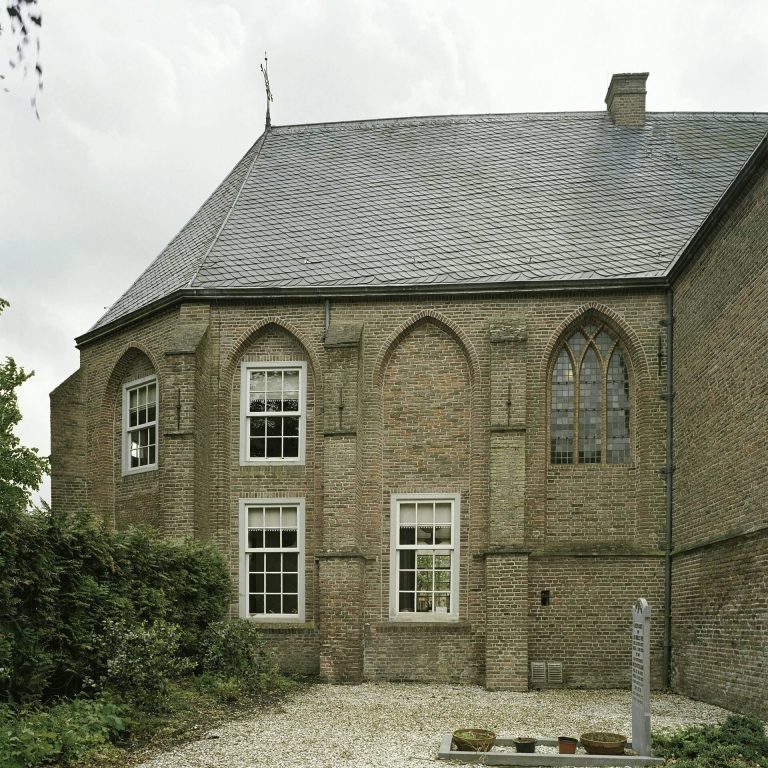
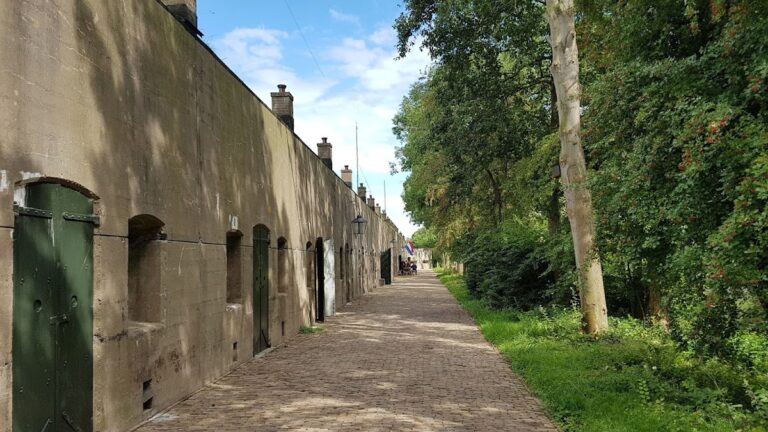
The Grote of Sint-Bonifaciuskerk is a brick, three-aisled hall church. Its two broad aisles and narrower southern aisle are arranged without the strongly elevated central nave typical of many other church plans, creating a more unified interior space. The surviving fabric includes the tower, historic bells, stained-glass windows, timber ceiling beams, furnishings, memorials, and two organs.
Tower and bells
The municipal tower
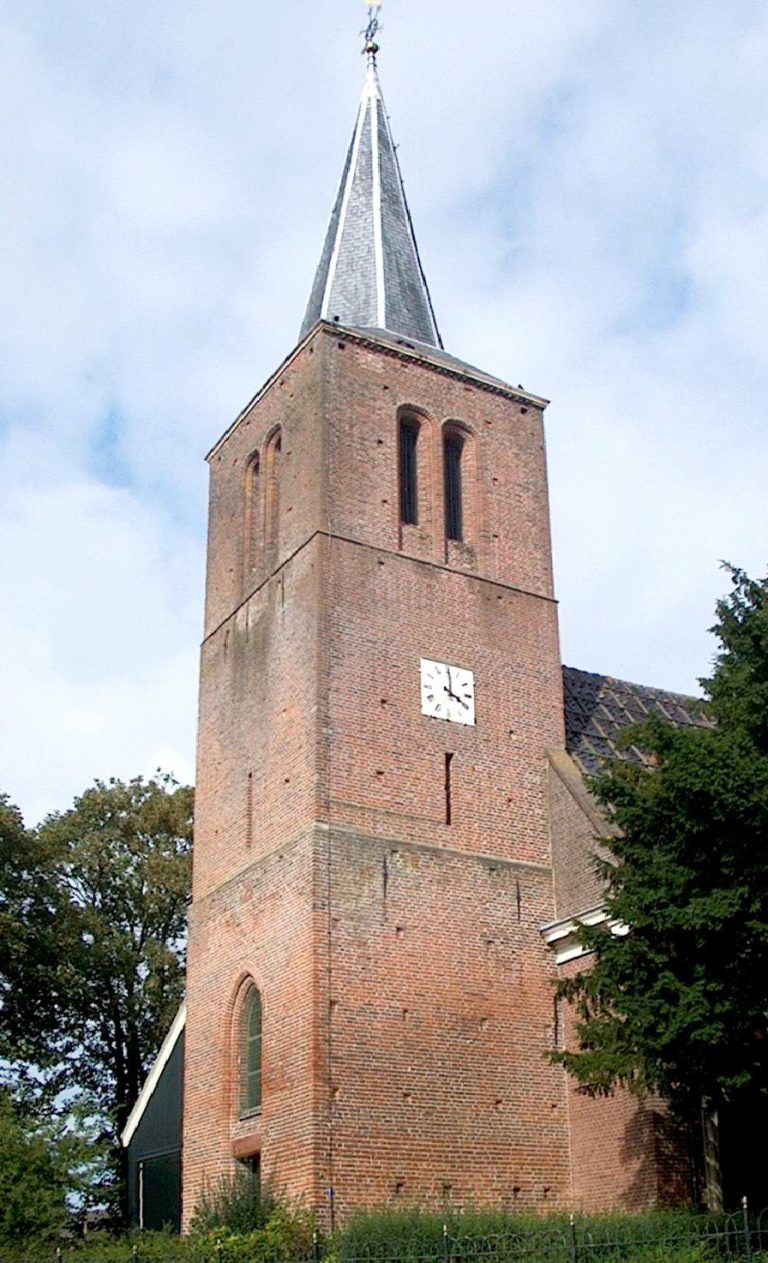
The tower is older than the church and is its oldest surviving part. Construction began in 1350, and the tower is also dated to 1404. Although it is attached to the church, it belongs to the civil municipality of Medemblik rather than to the church congregation. Its walls are two metres thick, and the tower reaches a height of 70.99 metres.
An openwork crown with a lantern, an open upper structure at the top of a tower, forms the tower’s present summit. This is the second crown and dates from 1667. The earlier pyramidal or spired top was destroyed by a storm in 1656, partly because it had become structurally unsound. Since the second half of the twentieth century, the tower has leaned toward the northeast, in the direction of the Wieringermeer polder. Drainage of the Zuiderzee and the resulting change in groundwater levels are considered the probable cause of this settlement.
The bells
The lantern contains a fourteen-bell automatic striking system installed in 1998. Cast by Petit and Fritsen in Aarle-Rixtel, these bells announce the hourly strike. Three heavy swinging bells hang in the tower alongside them.
The largest swinging bell is tuned to A0, weighs 4,239 kilograms, and has a diameter of 1,876 millimetres. Pieter and François Hemony cast it in Zutphen in 1649. Its Latin inscription records the rebuilding of the bell by magistrates after the city walls had been extended and the population had increased. A second Hemony bell was cast in the same year. Tuned to C-sharp 1, it weighs 2,256 kilograms, measures 1,503 millimetres in diameter, and carries a Latin inscription praising the Lord with well-sounding cymbals. One of the Hemony bells cracked after 1998 and was welded.
The third bell, tuned to E1 and called Sint Pieter, began as the Poortklok, dating from 1406. Everhardus Splinter recast it in 1636 at the bell foundry near the Noorderpoort in Enkhuizen. It weighs 1,136 kilograms and has a diameter of 1,253 millimetres. A Dutch inscription describes its service to God, its calling of the living, and its mourning of the dead. Images of Saint Peter appear on both sides, with Splinter’s maker’s inscription beneath them.
Interior furnishings and memorials
Stained glass and historic fittings
Six stained-glass windows occupy the southern aisle. The easternmost was donated by the city of Monnickendam in 1670. Another, given by the Rhine Boatmen’s Guild in 1671, shows Noah’s Ark above a view of Medemblik’s Oosterhaven and the Saint Boniface Tower.
The interior contains a sandglass that indicated the permitted length of a sermon. Brass candle chandeliers date from 1591 and 1571. Timber ceiling beams date from 1572. An epitaph commemorates George Murray, a Scottish nobleman and Jacobite military commander of the eighteenth century. His grave lies behind the church, where a simpler gravestone marks it.
The main organ
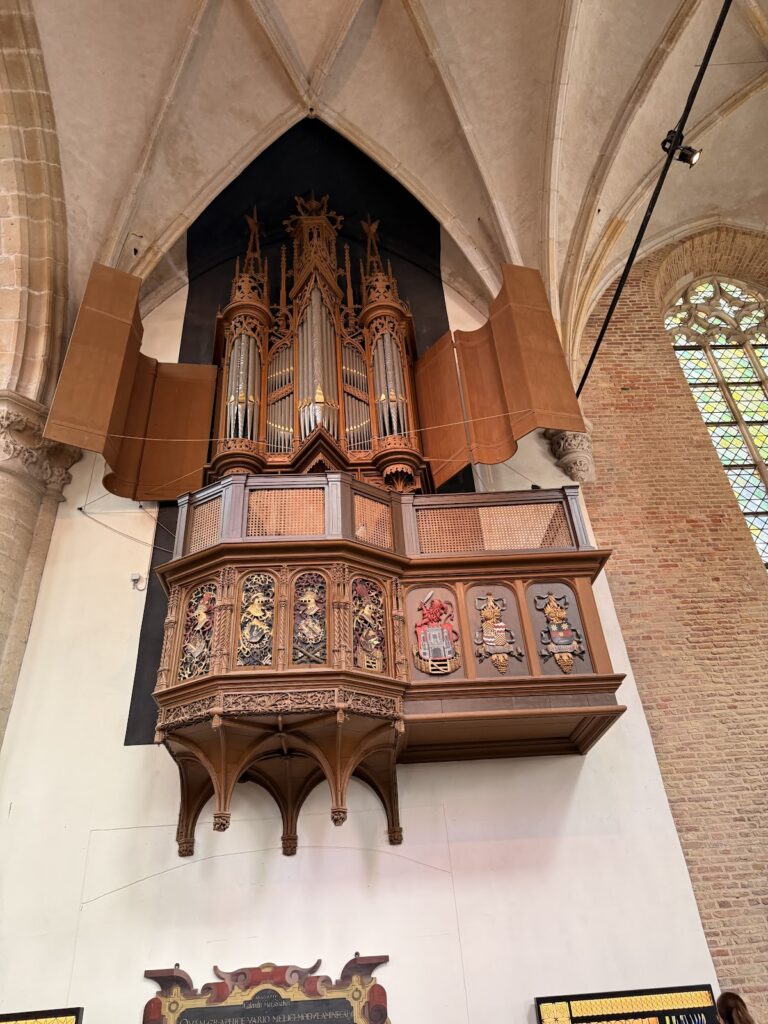
The main organ was built in 1671 by Pieter Backer, who also served as the church organist. It incorporates parts of an earlier instrument and was originally installed against the north wall. Christoffel Bätz renewed its rear-positive division, a smaller organ division placed behind or below the main case, in 1785 after age and wear had made the earlier division unusable.
After the church was shortened, the organ was moved in 1863 to the west wall and partly into the tower. The 1994 and 2000 restorations aimed to recover the 1863 arrangement, while returning the breast division, the division in the lower part of the organ case, to its 1671 state. The mahogany-like finish, thought to derive from its 1785 appearance, was restored by the Polman painting company of Hoorn.
The instrument has 23 stops, or selectable sets of organ pipes, distributed across three manuals with an attached pedal. Its sound is particularly associated with an 8-foot Regal made of turned pear wood in the breast division. A painted imitation drapery visible behind the organ in a late nineteenth-century photograph has not yet been restored.
The choir organ
A five-stop choir organ made by Flentrop Orgelbouw was installed in 1993. It forms a separate musical element within the restored church interior, alongside the older main organ.