Edam Fort: A Defensive Fort in the Stelling van Amsterdam


Site at a Glance
- Rating
- 4.3
- Popularity
- Low
- Country
- Netherlands
- Primary era
- Modern
- External website
- Open
- Eras represented
- Modern
- Civilizations
- Dutch
- Site type
- Military
- Remains
- Fort
On this page9 sections
History
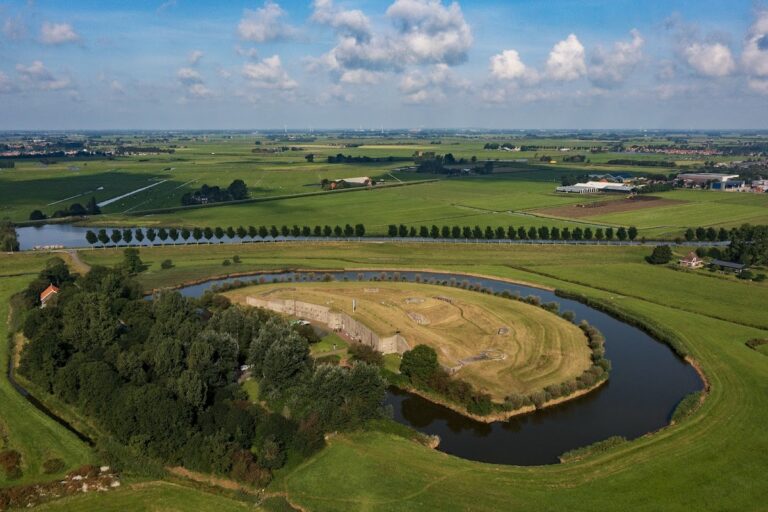
Edam Fort is a Dutch military fort in the Netherlands, near Edam, built between 1908 and 1913 as part of the Stelling van Amsterdam. This defensive ring around Amsterdam used forts and controlled flooding to protect the city, and the fort guarded the Edam lock, which could flood the low-lying Zeevang polder.
Construction and military service
Preparatory work began in 1885 with the construction of a service house and a storage shed. The service house served as a site office, while the shed stored building tools. Construction of the standardized Model B fort began in 1908, and the completed fort was delivered in 1913.
During the Dutch mobilization of the First World War, from 1914 to 1918, soldiers were stationed at the fort. After this period, it fell into disuse until military needs brought it back into use during the Second World War.
Wartime detention and later military use
The German Wehrmacht used the fort during the Second World War. During the German invasion of the Netherlands, the Zeevang polder was flooded. After liberation in 1945, the fort held members of the Dutch National Socialist Movement, a pro-German fascist organization, and other collaborators. Women associated with German soldiers or the movement were also imprisoned there, and the fort briefly served as an internment camp for convicted collaborators.
From 1948 to 1980, the Dutch Army used the fort as an arms and ammunition store, including for decommissioned small arms. A shooting range was added in 1951 for training by the National Reserve, a Dutch military reserve organization, the police, and Staatsbosbeheer, the Dutch state organization managing public forests and nature reserves. The range was later used by a local shooting club and remains in use by that association.
Conservation and public access
In 1986, the Dutch Ministry of Defence transferred the fort to Staatsbosbeheer. Its limited use allowed distinctive flora and fauna to develop, and the site became a protected nature reserve. In 2005, volunteers founded the Fort near Edam Foundation to help Staatsbosbeheer manage and operate the fort and make it accessible to the public. Edam Fort now forms part of the Stelling van Amsterdam UNESCO World Heritage property and is designated a provincial monument.
Remains
Edam Fort lies north of the Edam lock in the Zeevang polder. Its construction required major ground preparation because the original peat soil was too unstable for a heavy military structure. Part of the peat was removed and replaced with a thick layer of sand transported by ship. Some of this replacement sand was then excavated again so that more than 2,000 piles could be driven into the ground. The buildings were constructed on the piles in unreinforced concrete, and the excavated sand was later used to cover the front and upper surfaces of the fort.
Fort buildings and grounds
Armored front casemate
The fort has no retractable gun turrets. Instead, its defenses included a centrally placed armored front casemate, a fortified enclosed gun position that protected its occupants while allowing fire through openings. From this position, guns could be directed forward. The covered concrete structure and its position within the fort formed part of the defensive arrangement protecting the lock and the inundation system.
Service house
The service house built during the preparatory phase first functioned as the construction site office. It was later occupied by the fort keeper, giving the building a continuing practical role within the military site.
Tubular shooting range
A tubular shooting range was constructed on the grounds in 1951. It served the National Reserve, the police, and Staatsbosbeheer for training before later being used by a local shooting club, which continues to use it.