Karfi: A Late Minoan Mountain Settlement in Crete
Site at a Glance
- Popularity
- Medium
- Country
- Greece
- Primary era
- Bronze Age
- Eras represented
- Bronze Age, Iron Age
- Civilizations
- Minoan
- Site type
- City
On this page8 sections
History
Karfi is an ancient settlement on the southeastern slope of Karfi peak in the Hersonissos area of Crete, Greece. Its principal occupation began during Late Minoan IIIC, about 1200-1000 BCE, at the start of the Greek Dark Ages, the period following the collapse of Bronze Age palace societies. Karfi became one of the latest and largest hill communities associated with Eteocretan Minoans, an ancient designation for people regarded as indigenous to Crete.
Possible Middle Minoan sanctuary
Karfi may have served an earlier religious purpose as a peak sanctuary, a place of worship on high ground. A possible network of such sites, connected by lines of sight, is associated with the Middle Minoan IB-II period around 1900-1800 BCE. The sanctuary may have fallen out of use around 1650 BCE, perhaps as religious authority became more centralized. Both the identification of the site as a sanctuary and the reason for its possible abandonment remain uncertain.
Settlement in Late Minoan IIIC
The later settlement took shape amid upheavals near the end of the Bronze Age associated with the Sea Peoples, a modern term for groups linked to instability in the eastern Mediterranean. Reconstructions suggest that groups conventionally called Dorians came to Crete from the Peloponnese after about 1100 BCE and pushed local inhabitants toward the hills, where communities with Minoan material culture persisted. Karfi was one such community.
Residents occupied Karfi throughout the year, and its population may at times have approached 3,500. They hunted, raised livestock, and cultivated olives on land below the settlement. The mountain position has been interpreted as offering a defensive refuge, although life there was more difficult than in Crete’s lowlands and coastal areas. Across Crete, Minoans lived alongside Mycenaeans, a Greek Bronze Age civilization, in a subordinate position. The Minoan language may have continued among lower-status rural people, while the Mycenaean elite used Linear B, a syllabic script for writing Mycenaean Greek.
Abandonment and excavation
Karfi remained occupied into the post-Minoan period and was abandoned around 950-900 BCE, after roughly two centuries of settlement. John D. S. Pendlebury and the British School of Archaeology at Athens carried out extensive excavations in 1937 and 1939. Estimates indicate that the excavated area amounted to about one-third of the settlement.
Remains
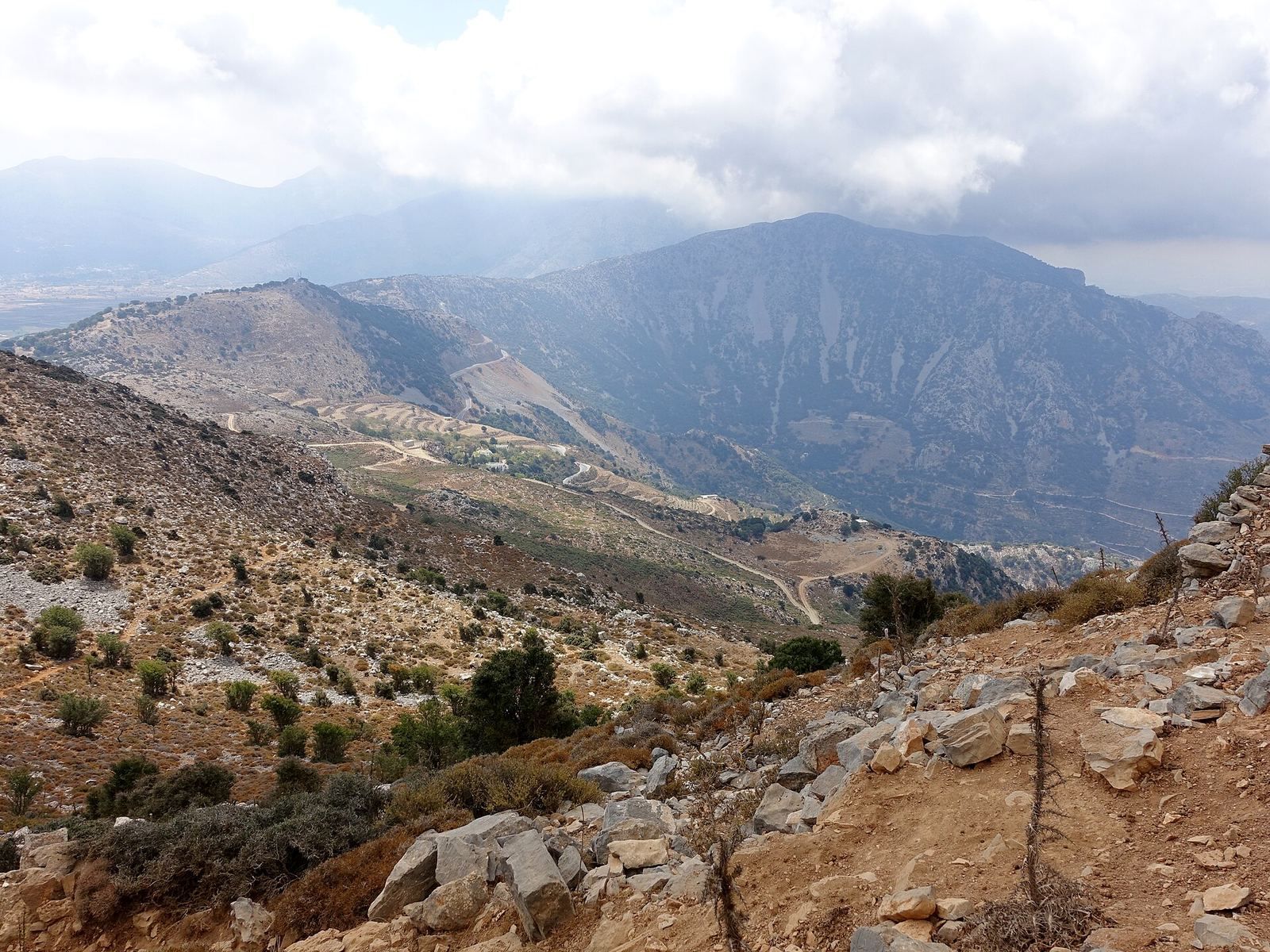
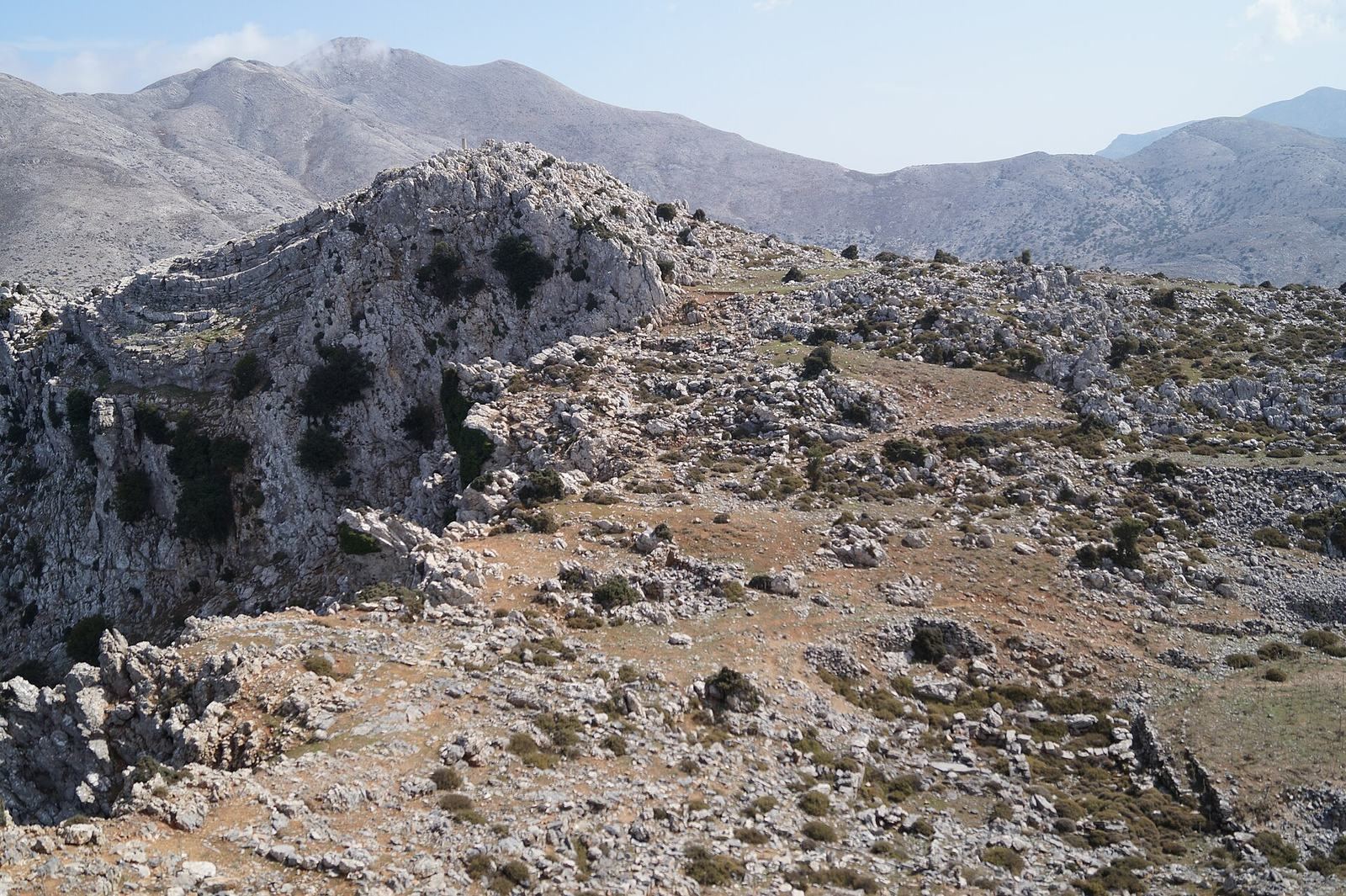
The settlement occupies an area about 250 by 450 metres at roughly 1,110 metres above sea level, on Karfi peak’s southeastern slope in the Dikti Mountains. The site lies northwest of the Nisimos Plateau and overlooks its northern entrance. The mountain range rises to about 1,559 metres; views from the site include the Sea of Crete, the Pediada valley, and the plateau with Heraklion. The name Karfi means nail and refers to the prominent limestone knob at the peak, especially conspicuous from the north.
Buildings and streets
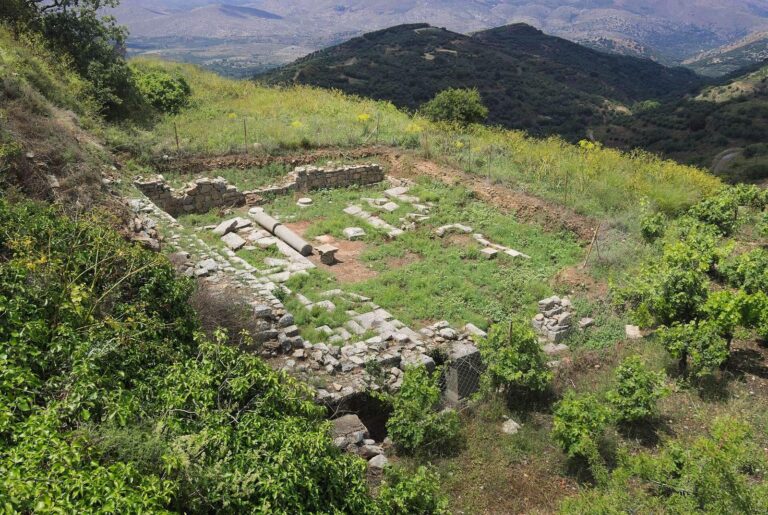
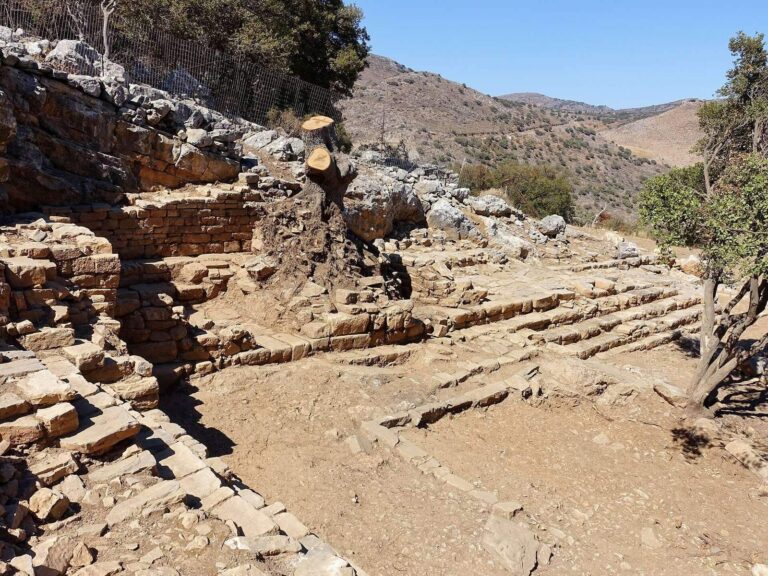
Surviving settlement features include single-storey houses and paved streets. Some groups of rooms resemble megarons, large-room buildings often arranged around a central hearth. One tripartite building of this type contained both a hearth and a sanctuary. A separate shrine with an altar also formed part of the settlement.
Rock outcrop and cemeteries
A forked rock outcrop is a notable feature of the rocky site. Its shape recalls stone altars with crescent-shaped horns known from Crete and Cyprus, though the resemblance does not establish that the outcrop itself served as an altar. Two cemeteries of circular, often beehive-shaped tombs lay near the settlement. Seventeen small tombs were found around the Vitzelovrysis spring, and four more near the Astividero spring.
Finds and preservation
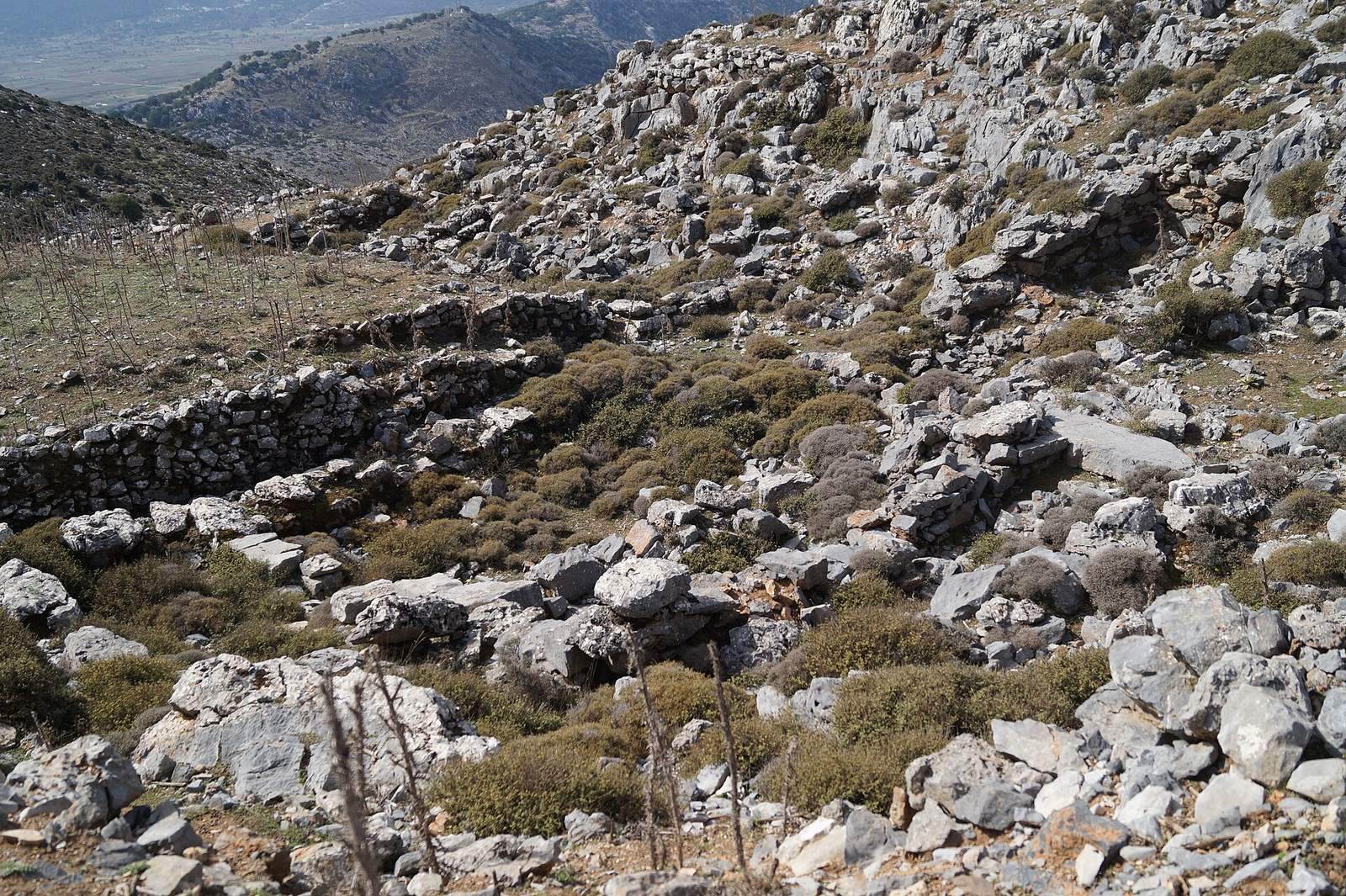
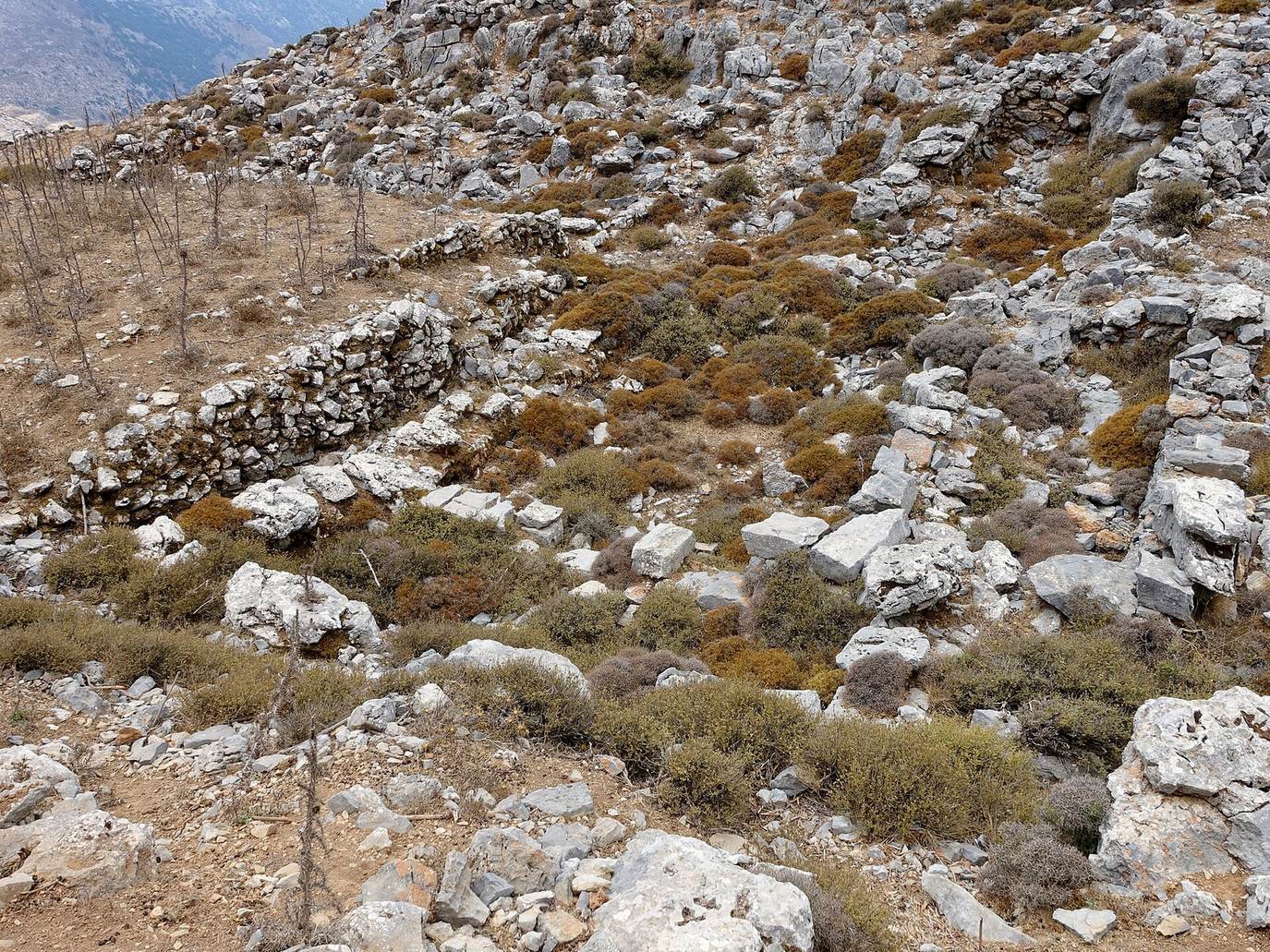
Finds include ceramic loom weights, miniature vessels, and clay figures of people and animals. Some human figures portray goddesses wearing cylindrical skirts with their arms raised in a gesture associated with a deity’s appearance. Karfi pottery is displayed in Room 11 of the Archaeological Museum of Heraklion. Low vegetation now covers parts of the settlement remains, which are also exposed to erosion.