Kanayama Kofun: A Rare Double-Circular Burial Mound in Japan


Site at a Glance
- Rating
- 3.9
- Popularity
- Low
- Country
- Japan
- Primary era
- Medieval
- External website
- Open
- Eras represented
- Medieval
- Civilizations
- Yamato
- Site type
- Burial
- Remains
- Burial Mound
On this page9 sections
History
Kanayama Kofun is a Kofun-period burial mound in Japan, located in Kanan in Osaka Prefecture. It was built around the transition from the late sixth to the early seventh century, with its construction style suggesting the latter half of the sixth century. The identity of the person or people buried there is unknown. A local tradition identifies one of its two mounds as the grave of Prince Saegusa, said to have been one of the sons of Prince Shotoku, an imperial prince associated with the promotion of Buddhism and the organization of the early Japanese state.
Burial and early investigation
The northern stone chamber was discovered and excavated in 1946. Robbers had disturbed the burial, apparently in the early seventh century, but the excavation recovered glass beads, silver rings, horse harness fittings, iron swords, and earthenware. These objects survived around the stone coffins rather than in their original positions. The results of the investigation were published in 1953.
Preservation and interpretation
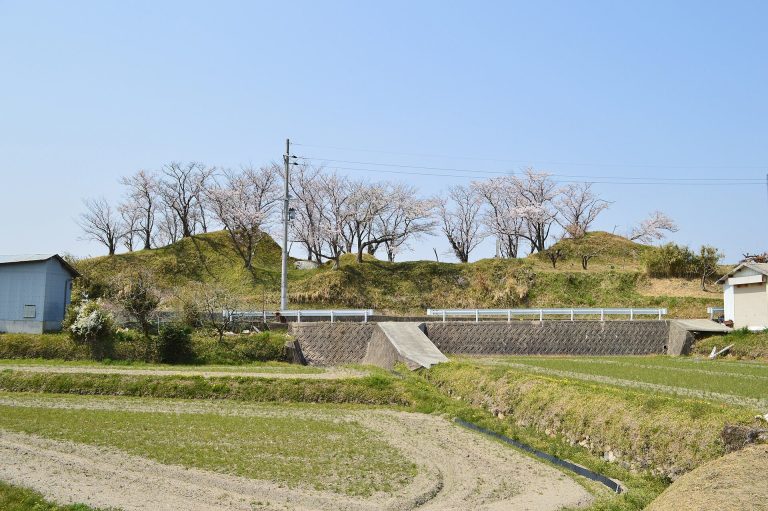
Kanayama Kofun was designated a National Historic Site of Japan on February 15, 1991. Excavations carried out in 1993 and 1994 supported preservation and development work, after which the monument was developed as Kanayama Kofun Park in 1995. Its large size and unusual double-circular form, a rare arrangement among kofun, give it particular archaeological importance. Comparable examples include Meofuzuka Kofun, Yabata No. 22 Kofun, and Hyotanyama Kofun in Higashiosaka.
Remains
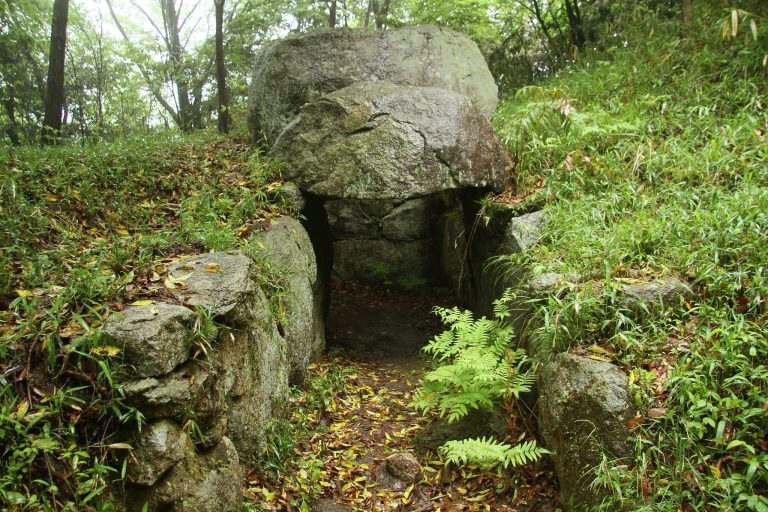
Kanayama Kofun lies at the innermost part of the Kanan Plateau, on the western foothills of Mount Katsuragi in southeastern Osaka Prefecture. It is a rare sōen-fun, or dumbbell-shaped burial mound formed by joining two circular tumuli. The two mounds follow a northwest-southeast axis and have a combined length of 85.8 meters. The northern tumulus is two-tiered, 38.6 meters in diameter, and 6.8 meters high. The southern tumulus is three-tiered, 55.4 meters in diameter, and 9.4 meters high. Their level surfaces appear to have remained separate, although the middle level of the northern mound probably met the lowest level of the southern mound.
Mound surfaces and moat
A double-circular moat surrounds the mound and averages 1.4 meters in depth. Including the moat, the monument measures 104 meters in length. Paddy fields lie about one level below the surrounding ground around its outer perimeter. Stones used as surface protection and finish, known as fukiishi, were extensively identified across the level surfaces. On the slopes, they were found only on the western side of the constriction near the northern stone chamber. A row of stones was also identified on the third level of the southern tumulus. Clay funerary figures and objects known as haniwa have not been identified on the mound surfaces.
Northern burial chamber
The northern tumulus contains a large, south-facing horizontal stone chamber, a burial chamber entered through a passage cut into the mound. It is a double-sleeved chamber, with side extensions at the junction between the main chamber and the entrance passage. The chamber is 10.6 meters long. Its main chamber measures 3.8 meters in length, 2.16 meters in width at the rear, 2.48 meters at the front, and up to 2.84 meters in height. The entrance passage is 6.26 meters long, 1.72 meters wide, and 1.94 meters high. Gravel covered the floor, while an approach passage lay in front of the chamber and retained an almost intact blocking structure.
Main-chamber stone coffin
A hollowed, house-shaped stone coffin made of tuff stood in the main chamber. Its lid is 2.36 meters long and 0.63 meters high. The outer body measures 2.36 by 1.26 meters and is 0.90 meters high, while the hollow interior measures 1.76 by 0.76 meters and is 0.575 meters deep. Six knobs for fastening ropes appear on the lid, one at each end and two on each side. Tool marks, traces of vermilion, and a hole made by robbers remain on the body.
Entrance-passage stone coffin
A second tuff coffin stood in the entrance passage. It is slightly smaller but has nearly the same house-shaped form. Its lid measures 2.26 meters in length, 1.19 meters in width, and 0.64 meters in height. The outer body is 2.21 by 1.15 meters and 0.76 meters high, with an interior measuring 1.65 by 0.63 meters and 0.51 meters deep. The lid also has six rope-fastening knobs, although their form differs from those on the coffin in the main chamber. This difference has led to the interpretation that the coffin was added later for a secondary burial. A robbers’ hole is visible in its body.
Both coffins were robbed, leaving almost no grave goods inside them. The surviving objects were found around the coffins, and none of the recovered goods remained in its original position.
Southern tumulus
The burial installation of the southern tumulus has not been fully investigated. An approach passage and an underground drainage channel within the mound have been identified. These features suggest that the southern mound also contained a horizontal stone chamber, although its details remain unknown.