Kongōfuku-ji Temple: A Shingon Buddhist Temple on Cape Ashizuri


Site at a Glance
- Rating
- 4.4
- Popularity
- Low
- Country
- Japan
- Primary era
- Modern
- External website
- Open
- Eras represented
- Medieval, Early Modern, Modern
- Civilizations
- Japanese, Kamakura shogunate, Tokugawa
- Site type
- Religious
- Remains
- Temple
On this page15 sections
History
Kongōfuku-ji Temple is a Shingon Buddhist temple in Tosashimizu, Japan, traditionally founded in 822 during the reign of Emperor Saga in the early Heian period. Shingon is an Esoteric Buddhist tradition centred on ritual, mantra, mandala, and the attainment of Buddhahood. The temple belongs to the Buzan branch of Shingon and is the 38th temple on the Shikoku 88-temple pilgrimage.
Foundation and sacred traditions
The temple’s formal name is Sadazan Fudarakuin Kongōfuku-ji. One tradition says that the Buddhist priest Kūkai, the ninth-century founder of the Shingon school, established the temple at Emperor Saga’s request. Kūkai is said to have carved a three-faced, thousand-armed Kannon, the bodhisattva of compassion, and built a hall to house the image. Another tradition names Gyōki, a major Buddhist priest of the Nara period, as the founder.
The temple’s name is connected by tradition with a vajra, a Buddhist ritual implement symbolizing indestructibility and spiritual power. Before returning from Tang China, Kūkai is said to have thrown such an object toward Japan, where it was believed to have flown to Cape Ashizuri. Kongō refers to the vajra, while fuku is derived from a line of the Kannon Sutra expressing boundless blessings.
The mountain was originally called Gachirinzan. Tradition relates that the abbot Kinpō subdued beings from a demonic realm who obstructed religious practice. In frustration, they stamped their feet, and the mountain name was then changed to Sadazan. Both characters in Sadazan carry the meaning “to stumble,” a word association also linked with the difficulty of the terrain. The temple is popularly known as Ashizurizan.
Heian and Kamakura connections
Kongōfuku-ji was reportedly made a place of imperial prayer and received support from the Minamoto family. Minamoto no Mitsunaka donated a treasure pagoda, and his son Minamoto no Yorimitsu helped improve the temple buildings. By the late Heian period, the temple had become a centre of ascetic practice because of its position at the tip of Cape Ashizuri and its association with Fudaraku, the paradisiacal realm traditionally connected with Kannon.
Practitioners and pilgrims came to the cape, including an emissary of an imperial consort and the poet Izumi Shikibu. The Fujiwara regent family also protected the temple. Maintaining its estates and buildings remained difficult, however, and fires in 1256, 1289, and 1310 destroyed buildings, Buddhist images, and other parts of the complex. Fundraising campaigns supported repairs after each fire, and the principal image now preserved at the temple is dated approximately to 1342.
During the Kamakura period, the establishment of the Hata estate brought the temple under the support and protection of the ruling Kujō family. The Ichijō family later succeeded them in that role. In the later Kamakura period, the priest Nanbutsu is traditionally said to have revived Kongōfuku-ji, while the senior priest Keizen is also associated with fundraising. Nanbutsu may have been another name for Keizen.
Muromachi to modern observances
During the Muromachi period, the temple adopted worship of Kumano Gongen, the deities of the Kumano religious tradition that combines Buddhist and local Japanese sacred practices. Kongōfuku-ji became a centre of ascetic practice in western Tosa, and Prince Sonkai served as its abbot. The temple temporarily declined during the Warring States period, an era of prolonged political conflict before Japan’s late-sixteenth-century unification.
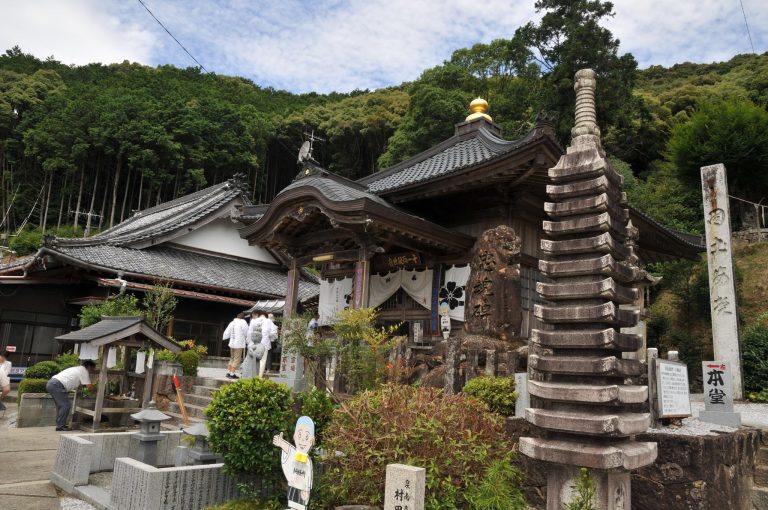
Its revival came in the Edo period through Yamauchi Tadayoshi, the second lord of the Tosa domain. He donated several objects and monuments, including a thirteen-story stone pagoda, a bell, and a granite washbasin. The Yamauchi family crest, showing three oak leaves within a circle, appears on the washbasin and elsewhere in the temple.
The temple’s 1,200th-anniversary grand festival began on 4 December 2022. It was described as an observance held once every hundred years. The associated Kongōfuku-ji Road, part of the Tosa Pilgrimage Road, extends for approximately 600 meters around the Shin’nen-an area in Shimonokae, about seven ri from the temple. This pilgrimage route received cultural-property designation in 2025.
Remains
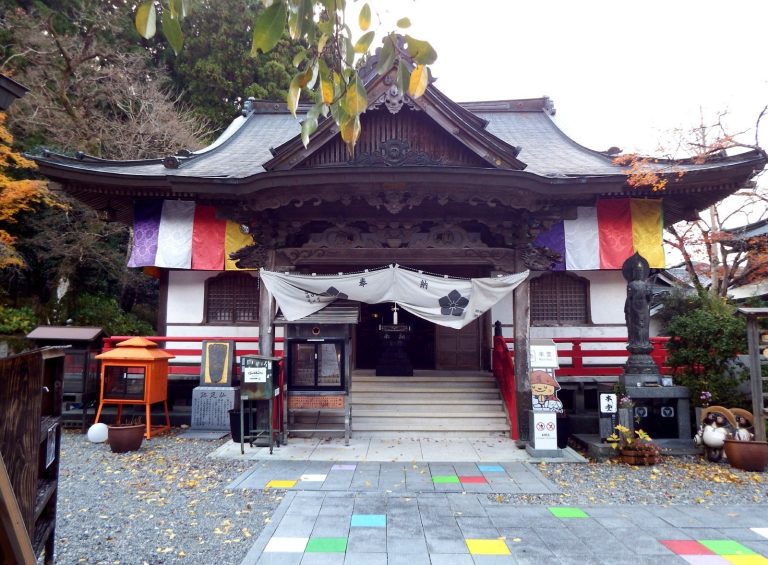
Kongōfuku-ji occupies a mountainside site near Cape Ashizuri, where subtropical vegetation surrounds the precinct. The approach enters from the south through a Sanmon gate designed as a Niōmon, a temple gate with spaces for two guardian figures on either side of the passage. From the gate, the route rises toward the main buildings. A pond lies near the lower entrance, with a sea-turtle statue to the left, a large stone “Daishi turtle” before the pond, and a memorial stone for a “sea-crossing priest” at the lower right.
Principal halls and Buddhist images
Hondō and principal image
The Hondō stands at the rear centre of the precinct. It enshrines a wooden standing image of a three-faced, thousand-armed Kannon. The figure is 163.5 centimetres high, with crystal eyes and white-hair marks on its central and side faces. The image dates approximately to 1342, placing it among the physical reminders of the temple’s reconstruction after the medieval fires.
The principal image is accompanied by standing images of Fudō Myōō and Bishamonten. Fudō Myōō is a Wisdom King associated with immovable resolve and the destruction of obstacles. His wooden image is 140 centimetres high and dates from the early Muromachi period. Bishamonten, a guardian deity associated with protection and prosperity, is represented by a 130-centimetre-high wooden image from the same period.
Gomadō and Tahōtō
The Gomadō and Tahōtō stand to the right of the Hondō. The Gomadō is used for goma fire rituals, Buddhist ceremonies in which offerings are burned before a sacred fire as part of prayer and purification. The Tahōtō is a square, three-bay pagoda 19.14 metres high. Begun in 1878 and completed in 1880, it enshrines a seated Dainichi Buddha of the Womb Realm.
Halls beside the pond
Aizendō, Gyōjadō, Gongendō, and Monjūdō form a group of halls to the left of the Hondō, beside a pond. Aizendō contains a seated Aizen Myōō made from joined blocks of hinoki wood, with carved eyes and painted colouring. The image is 84 centimetres high and dates from the late Heian period. Aizen Myōō is a Wisdom King associated with transforming desire into spiritual insight.
Gyōjadō houses an image of the ascetic En no Gyōja, flanked by the figures of Zenki and Kōki. Gongendō enshrines the three Kumano Gongen and functions as the guardian shrine of the mountain. Monjūdō, also described as a shrine, contains an unfinished-wood image of Monju seated on a lion. Monju is the bodhisattva of wisdom.
Shakadō and Daishidō
Shakadō is an octagonal hall painted red and white and enshrines a seated Shaka Buddha. Farther along the route, Daishidō is dedicated to the temple’s founder and contains an image of Kūkai. The arrangement of these halls extends the precinct beyond the central Hondō and its adjoining buildings.
Bell structures, monuments, and ritual objects
Bell tower and stone pagoda
The Shōrōdō is a tower-like bell building containing two suspended bells. A separate temple bell donated by Yamauchi Tadayoshi is 132 centimetres high, with a lower rim 95 centimetres in diameter. Within the grounds, the thirteen-story stone pagoda donated by Yamauchi Tadayoshi in August 1664 rises 5.17 metres.
Gong, washbasin, and memorial tower
A bronze gong made in 1385 measures 45 centimetres in diameter. The granite hand-washing basin donated by Yamauchi Tadayoshi in 1664 measures 153 centimetres long, 78 centimetres wide, and 75 centimetres high. It bears the Yamauchi crest of three oak leaves enclosed within a circle.
A 1.65-metre-high hōkyōintō, a Buddhist memorial tower associated with preserving sacred texts and merit, dates from the Kamakura period. Tradition identifies it as a memorial tower in which Izumi Shikibu’s hair was buried during her lifetime.
Cast images and legendary features
One hundred and eight cast Buddhist images are arranged within the grounds. They represent the Five Wisdom Buddhas, the Thirteen Buddhas, and the thousand-armed Kannon. The precinct also contains an image of a sea turtle and a statue of Kūkai in ascetic practice.
Several traditional “Seven Wonders of Ashizuri” are associated with paths near the temple. They include a rocking stone, a turtle-shaped stone, an unfinished torii linked by tradition to a one-night construction attempt by Kūkai, a place for calling turtles, and a stone said to bear writing made with the master’s fingernails. Other legendary features include an inexhaustible hand-washing basin, a basin whose water follows the tides, dwarf bamboo, and a “hell hole.” These latter features are associated with local legend rather than with Kūkai.
Poetry and inscription steles
Near the Tahōtō, an inscription stele bears a verse by Matsuo Bashō, translated as “Only today, let people grow old, first winter rain,” alongside Izumi Shikibu’s memorial tower. Two steles by Haruko Takagi carry verses translated as “Thinking of the sea-crossing priest, I look toward the offshore spring waves” and “In the summer tide, I listen closely to the coral’s sigh.”
Near the entrance, a stele by Akira Uebayashi bears the verse “They say it is the eastern gate of Fudaraku, a spring temple,” together with twenty verses titled “A Night at Ashizuri Mountain.” Behind the Hondō, a stone stele carries twelve haiku dedicated by Kyōko Kuroda. Their subjects include immersion in the Ganges, dawn bells, weeping cherry blossoms, fireflies, a rainforest mandala, the sun and moon, masks, autumn pilgrims, figs, a yuzu bath, and the light of a white leek.