Ryūsen-ji Temple: A Kōyasan Shingon Buddhist Temple in Osaka


Site at a Glance
- Rating
- 3.7
- Popularity
- Very Low
- Country
- Japan
- Primary era
- Unclassified
- External website
- Open
- Eras represented
- Unclassified
- Civilizations
- Unclassified
- Site type
- Religious
- Remains
- Temple
On this page15 sections
History
Ryūsen-ji Temple is a Kōyasan Shingon Buddhist temple in Tondabayashi, Osaka, Japan, traditionally founded in 594 during the reign of Empress Suiko. Its formal name is Gozuzan Iō-in Ryūsen-ji, its principal image is Yakushi Nyorai, the Buddhist Buddha of healing and medicine, and it belongs to the Kōyasan Shingon school, an esoteric Buddhist tradition associated with the monastery on Mount Kōya. The temple is also the 11th stop on the Kawachi Asuka Ancient Temples pilgrimage.
Traditional Foundation
Temple tradition attributes the foundation to Soga no Umako, a powerful figure at the Asuka-period court, who is said to have acted under an imperial order. According to the story, a harmful dragon lived in a pond on the mountainside. Umako drove it away through religious rites and then established the temple at the site.
The same tradition relates that the dragon later retaliated by causing the temple pond and the water veins at the foot of the mountain to dry up. On January 8, 823, Kūkai, the monk who founded the Shingon school in Japan, is said to have visited Ryūsen-ji. Through prayer, he obtained rain and restored the pond. Three islands reportedly appeared in the water at that time, and Kūkai established small shrines on them.
Imperial Patronage and Early Evidence
In 828, Emperor Junna ordered Fujiwara no Fuyuo to rebuild Ryūsen-ji. The temple was then designated an imperial-prayer temple, meaning a Buddhist institution supported by imperial command for prayers on behalf of the court. It received the formal name Gozuzan Ryūsen-ji Iō-in. The rebuilt complex was said to contain eastern and western pagodas and 25 large and small subsidiary temple compounds, each an associated dependent institution within a larger temple establishment.
Excavations at the site recovered roof tiles dating to the first half of the Nara period. These finds provide material evidence of activity at Ryūsen-ji during that era, but they do not settle the traditional account of its foundation. Since a mountain temple is considered unlikely in seventh-century Japan, another interpretation proposes that the site may have been a clan temple established in the Heian period by the Ishikawa family, regarded as descendants of the Soga clan.
Castle Warfare and Destruction
During the Nanboku-chō period, a time of conflict between rival Northern and Southern imperial courts, Kusunoki Masashige built Ryūsen-ji Castle on the summit of Mount Dake. Also called the castle on Mount Dake, it drew the temple into the warfare surrounding the stronghold. The temple halls, pagodas, and other buildings were burned, along with many treasures. The Niō Gate was the sole stated exception, and Ryūsen-ji was rebuilt afterward.
Further damage followed during the fifteenth and early sixteenth centuries. From December 1460, Hatakeyama Yoshinari occupied the castle and began fighting Hatakeyama Masanaga for control of it. In 1507, Hatakeyama Yoshihide held the castle, and the Tamon’in Diary described the foothills as burning heavily each day. These conflicts repeatedly affected the temple as well as the mountain fortress.
Later Patronage and Religious Change
In the Azuchi-Momoyama period, Ryūsen-ji received an allowance of three koku for lamp offerings. A koku was a historical Japanese unit used to assess rice-based land or stipends, conventionally associated with the annual rice consumption of one person. This support marked the beginning of a further restoration of the temple.
During the Edo period, the surrounding area formed part of the Ishikawa family’s domain, where the Shiraki administrative compound was established. The Ishikawa lords continued to make repeated donations to Ryūsen-ji even after the family moved from the Kōbe Domain in Ise Province to the Shimodate Domain in Hitachi Province. The temple nevertheless never recovered its former scale.
During the Meiji period, the government policy separating Buddhism and Shinto made the temple’s guardian shrine an independent institution. The shrine was identified with the ancient Kanko Shrine, and its enshrined deity changed from Gozu Tennō, a protective deity associated with epidemics and disease prevention, to Kamuyaimimi no Mikoto, a figure of early Japanese imperial tradition.
Ryūsen-ji’s surviving heritage includes the Niō Gate, which is designated an Important Cultural Property, and the garden, which is a nationally designated Place of Scenic Beauty. Two wooden Kongō Rikishi guardian statues and a wooden standing image of Prince Shōtoku, together with its deposited contents, are designated tangible cultural properties by Osaka Prefecture.
Remains
Ryūsen-ji stands on the mountainside of Mount Dake. Its narrow approach is lined with cherry trees, azaleas, and maple trees before reaching the temple grounds. The surviving landscape combines the pond associated with the foundation tradition, the independent Kanko Shrine, the surviving gate, and religious and archaeological objects connected with the temple’s history.
Temple Garden and Shrine
Pond and Island Shrines
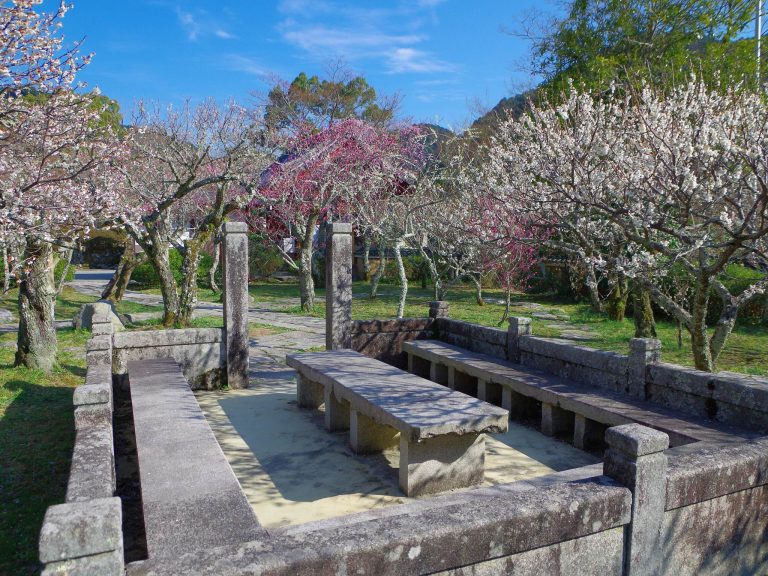
The pond described in the foundation tradition survives as the temple garden. It contains three small islands, where small shrines are said to have been established for Shōten, Benzaiten, and a third deity. Shōten is associated with prosperity and the removal of obstacles, while Benzaiten is associated with music, eloquence, and wealth. The pond therefore remains both a physical part of the temple landscape and a central element in the traditional account of Kūkai’s visit.
Kanko Shrine
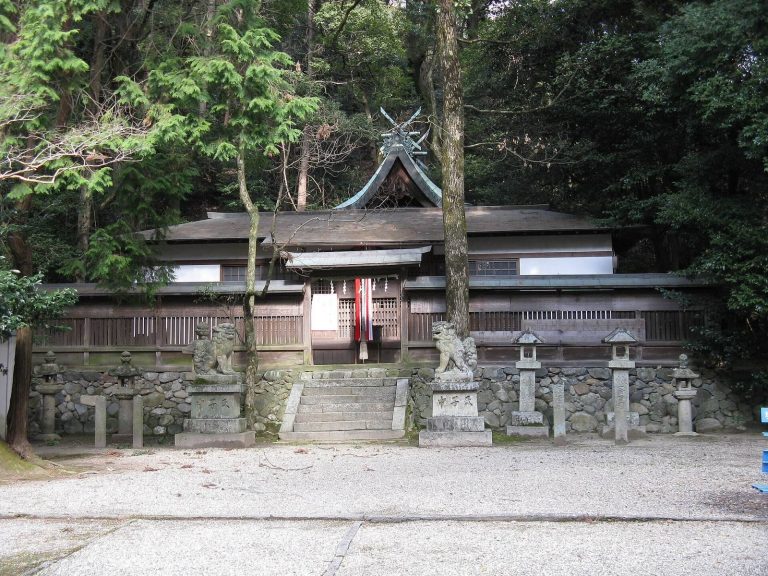
Kanko Shrine stands as an institution independent of Ryūsen-ji, a result of the Meiji-period separation of Buddhism and Shinto. It is associated with the former guardian shrine of the temple and enshrines Kamuyaimimi no Mikoto. Its present institutional identity preserves a separate expression of the religious landscape that once stood within the temple’s sphere.
Gate and Guardian Figures
Niō Gate
The Niō Gate survived the medieval burning that destroyed the other parts of the temple complex at that time. A Niō Gate is an entrance guarded by fierce Buddhist figures, and this surviving structure provides a physical link to the temple’s pre-destruction layout. Its survival also distinguishes it from the halls, pagodas, and other buildings that were lost in the wartime fire.
Kongō Rikishi Statues
Two wooden Kongō Rikishi statues remain among Ryūsen-ji’s religious objects. Kongō Rikishi are fierce Buddhist guardian figures commonly placed at temple entrances. The statues are designated tangible cultural properties by Osaka Prefecture.
Archaeological and Devotional Evidence
Nara-Period Roof Tiles
Roof tiles recovered through excavation date to the first half of the Nara period. Their presence supplies material evidence for activity at the site during the eighth century and gives the physical remains a chronological point independent of the traditional foundation story.
Prince Shōtoku Image and Deposited Materials
A wooden standing statue of Prince Shōtoku is preserved with deposited materials included in its Osaka Prefecture cultural-property designation. These materials consist of a printed paper image of Nyoirin Kannon, an ink painting on paper depicting Amida and Jizō, a printed paper image of Prince Shōtoku, one talisman, and one fragmentary document. Together with the statue, they form a group of devotional materials connected with the temple’s religious history.