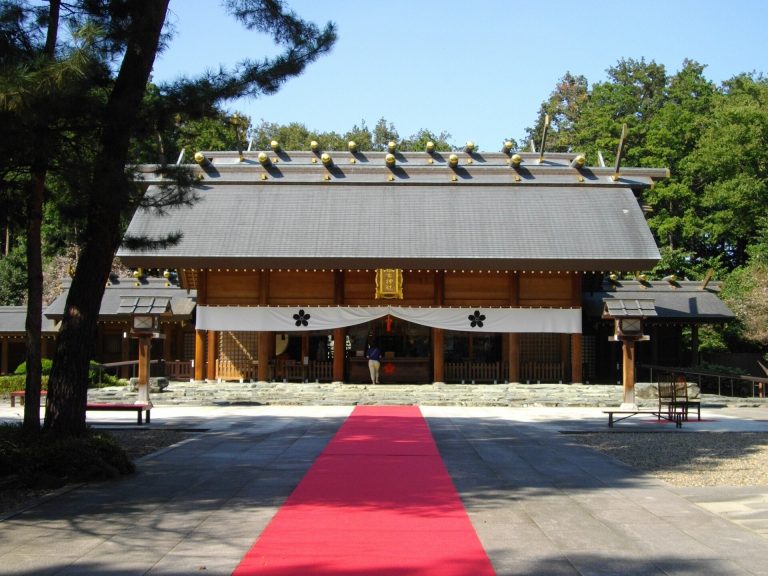
Kanamura Wake Ikazuchi Shrine: A Thunder-Deity Shrine in Tsukuba, Japan


Site at a Glance
- Rating
- 4.1
- Popularity
- Low
- Country
- Japan
- Primary era
- Early Modern
- External website
- Open
- Eras represented
- Early Modern, Modern
- Civilizations
- Japanese, Tokugawa
- Site type
- Religious
- Remains
- Sanctuary
On this page13 sections
History
Kanamura Wake Ikazuchi Shrine is a Shinto shrine in Tsukuba, Japan, dedicated to the thunder deity Kamo Wake-ikazuchi. Founded in 931 during the reign of Emperor Suzaku, it became a regional center for prayers concerning rainfall, agriculture, household safety, and protection from calamity. The shrine is also known locally as Kanamura-sama and Raijin-sama, and is regarded as one of the three major Raijin shrines of the Kanto region. Under Japan’s modern shrine-ranking system, it was formerly classified as a district shrine.
Foundation traditions
The shrine’s traditional founding date is March 15, 931. Toyoda-ko, described as the first lord of the Toyoda domain, is said to have invited a divided manifestation of Kamo Wake-ikazuchi from Kamo Wake-ikazuchi Shrine in Kyoto. A divided manifestation was understood as the same sacred power appearing at another place, allowing the deity to be worshipped locally.
Another foundation tradition links the shrine to the Earlier Nine Years’ War, a conflict involving the Minamoto and Kiyohara clans in the eleventh century. While accompanying the Minamoto commander Minamoto no Yoshiie against Kiyohara no Takehira, Toyoda-ko was reportedly unable to cross the Abukuma River. According to the tradition, a dragon emerged from a golden dragon banner granted by Emperor Go-Reizei and formed a bridge across the river. After crossing and winning the military engagement, Toyoda-ko is said to have established the shrine and placed the golden banner there as its sacred object. The name Kanamura, meaning “golden village,” is associated with this story.
Village shrine and syncretic administration
Kanamura Wake Ikazuchi Shrine remained at Kamigo for many centuries, although few records survive from its earlier history. An 1800 village register called it a “water shrine,” reflecting its connection with rain and water. The shrine may have deteriorated after the Toyoda clan lost power and the Tagaya clan took control. The same register states that villagers later rebuilt it, while Sone Gorozaemon received the present shrine site during the 1670 land survey. The shrine was subsequently relocated to that site.
During the Edo period, the shrine operated within a Shinto-Buddhist syncretic institution, a system that combined shrine worship with Buddhist administration and ritual. The Buddhist temple Myoko-in maintained a deputy administrative office at the shrine. Members of the Toyoda family or their senior retainers appear to have held that office and managed the shrine while the Toyoda clan remained powerful.
The Meiji-era separation of Buddhism and Shinto ended this arrangement. Myoko-in was closed, and Buddhist elements were removed from the shrine institution. In 1815, during the late Edo period, a monument to the magistrate Takegaki Naoharu was erected in the grounds. He was remembered for benevolent governance after entering the Kamigo administrative headquarters. Local belief held that rubbing the monument would bring good fortune in childbearing.
Rainmaking and regional worship
Kamo Wake-ikazuchi was worshipped through both a powerful aspect, associated with thunder that brings rain and destroys crop pests, and a benevolent aspect, associated with life-giving rainfall. The shrine consequently became a center of rainmaking and agricultural protection in the Kanto region. People also prayed there for household safety, freedom from illness, protection from lightning, and healing from smallpox.
The well in the precinct was regarded as a sign of the deity’s sacred power and was used in rainmaking rites until around the 1960s. In the late Edo period, a settlement of shops and lodging houses developed along the approach for roughly 250 meters. It survived until the 1960s, when improvements to the Kokai River moved the settlement to the left bank of the embankment and separated it from the shrine. The former settlement area is now used for parking.
Devotional associations known as ko, voluntary groups organized around shared worship, offerings, or proxy pilgrimage, formed the shrine’s wider religious network. Daidai-ko groups offered daidai kagura, formal sacred dance, at the spring and autumn festivals. They also received household and agricultural talismans and prayed for protection from hail, lightning, and insect damage. Kinen-ko groups distributed New Year’s talismans by post, although their links with the shrine weakened and some dissolved into individual worship.
Nichigetsunensanko groups organized daily, monthly, or annual proxy pilgrimages. Most now make an annual visit, praying for protection against epidemics and other calamities entering a settlement. Spring-and-autumn associations made collective visits in April or November, and some continued traditions that began in the Edo period.
The shrine’s worship sphere included 218 Kanamura-ko groups across Ibaraki, Chiba, Saitama, Tokyo, Tochigi, and Fukushima in 1949. By 1995, it had contracted to Ibaraki, Chiba, Saitama, and Tokyo, with especially marked decline in urbanizing parts of Chiba and Saitama. The groups were concentrated south and west of the shrine. Mountains separating this area from Mito’s Wake-ikazuchi shrine limited overlap between the two spheres.
In the nearby worship sphere, including the Toyosato area of Tsukuba, Kanamura-ko organizations became subordinate to other religious or neighborhood groups and mainly distributed talismans. They also attracted guardian-deity worship that was not directly connected with the original thunder cult. In more distant places such as Yoshikawa in Saitama, the groups remained independent, retained older thunder-centered worship, and generally relied on proxy visits.
Festivals and modern recognition
The principal annual festival was formerly held on the fifteenth day of the third lunar month. Since 1993, it has taken place on the third Saturday and Sunday of April as the Spring Grand Festival, also called Oraimachi. Dragon-deity and children’s dances are performed, while red-and-white rice cakes are scattered as prayers for freedom from illness. A related pilgrimage custom involved preparing red rice and mugwort rice cakes.
On January 1, the Mezame Festival, or first New Year’s prayer, celebrates the awakening of the dragon deity, who is believed to have gone to sleep on November 26. Spring and autumn festivals are also associated with formal sacred dances. In fiscal year 1995, more than half of recorded individual prayers concerned household safety. Traffic safety, business prosperity, protection from misfortune and unfavorable directions, and Shichi-Go-San rites followed. Prayers for protection from lightning and wind ranked eighth, while farmers and electric-power companies also requested rites for lightning and fire prevention.
Individual worshippers came from Ibaraki, Tochigi, Chiba, Saitama, Tokyo, Kanagawa, Nagano, and Aichi, with 85.2 percent from Ibaraki. The shrine’s parish area comprises Kamigo, Tegomaru, Nobata, Kakunai, and Kimata, five local divisions of the Toyosato district of Tsukuba. About 34 percent of individual worshippers made their prayers on New Year’s Day.
The former Toyosato town designated the worship hall, kagura hall, and corridor as cultural properties in 1980. After Tsukuba City was created, they became city-designated tangible cultural properties. Ibaraki Prefecture designated the main sanctuary, its ridge-pole tablet, and its protective covering structure as tangible cultural properties in 1991. The shrine is also included among the Ibaraki Hundred Scenic Landscapes.
Remains
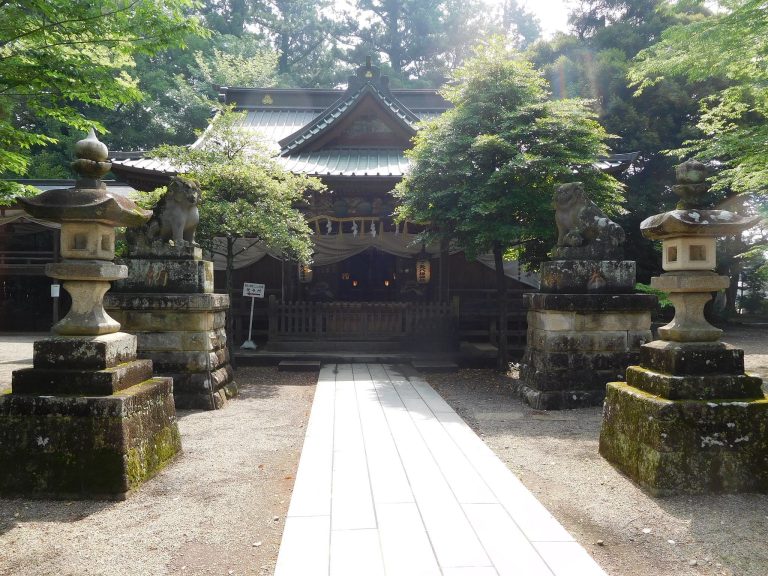
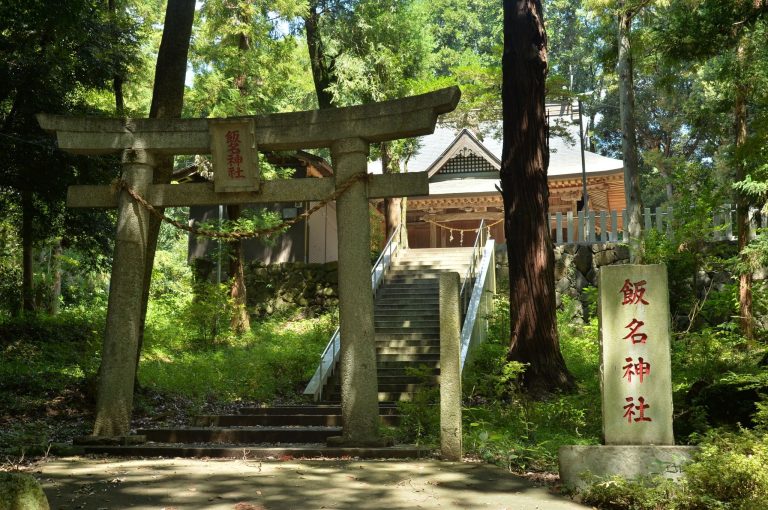
Kanamura Wake Ikazuchi Shrine stands beside the Kokai River in Kamigo, on an alluvial floodplain about 14 meters above sea level. The surrounding land is prone to flooding, while the shrine precinct itself was reportedly never inundated. The grounds cover 1,613 tsubo, approximately 5,532 square meters, and contain mature Japanese zelkova and hackberry trees. A torii marks the approach, whose former line of shops and lodging houses is now separated from the shrine by the river embankment and used as a parking area.
Principal shrine buildings
Main sanctuary
The main sanctuary is a one-bay nagare-zukuri structure, a shrine form with a roof slope extending forward over the entrance. It has a kokera-shingle roof made from thin wooden shingles and extensive carved decoration. Its date is generally placed in 1714 on the basis of its ridge-pole tablet. The sanctuary and tablet are protected as prefectural tangible cultural properties.
Protective covering
A protective covering with a copper-sheet roof encloses the main sanctuary. It is considered to have been rebuilt in 1831 and is included with the sanctuary in the prefectural cultural-property designation. The covering preserves the relationship between the later protective structure and the older sanctuary within the precinct.
Worship hall
The worship hall is an irimoya structure, whose roof combines hipped and gabled sections. Rebuilt in 1879, it has a corrugated-metal roof and covers 32 tsubo, approximately 105.8 square meters. A shrine-name plaque, banners, and drum inside the hall were donated by worship associations.
Kagura hall
The kagura hall, a building for sacred dance and musical performance, has a tiled roof and was also rebuilt in 1879. It covers 7.5 tsubo, approximately 24.8 square meters. Its role is connected with the formal dances offered during the shrine’s seasonal festivals.
Corridor
The corridor was rebuilt in 1879 and has a corrugated-metal roof. Together with the worship hall and kagura hall, it forms part of the group of buildings recognized first by the former Toyosato town in 1980 and later by Tsukuba City.
Well, subsidiary shrines, and monument
The precinct contains the well associated with the shrine’s rainmaking power, as well as numerous subsidiary shrines. These are connected with Inari, Hachiman, Itsukushima, Tenmangu, Atago, Kashima, Matsuo, Raiden, and the water deity. Other subsidiary shrines are associated with Tansho, Tsunumi, Shinmei, Mishiro, Suga, Kifune, silkworm production, and the wind deity.
The monument to Takegaki Naoharu is formally known as the “Monument to Takegaki’s Virtuous Governance.” Its inscription was composed by the Confucian scholar Kameda Bosai. Erected in 1815, it preserves the local memory of Takegaki’s administration and the belief that contact with the monument could bring good fortune in childbearing.