Hōjū-ji Temple: A Tendai Buddhist Temple in Kyoto


Site at a Glance
- Rating
- 4
- Popularity
- Low
- Country
- Japan
- Primary era
- Medieval
- External website
- Open
- Eras represented
- Medieval
- Civilizations
- Unclassified
- Site type
- Religious
On this page8 sections
History
Hōjū-ji Temple is a Tendai Buddhist temple in Kyoto, Japan, founded in 988 by Fujiwara Tamemitsu. Its principal image is Acala, the Buddhist wisdom king regarded as a fierce protector. Tamemitsu is said to have established the temple in memory of his wife and daughter, Fujiwara no Shishi, who had died in 985. The original site of this foundation is unknown.
Foundation and the Hōjūjidono complex
The early temple was destroyed by fire in 1032. During the mid-twelfth century, Hōjū-ji and its associated residences were developed into the Hōjūjidono complex, a large religious and residential center. Shinzei, also known as Fujiwara no Michinori, was involved in its construction. The complex brought together imperial residences, Buddhist halls, shrines, and gardens.
After abdicating in 1158, Emperor Go-Shirakawa used Hōjū-ji as his cloistered residence. Cloistered rule allowed a retired emperor to continue exercising political authority from a separate court and residence. Construction of the palace complex probably began around 1161, and Go-Shirakawa moved into its newly built southern residence that year. The estate later included several residences, religious buildings, and associated shrines.
In 1160, shrines dedicated to Hiyoshi and Kumano were established within the precinct. These became New Hiyoshi Shrine and New Kumano Shrine. In 1169, Go-Shirakawa took Buddhist vows under Kakuchū, chief administrator of Onjō-ji. Myōhō-in was later transferred from Mount Hiei to an area east of the Kamo River, where it became closely associated with Hōjū-ji and New Hiyoshi Shrine.
Imperial residence, conflict, and rebuilding
Hōjūjidono was drawn into the military struggles of the late twelfth century. In 1183, during the Hōjūjidono conflict, forces led by Kiso Yoshinaka attacked the complex, burned the southern residence, killed many occupants, and seized Go-Shirakawa. The retired emperor escaped through the northern gate toward New Hiyoshi Shrine before he was taken. He later moved to the Chōkōdō residence at Rokujō-Nishinotōin.
Minamoto no Yoritomo ordered the rebuilding of Hōjūjidono in 1191. Archaeological evidence indicates that the southern residence may not have been completely destroyed, since its excavated roof tiles show no clear signs of fire. Contemporary records describe the work as repairs, suggesting a more complex rebuilding process than a total replacement.
Go-Shirakawa died in 1192 and was buried at Hōjūjidono. Hōjū-ji then continued to protect his mausoleum until the end of the Edo period. The temple also retained a close relationship with Myōhō-in. Under the Edo shogunate, it was treated as an affiliated institution, or inke, of the Myōhō-in monzeki, a high-ranking Buddhist institution traditionally connected with imperial or aristocratic families. Tombs of successive imperial-prince abbots of Myōhō-in were located within the temple grounds.
Later history and continuing traditions
During the period of Toyotomi Hideyoshi, nearby Hōkō-ji incorporated Hōjū-ji and Rengeō-in into its larger temple area. The connection with Go-Shirakawa’s mausoleum continued, as shown by an Edo-period stone water basin bearing the temple’s name in the adjoining tomb precinct.
Hōjū-ji is traditionally associated with Ōishi Kuranosuke, who is said to have worshipped there during the Genroku era. This association led to the installation of wooden figures representing the Forty-Seven Rōnin, the retainers whose revenge for their lord became one of Japan’s best-known samurai narratives. Their memorial observance is traditionally held on December 14.
In the late Edo period, a scholar questioned the identification of Go-Shirakawa’s mausoleum. The temple’s abbot is said to have excavated beneath it and found a stone container holding human remains, in accordance with historical records. At the beginning of the Meiji period, the mausoleum and the tombs of the Myōhō-in imperial-prince abbots were separated from the temple precinct and placed under the authority of the Imperial Household Ministry. Hōjū-ji was renamed during the Meiji period and resumed its historic name in 1955.
Early in the Meiji period, an image of Amida Buddha associated with Shinran and a statue showing Shinran eating soba were transferred to Hōjū-ji from Bukō-ji. The temple remains connected with Go-Shirakawa’s mausoleum, where a replica of a statue of the retired emperor was installed in 1991. Hōjū-ji is also the mortuary temple of manga artist Machiko Hasegawa. After she developed an association with the temple through places connected with The Tale of the Heike, part of her remains was transferred there after her death.
The temple preserves traditions associated with Go-Shirakawa, including performances of imayō, a medieval Japanese song form linked with court culture. Its observances include a memorial service for Go-Shirakawa, an imayō song contest, an annual Acala festival with a fire ritual and court-music performance, a radish-cooking observance for Acala, and a memorial festival for the Forty-Seven Rōnin.
Remains
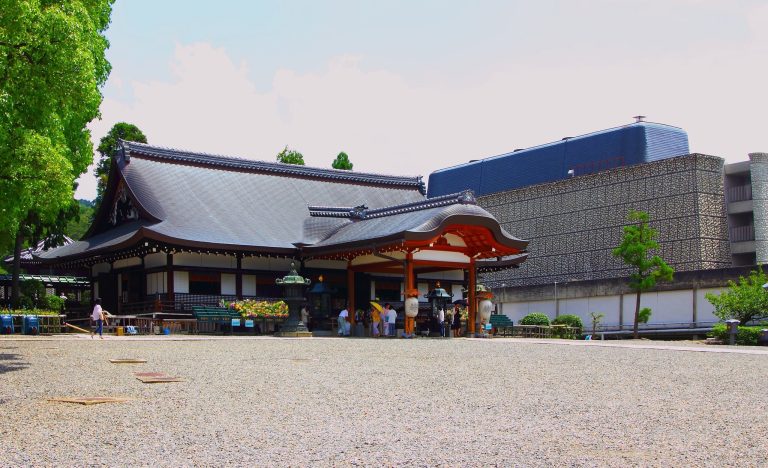
The former Hōjūjidono estate extended for more than 14 hectares along Shichijō Street, from the Kamo River toward the Higashiyama foothills. Archaeological remains in the area reach back to the early Heian period and include installations used for ritual deposition. The present temple preserves a smaller part of this long historical development, with its entrance gate, religious images, memorial precinct, and surviving elements associated with the former complex.
Temple buildings and principal image
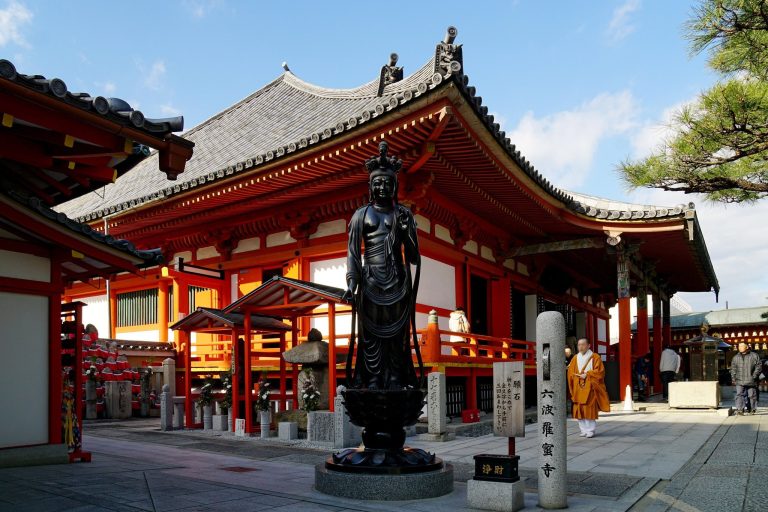
The present entrance gate is known as the Ryūgūmon. Inside the temple, the principal image is a statue of Acala called the Substitute Acala. It is considered stylistically related to the Heian period and is traditionally attributed to Ennin, also known as Jikaku Daishi, a prominent Tendai monk.
The Substitute Acala is traditionally believed to have protected Go-Shirakawa during Yoshinaka’s attack by taking the retired emperor’s place. The statue remains the focus of the annual Acala observance, which includes a fire ritual and court-music performance.
Hōjūjidono residences and religious complex
The southern residence, also called the Southern Palace or Higashiyama Residence, was organized around a central shinden-style hall, a formal aristocratic residence, with a garden pond along its southern side. Its buildings were reportedly transferred from the Naka-Gomon-Nishinotōin residence of Fujiwara no Nobuyori.
The northern residence, known as the Shichijō Residence, comprised a western lower residence beside the Shichijō riverbank and an eastern upper residence called the Eastern Residence. The western part later became known as the Viewing Pavilion. A new palace was built at Yamashina in 1167, while a new Buddhist hall and an Acala Hall were also established within the wider complex.
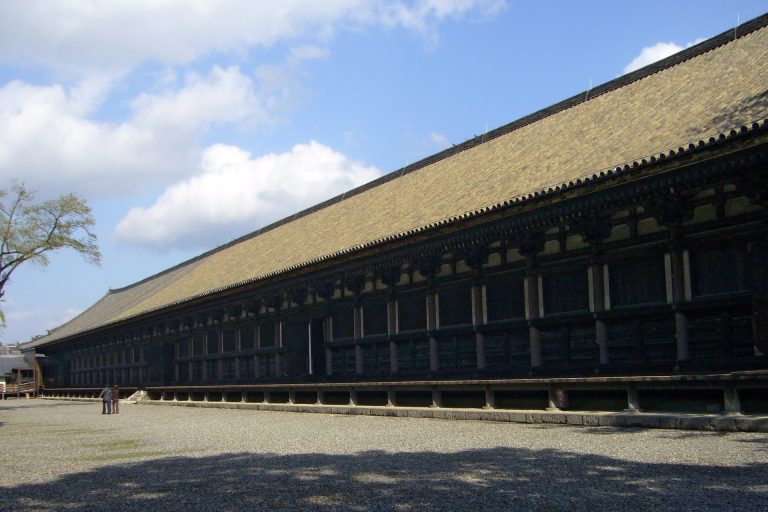
Rengeō-in, now widely known as Sanjūsangen-dō, was commissioned by Taira no Kiyomori in 1164. Its name refers to the Lotus King, and the hall is especially known for its great length and its ensemble of Buddhist images. Rengeō-in stood within Hōjūjidono, while Saishōkō-in occupied a position to its southwest.
Memorial halls and mausoleum precinct
Two Lotus Samadhi Halls stood east of Rengeō-in. These were Buddhist halls associated with the Lotus Sutra and its devotional practices. The southern hall contained Go-Shirakawa’s tomb, while the northern hall contained the tomb of Kenshunmon’in, the name used by Taira no Shigeko, one of Go-Shirakawa’s consorts. The northern hall was severely damaged by the fourteenth century, while the hall associated with Go-Shirakawa is the one that survives.
Go-Shirakawa’s tomb lies in an adjoining mausoleum precinct with a Hokke Hall. The precinct is physically next to Hōjū-ji but has been institutionally separate since the Meiji period. The temple grounds also contain wooden figures of the Forty-Seven Rōnin, a replica of Go-Shirakawa’s statue, the transferred images associated with Shinran, and a calligraphic display by Machiko Hasegawa depicting Sazae, Wakame, and Tara.