Rokuō-in Temple: An Independent Rinzai Zen Temple in Kyoto


Site at a Glance
- Rating
- 4.3
- Popularity
- Low
- Country
- Japan
- Primary era
- Medieval
- External website
- Open
- Eras represented
- Medieval
- Civilizations
- Ashikaga shogunate
- Site type
- Religious
- Remains
- Monastery
On this page9 sections
History
Rokuō-in Temple is an independently administered Rinzai Zen temple in Kyoto, Japan. Its predecessor, Hōdōji, was founded in 1380 by Ashikaga Yoshimitsu, the third shogun of Japan’s Muromachi shogunate and a major patron of Zen institutions, with the monk Shun’oku Myōha as its founding abbot. The temple belonged to the Rinzai tradition, a major Japanese form of Zen Buddhism centred on disciplined monastic practice and meditation, including the use of koans.
Foundation and religious traditions
Hōdōji was first called Kōshōji and later received its better-known name. Tradition connects its foundation with a warning delivered to Yoshimitsu in a dream or vision, telling him that a temple dedicated to Hōdō Nyorai would extend his life. Another version says that Yoshimitsu overheard Tamonten and Jizō discussing the establishment of such a temple.
Rokuō-in was founded in 1387 as a subtemple responsible for protecting Shun’oku Myōha’s pagoda tomb, a memorial structure commemorating a Buddhist monk’s remains. The tomb was built during his lifetime, and Shun’oku died in 1388. The name Rokuō-in is linked both to herds of wild deer said to have occupied the land when it was opened and to the Deer King of Deer Park, associated with the place where Shakyamuni first preached.
Institutional authority and wartime destruction
As Hōdōji’s only subtemple, Rokuō-in became the headquarters of the Shun’oku branch. It recommended Hōdōji’s abbots to the shogunate, controlled the appointment and dismissal of abbots at fifteen affiliated branch temples, and administered estates scattered across different areas.
Hōdōji grew prosperous and ranked fifth among Kyoto’s Ten Zen Temples. The Ōnin War, a civil conflict from 1467 to 1477 that caused extensive destruction in Kyoto, brought the complex to an end when it was burned in 1468. Rokuō-in alone survived because it contained the founder’s hall. It consequently inherited Hōdōji’s historical records and institutional status.
Earthquake, revival, and later rebuilding
The Keichō Fushimi Earthquake of 1596 caused the main hall to collapse and left the precinct in disrepair. During the Kanbun era, from 1661 to 1673, Koshin Genchiku, a son of the hatamoto Sakai Tadachika, led the temple’s revival and became known as its restoration founder. The Sakai family, the ruling house of the Tsurugaoka domain, provided protection for the renewed institution.
The guest hall was rebuilt in 1890 during the tenure of the abbot known as Gasan. Rokuō-in remains associated with the Rinzai tradition while continuing to operate as a separately administered institution rather than as a subordinate temple. Its grounds adjoin Donge-in on the west.
Remains
Surviving precinct
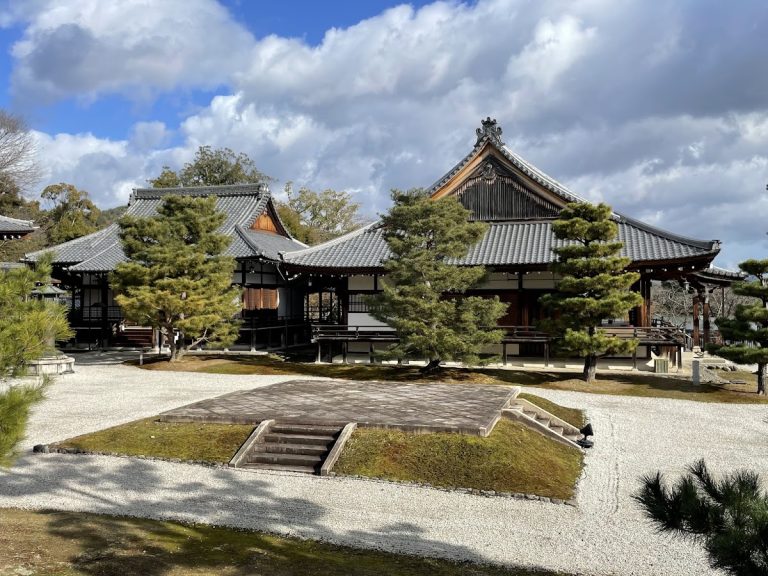
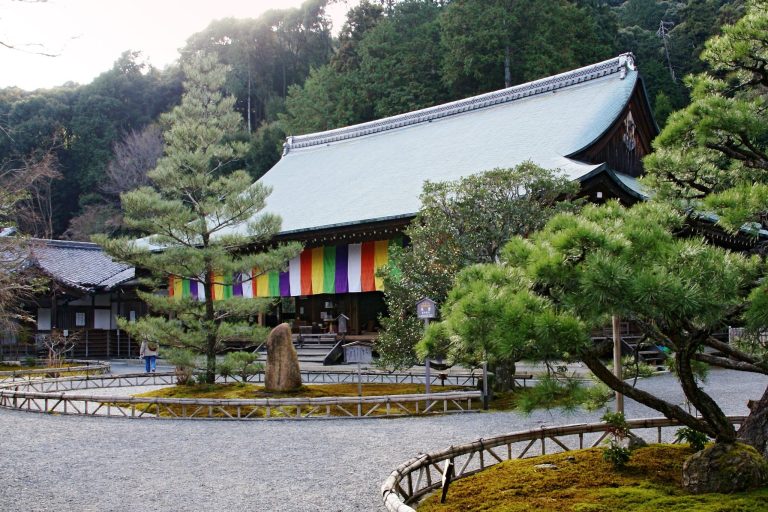
Rokuō-in’s surviving precinct includes a reliquary hall, a dry landscape garden, and a guest hall. A dry landscape garden is composed mainly of arranged rocks, gravel, and limited vegetation rather than ponds or flowing water. The complex stands in the Kita-Horimachi area of Saga, in Kyoto’s Ukyo Ward. Its principal image is Shakyamuni Buddha.
Reliquary hall
The reliquary hall belongs to the part of Rokuō-in associated with the memorial foundation established for Shun’oku Myōha. The temple’s survival after Hōdōji was burned in 1468 is connected with its founder’s hall and pagoda tomb, and this surviving institutional core carried forward Hōdōji’s records and status.
Dry landscape garden
The precinct’s dry landscape garden uses the Japanese garden tradition of arranging rocks, gravel, and restrained vegetation to create a composed setting without flowing water. It forms part of the surviving temple grounds alongside the reliquary hall and the other buildings.
Guest hall
The guest hall was rebuilt in 1890 and forms part of the temple complex in its present historical sequence. Its reconstruction belongs to the later phase of Rokuō-in’s development after the seventeenth-century revival.