Kalan Mosque: Bukhara’s Historic Congregational Friday Mosque


Site at a Glance
- Rating
- 4.8
- Popularity
- Medium
- Country
- Uzbekistan
- Primary era
- Early Modern
- Eras represented
- Medieval, Early Modern, Modern
- Civilizations
- Timurid
- Site type
- Religious
- Remains
- Mosque
On this page9 sections
History
Kalan Mosque is the historic congregational Friday mosque of Bukhara, Uzbekistan, whose present form belongs to the sixteenth-century Shaybanid period. It forms part of the Po-i Kalyan complex with the Kalyan Minaret and Miri Arab Madrasa, and is also associated with the Amir Olim Khan Madrasa. As Bukhara’s principal mosque, it preserves the site of a long succession of buildings used for communal Friday prayer.
Early Islamic mosques
Congregational mosques existed in Bukhara from the early period of Islam’s expansion into the region. After Qutayba ibn Muslim, an Umayyad governor of Khorasan and commander of the Arab conquest of Transoxiana, captured the city in 709, tradition places a large mosque in the citadel in 712 or 713. It may have occupied the site of an earlier Zoroastrian or Buddhist temple. Qutayba was also said to have encouraged conversion by paying worshippers two dirhams and allowing prayers in Sogdian rather than Arabic.
By 770, the first mosque had become too small, and Khalid ibn Barmak built another between the citadel and the city. The older building later deteriorated and was converted into a tax-collection office. A mosque built or replaced in 793 or 794 was enlarged by about one-third under Ismail Samani, the Samanid emir.
Early in the reign of Nasr II, a mosque collapsed during Friday prayer, killing many people. It was rebuilt in the same year, collapsed again without casualties, and was rebuilt five years later. That structure endured until 1068, when fire destroyed it during a deadly battle for control of Bukhara.
From the Karakhanids to the Mongol conquest
After 1068, the mosque was rebuilt several times, with successive buildings placed farther from the citadel. By 1121 or 1122, it had reached the location of the present mosque. Its arrangement was probably similar to that of the mosque built under Arslan Khan, a Karakhanid ruler, although the exact plans of this and earlier buildings are not known.
A later collapse of the minaret destroyed about two-thirds of the twelfth-century mosque, which was subsequently rebuilt. The building survived until Bukhara was captured by the forces of Genghis Khan in 1219 or 1220. Genghis Khan, founder and first great khan of the Mongol Empire, was reportedly so impressed by its size that he initially believed it was the ruling family’s palace. After entering on horseback and learning that it was the House of God, he ordered Quran stands to be used as feed troughs and desecrated the pulpit before his troops plundered the city.
The mosque was burned and destroyed along with most of Bukhara. The Kalyan Minaret, which had also impressed Genghis Khan, survived. The mosque then remained in ruins for several centuries, during a period when Bukhara itself was nearly abandoned for decades.
Timurid and Shaybanid rebuilding
The ruins were cleared during the Timurid period, from 1370 to 1507, although the reconstruction undertaken at that time is not recorded in detail. A rebuilding possibly carried out during the reign of Mirzo Ulugh Beg, a Timurid ruler and scholar, has also been proposed.
Under Ubaidullah Khan, the Shaybanid ruler, the mosque underwent a major rebuilding and decoration campaign. The present facade was completed in 1514 or 1515, additional ornament was applied during the 1530s, and completion of the present building is dated to 1541. The work made Kalan Mosque one of the earliest major monuments of the Shaybanid dynasty, which established the Bukhara Khanate, and expressed Bukhara’s renewed prominence in the sixteenth century.
Modern religious use and preservation
During the Soviet period, the mosque was closed for worship and was used as a granary in 1935. Friday prayers were held instead at the Miri Arab Madrasa. Religious use resumed after Uzbekistan became independent.
In 1542, a marble plaque bearing a decree by the Bukhara khan Abdulaziz Khan was installed at the main entrance. Written by the calligrapher Mirshaikh al-Pourani, it exempted Bukhara’s residents from certain taxes. A second marble plaque of the same size was installed opposite it in 1996. It records Islam Karimov’s decree transferring the mosque to the jurisdiction of the Muslim Board of Uzbekistan.
Kalan Mosque was renovated in 1997 as part of preparations for Bukhara’s 2,500th anniversary. Its waqf documents, records of a permanent religious endowment supporting an institution, were first translated into Uzbek by M. Yu. Saidjanov. The mosque is part of the UNESCO World Heritage property Historic Centre of Bukhara, inscribed in 1993, and is included in Uzbekistan’s national register of material and cultural heritage. Its repeated destruction and rebuilding reflect Bukhara’s enduring importance as a major Islamic city in Central Asia.
Remains
Courtyard and surrounding galleries
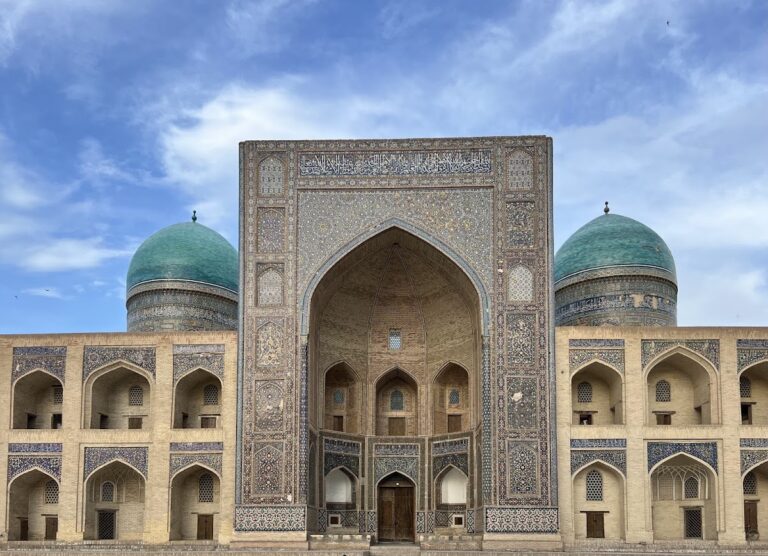
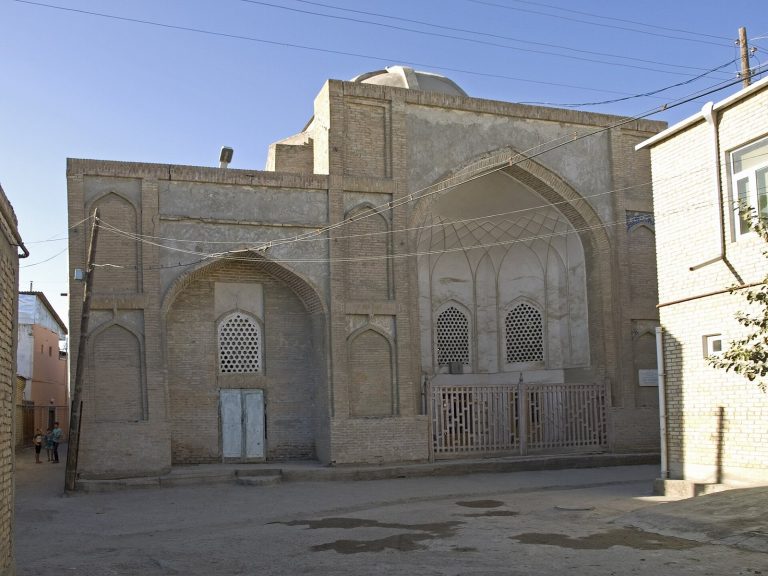
Kalan Mosque is a one-story rectangular building measuring approximately 130 by 80 metres, constructed with brick, wood, and concrete. Its inward-facing plan centers on a large courtyard surrounded by covered, vaulted galleries and four iwans, vaulted halls or recesses open on one side. The galleries contain 288 small domes supported by 208 columns or monumental piers. Decorated iwans occupy all four sides of the courtyard, while the eastern outer iwan is especially notable for its scale and elaborate ornament.
The mosque has seven outer gates. Its principal eastern entrance consists of a monumental outer portal facing Po-i Kalyan Square and an inner portal facing the courtyard. Broad verandas extend in front of the outer portal and within the mosque. The relatively low arcaded courtyard walls allow neighboring buildings to remain visible. The alignment with Miri Arab Madrasa permits its domes to rise above the eastern arcade, while the much taller Kalyan Minaret strengthens the complex’s upward and outward visual effect.
Prayer area and eastern axis
The courtyard’s longitudinal axis ends at the maksura, an enclosed or specially defined area near the prayer niche traditionally associated with the ruler or leading officials. Here it takes the form of a portal-and-dome structure containing a cross-shaped hall. A substantial blue dome rises above the hall on a drum covered with mosaic. Blue domes also identify the area of the prayer niche.
The mihrab, the niche indicating the direction of Mecca, is surrounded by tiles signed by Bayazid Purani. The chamber before it has a vaulted ceiling, and its exterior dome is faced with blue glazed tiles. The dome rests on a tall drum covered with Kufic inscriptions, an angular style of Arabic calligraphy, with a ring of muqarnas, stepped or cellular architectural forms, mediating between the drum and the dome.
Facade, courtyard features, and later additions
The facade combines faience and mosaic work with colored glazed bricks, wall arches, vegetal decoration, and inscriptions. Six-sided plates are associated with Bayazid Purani, while fifteenth-century borders survive beneath the covering of the front facade. Parts of the decorative work have been conserved and restored.
Around 1915, the Bukhara architect Usto Shirin Muradov built an octagonal pavilion at the inner portal over the burial place of one of the mosque’s early imams. The pavilion functions as a pulpit and was designed in accordance with the mosque’s earlier appearance. The courtyard is described as containing a small kiosk at its western end and a solitary tree to the kiosk’s eastern side.
Archaeological research has identified remains of two earlier mosques beneath the present structure. The lower mosque was built under Arslan Khan and had the same dimensions as the current building. The other, dating from the first quarter to the middle of the fourteenth century, belonged to the same general type but was built entirely of brick. The original minaret was retained during the Shaybanid rebuilding, preserving a physical link with Bukhara’s pre-Mongol history.