Hanishina Kofun Group: Keyhole-Shaped Burial Mounds in Japan


Site at a Glance
- Rating
- 4.4
- Popularity
- Low
- Country
- Japan
- Primary era
- Classical
- Eras represented
- Classical
- Civilizations
- Unclassified
- Site type
- Burial
- Remains
- Necropolis
On this page8 sections
History
The Hanishina Kofun group is an archaeological complex of four keyhole-shaped burial mounds in Japan, around Yashiro in Chikuma and Nagano. Built during the Kofun period, when monumental Japanese burial mounds were constructed chiefly between the third and seventh centuries, the group consists of Mori-Shogunzuka, Ariakeyama-Shogunzuka, Kurashina-Shogunzuka, and Doguchi-Shogunzuka. The surrounding basin contains many additional tombs dating from approximately the late fourth to the early sixth centuries, showing that the area was a center of the pre-Yamato Shinano kingdom and was connected with the emergence of the polity that later became Shinano Province.
Regional rulers and the Kofun period
Mori-Shogunzuka was built during the fourth century, probably toward its end, and is regarded as the tomb of a local ruler. One tradition identifies the occupant as the first traditional provincial governor of ancient Shinano, although the person buried there remains uncertain. The tomb’s construction and the objects placed within it indicate connections with the Yamato polity, the early state centered in the Kinai region of central Japan that gradually extended influence over other regional ruling groups during the Kofun period.
Ariakeyama-Shogunzuka dates from approximately the late fifth to early sixth century. Kurashina-Shogunzuka was built later than Mori-Shogunzuka during the middle phase of the Kofun period, while Doguchi-Shogunzuka was constructed at about the same time. Together, the four tombs represent successive phases of burial and changing expressions of authority within the Shinano region.
Later reuse and archaeological protection
Kurashina-Shogunzuka was partly demolished during the Muromachi period, the era from the fourteenth to the sixteenth century associated with the Ashikaga shogunate. Its material was used in the construction of early Washio Castle, and the mound was also considered to have formed part of the castle complex. Doguchi-Shogunzuka was excavated jointly by the cities of Nagano and Chikuma from 1982 to 1986, while Ariakeyama-Shogunzuka was completely excavated in 1999 and then backfilled.
Mori-Shogunzuka became a National Historic Site of Japan in 1971. Ariakeyama-Shogunzuka, Kurashina-Shogunzuka, and Doguchi-Shogunzuka were added to the protected designation on February 6, 2007, bringing the four tombs under unified protection. Mori-Shogunzuka was extensively reconstructed from 1981 to 1992 to restore its presumed original appearance. The group is now incorporated into Shinano-no-Sato Historic Park, which includes the Mori-Shogunzuka Kofun Museum and the Nagano History Museum. Excavation and reconstruction have made the funerary architecture and associated artifacts available for public interpretation.
Remains
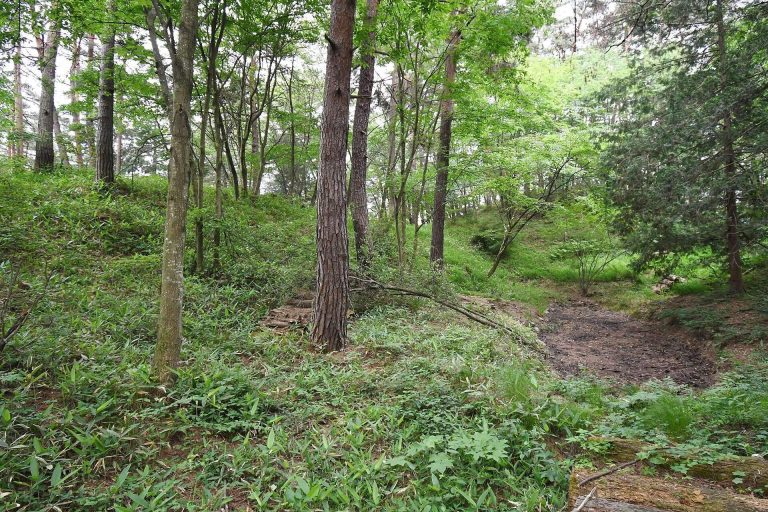
The four principal monuments are keyhole-shaped kofun, each formed from a rectangular front section joined to a rounded rear section when viewed from above. They occupy ridges and slopes around the Chikuma River basin. Their surviving forms, burial chambers, stone coverings, haniwa, and grave goods reflect varied construction methods and burial practices. Haniwa were clay funerary objects placed on or around mounds, including cylindrical markers and figurative forms representing people, animals, buildings, weapons, and other subjects.
Mori-Shogunzuka Kofun
Mori-Shogunzuka stands on a narrow, curving ridge of Mount Ariake at approximately 490 meters above sea level, about 130 to 140 meters above the plain on the right bank of the Chikuma River. Its mound is approximately 100 meters long. Steep slopes shaped its construction, leaving the monument asymmetrical: the rear circular section is close to elliptical, and the central axes of the front and rear sections differ by about 20 degrees. The front section is approximately 40 meters long, 30 meters wide, and 4 meters high, while the rear section is about 45 meters in diameter and 4 meters high.
Fukiishi, stones laid over a mound to protect its earthen construction, originally covered the surface. Three rows of haniwa surrounded the mound, including figurative examples on the summit, and these features form part of the reconstructed monument. At the center of the rear mound, a pit approximately 15 meters long, 9.3 meters wide, and 2.8 meters deep contained a vertical stone burial chamber. This chamber, reached from above rather than through a side entrance, was enclosed by a double stone wall and measured approximately 7.6 meters long, 2 meters wide, and 2.3 meters high. It is among the largest burial chambers in eastern Japan.
Although the tomb was robbed in antiquity, excavated remains include fragments of triangular-rimmed divine-beast mirrors, bronze mirrors, swords, knives, spears or pointed blade fragments, iron arrowheads, agricultural sickles, jade magatama beads, jasper tubular beads, and pottery. Magatama are curved, comma-shaped beads used as ornaments and ritual or prestige objects. The pottery includes cylindrical, jar-shaped, morning-glory-shaped, and possibly house-shaped or other unusual haniwa forms, with influences associated with the Kansai region. The mirror fragments point to a connection with the Yamato royal polity, while the combination of status-related mirrors and beads with weapons and production tools forms an unusual assemblage.
More than 13 small circular kofun and more than 76 smaller graves surrounded Mori-Shogunzuka. Wider investigations recorded nearly 100 small burial facilities, including haniwa coffins, stone coffins assembled from several slabs, and cylindrical haniwa coffins. Some remains were lost through later quarrying, while burials continued into the sixth century. The repeated interments over roughly two centuries identify the area as a cemetery for the lineage connected with Mori-Shogunzuka. A full-scale model of its burial chamber is exhibited at the Mori-Shogunzuka Kofun Museum, and artifacts from the tomb are displayed at the Nagano History Museum.
Ariakeyama-Shogunzuka Kofun
Ariakeyama-Shogunzuka lies on the same ridge as Mori-Shogunzuka and measures approximately 37 meters in length. The smaller mound had been robbed in antiquity and yielded small bronze mirrors, pottery fragments, and beads. Its complete excavation in 1999 was followed by backfilling, preserving the excavated remains below the reconstructed ground surface.
Kurashina-Shogunzuka Kofun
Kurashina-Shogunzuka is an approximately 83-meter-long keyhole-shaped mound, the third largest kofun in Nagano Prefecture. Its rear circular section contains a vertical pit-type burial chamber, while the rectangular front section contains a box-shaped sarcophagus, a durable coffin designed to hold the deceased. Robbery in antiquity disturbed the burial, but the chamber ruins produced a fragment of leather-bound triangular-plate armor. Part of the mound was later dismantled for building material during the Muromachi period, and the mound was considered to have been incorporated into early Washio Castle.
Doguchi-Shogunzuka Kofun
Doguchi-Shogunzuka is approximately 67.7 meters long and stands at the boundary between Nagano and Chikuma, at the western end of the Sasazakiyama ridge, a branch of Mount Saijoyama. Two burial chambers lay side by side in the rear circular section. Antiquity robbery disturbed the chambers, but excavations recovered fragments of armor, pottery, and glass beads.