Abbey of Saint Bertin: A Medieval Monastic Centre in Saint-Omer, France


Site at a Glance
- Rating
- 4.4
- Popularity
- Low
- Country
- France
- Primary era
- Medieval
- External website
- Open
- Eras represented
- Medieval
- Civilizations
- French
- Site type
- Religious
- Remains
- Monastery
On this page15 sections
History
The Abbey of Saint Bertin in Saint-Omer, France, is a seventh-century Christian monastery founded by Audomar, bishop of Thérouanne, with the missionary monks Bertin, Momelin, and Ebertram. Established on the Sithiu hill beside the Aa, it developed through the medieval period as a Benedictine abbey, a centre of learning, and one of the most influential monastic institutions in northern Europe.
Foundation and independence
The monastery began around 648, when the landowner Adroald gave Audomar his estate at Sithiu for a religious foundation initially dedicated to Saint Peter. An earlier community, known as the Vetus monasterium or Old Monastery, had been established in the marshes under Momelin. Because that location was too wet, a new monastery was founded on the 21-metre-high Sithiu hill, where the later Abbey of Saint Bertin grew.
Momelin became bishop of Noyon around 660, and Bertin then served as abbot of the new foundation. The monastery eventually took Bertin’s name, while the settlement around it retained the name of Saint Audomar and became Saint-Omer. The community first followed a mixed Benedictine-Columbanian rule, combining Irish and Roman monastic traditions, before joining the Cluniac reform in the twelfth century. This movement sought stricter observance of Benedictine discipline and greater independence for monasteries from secular control.
The abbey secured an unusually independent position through a charter issued by Audomar in 663. The document removed its property from episcopal control and freed the monks from the bishop’s disciplinary authority. King Chlodwig III confirmed the monastery’s immunity in 691, and an emperor reaffirmed its privileges, protection of its possessions, and exemption from outside jurisdiction in 830.
Expansion and economic power
Saint-Bertin accumulated estates, land, tithes, villages, mills, and other rights through donations and purchases, including important acquisitions in 723. From the ninth century onward, the abbey helped drain thousands of hectares of marshland and exercised wide economic influence throughout the ancien régime, the system of government and society that preceded the French Revolution.
Its ecclesiastical and seigneurial rights extended across a broad area. A priory existed at Poperinge by the ninth century, while the abbey held patronage rights in places including Lissewege, Ruiselede, Steenkerke, and Bulskamp from the twelfth century. It appointed clergy in major parishes such as Gravelines and Loon, controlled rights over mills between Arques, Bourbourg, and Lodic, and possessed churches at Chilham and Throwley in Kent. These privileges repeatedly led to disputes with local lords, towns, other monasteries, and bishops. Popes confirmed rights including the abbey’s tithe of herring in coastal and inland parishes, while also requiring payments to the papal treasury.
In 820, Abbot Fridugis divided the institution into a lower monastery beside the Aa and an upper monastery on the hill associated with Audomar’s tomb. The upper foundation later became a collegiate church, served by secular canons rather than monks, and developed into the Church of Notre-Dame, the future cathedral of Saint-Omer. Saint-Bertin itself remained a Benedictine abbey.
Relics, rulers, and destruction
The abbey’s identity was closely connected with the relics of Bertin, Folcwin, Winnoc, and Silvin of Auchy. A relic is a physical remain or object venerated because of its association with a saint or other sacred figure. Arnulf I of Flanders transferred the body of Silvin to Saint-Bertin, although a twelfth-century copy of Folcuin’s account does not explain the circumstances. During the ninth-century Viking invasions, the monastery was regarded as a fortified and relatively safe refuge, and relics from other churches and monasteries were brought there. They included relics associated with Winoc, Bavo, Pharaïlde, Saint-Valery, Saint-Riquier, and Frédegaud. Folquin, bishop of Thérouanne, hid Bertin’s relic, which was recovered in 1050 after 206 years.
Saint-Bertin was plundered and burned during Viking attacks in the ninth century, an episode dated to either 845 or 860. An earthquake destroyed the church and monastery in 894. Major fires followed in 1020 and 1031, and fire destroyed the entire abbey in 1081. In 1152, the abbey and part of Saint-Omer were burned again.
The monastery also had connections with the Frankish monarchy and the counts of Flanders. Childeric III, the last king of the Merovingians, the early medieval Frankish dynasty before the Carolingians, was confined at Saint-Bertin in the eighth century. He probably spent part of his childhood there and died at Saint-Omer in 755. Several counts of Flanders were buried at the abbey, including William Clito in 1128.
Learning and artistic patronage
Saint-Bertin became a major centre of manuscript production and historical writing. Its scriptorium, the workshop where monks copied and decorated manuscripts, produced Carolingian illuminated books in the Franco-Saxon style, including the Psalter of Louis the German. The abbey library temporarily housed the Leiden Aratea, from which two copies were made.
The Annals of Saint-Bertin survived in an early manuscript associated with the abbey and became an important record for ninth-century history, although the work was not written by a Saint-Bertin monk and does not recount the monastery’s own history. The abbey also preserved the Gesta Abbatum Sithiensium and later historical works by Folcuin and John of Ypres. Its cultural role continued during the Renaissance, when Abbot Antoine de Berghes made the institution an important centre of humanism. Between 1495 and 1532, the monk Allard-Tassar copied the Annals of Saint-Bertin and other historical texts. Part of the former library is now held by the Saint-Omer library.
The Gothic church replaced the Romanesque church begun in 1045 and 1046. Construction of the Gothic building extended over roughly three centuries, and it was consecrated in 1520. A major rebuilding phase began in April 1345, when Pope Clement VI granted indulgences to visitors on specified feast days. Between 1455 and 1459, Abbot Guillaume Fillastre commissioned Simon Marmion to create a major altarpiece for the high altar.
Revolution and later conservation
The French Revolution ended the monastic community. The abbey became national property in 1789, and monastic vows and regular religious orders were suppressed in 1790. The monks were expelled in August 1791, first seeking refuge at Saint-Nicolas d’Arrouaise and Bapaume before dispersing. In 1792, the conventual buildings were sold, the bells were broken, and the remaining furnishings and objects were auctioned publicly. The buildings were initially used as a hospital for the French army, while dismantling began that same year.
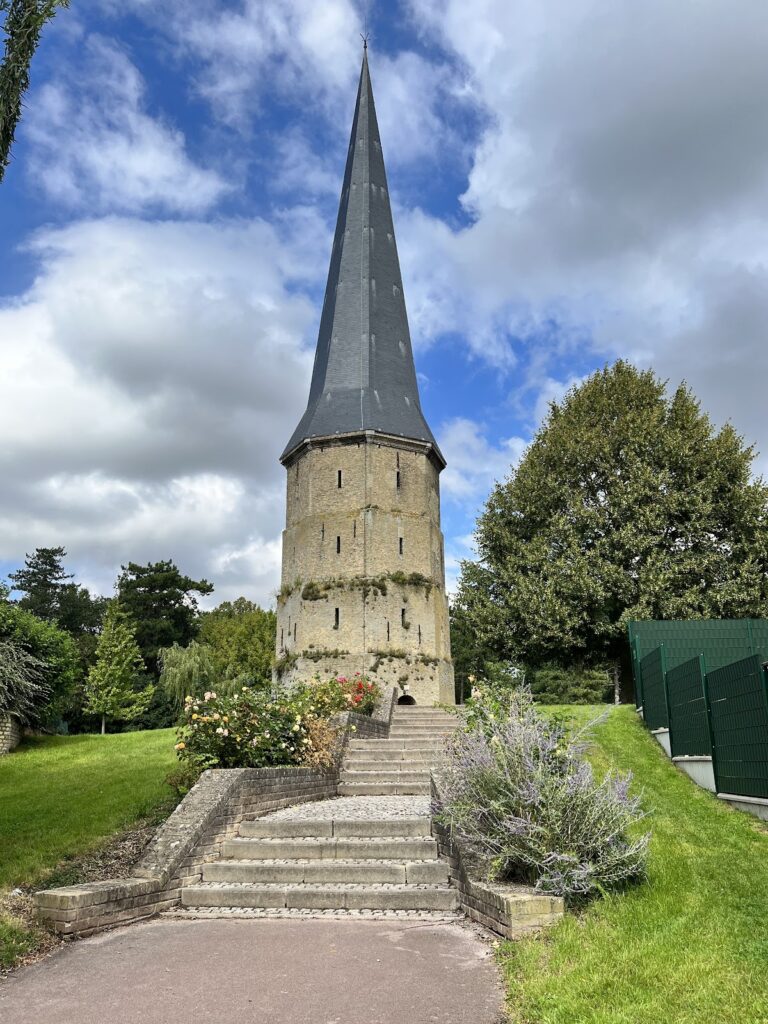
The abbey church was sold in 1799 on the condition that its tower and three buttresses remain standing. Saint-Omer became the owner of the ruins in 1811. The church was demolished in 1830, and stone from the complex was reused in public buildings, including the town hall, a music school, and a slaughterhouse. The town hall was built partly with stone removed from the abbey in 1834. The ruins were classified as a French historic monument in 1840. The surviving tower later collapsed in 1947 after Second World War shelling and prolonged neglect. Since 2007, a programme has sought to enhance the ruins and their surroundings, which are now arranged as an urban park.
Remains
The abbey stood northeast of medieval Saint-Omer, separated from the town and enclosed by a perimeter wall. The Aa and the Haute Meldick bordered the complex. Its Benedictine layout was divided into regular buildings, peripheral quarters, and outlying annexes, with the church at the centre and the principal monastic buildings arranged around it.
Monastic enclosure
A cloister adjoined the south side of the church. Four covered galleries surrounded this central space and organized the community’s material and intellectual life. The long south wing contained seven bays and was divided by six piers. Built under Abbot Gilbert, it served as the refectory. The west wing included the former parlour, cellar, chapter house, warming room, and kitchens. These buildings had become depots and stores by 1789.
The abbot’s quarters stood to the west, the chamberlain’s quarters to the south, and the receiver’s and prior’s quarters to the east. Farms, workshops, mills, stables, a brewery, and a bakery formed the peripheral annexes. Together, these facilities supported a largely self-sufficient monastic enclosure.
Church and archaeological remains
Romanesque church
The Romanesque church began in 1045 and 1046. Several capitals and fragments of a mosaic survive and are preserved in the Musée de l’Hôtel Sandelin. These remains belong to the earlier building that was later replaced by the Gothic church.
Gothic church
The later Gothic church measured approximately 122 metres in length and rose about 25 metres high. Its tower reached approximately 48 metres. A large semicircular sanctuary with five chapels was built in the fourteenth century and served as the model for the later church, whose construction continued until the beginning of the sixteenth century.
The church’s nave, tower, and buttresses underwent dismantling or reuse after the Revolution. The tower survived the nineteenth-century demolition before collapsing in 1947. A supporting buttress built within the former nave remains visible. Excavations in 1844 uncovered numerous burials of abbots in the nave. One tomb was associated with an otherwise unidentified Countess of Flanders, probably Athala, Adele, Ida, or Adelaide. The grave appears to predate the thirteenth century, but the woman’s identity and the date of the burial remain uncertain.
Artistic and commemorative remains
Simon Marmion altarpiece
The altarpiece commissioned from Simon Marmion between 1455 and 1459 survives in fragments. Two elongated panels depicting episodes from the life of Saint Bertin and two panels showing angels are divided between the Gemäldegalerie in Berlin and the National Gallery in London. The central goldsmith’s section disappeared.
Statue of Suger
A marble statue of Suger by Jean-Baptiste Stouf stands outside the ruins. It was one of twelve statues installed at Versailles in 1836 and was moved to Saint-Omer in 1931 because of a local tradition that Suger was born there.
Manuscripts and former dependencies
The former abbey library included the Leiden Aratea and manuscripts made or copied in the Saint-Bertin scriptorium. Two manuscripts copied by Allard-Tassar, concerning the customs of Saint-Bertin and the bishops and abbots of France, survive in Saint-Omer.
A Saint-Bertin refuge house once stood at 63 Noordzandstraat in Bruges during periods of unrest. It was sold in 1758 and later acquired for Saint-Lodewijkscollege in 1846. Demolition in 1974 left two seventeenth-century facades standing.
Nearby sites