Sakura Shrine: A Shinto Shrine and Historic Site in Tsuyama, Japan


Site at a Glance
- Rating
- 4.1
- Popularity
- Low
- Country
- Japan
- Primary era
- Modern
- External website
- Open
- Eras represented
- Medieval, Early Modern, Modern
- Civilizations
- Ashikaga shogunate, Japanese, Kamakura shogunate, Tokugawa
- Site type
- Religious
- Remains
- Sanctuary
On this page13 sections
History
The medieval fortified residence
Sakura Shrine is a Shinto shrine in Tsuyama, Japan, founded in 1869 on the site of Innoshō-no-yakata, a fortified residence used by the shugo, the provincial military governors appointed under Japan’s medieval shogunates, of Mimasaka Province. The residence was associated with the Kamakura and Muromachi periods, successive eras of Japanese medieval history spanning the late twelfth through sixteenth centuries.
The site is linked to Emperor Go-Daigo’s struggle against the Kamakura shogunate. After an unsuccessful attempt to overthrow the shogunate in 1331, Go-Daigo was forced to abdicate. In March 1332, while traveling from Kyoto toward exile on the Oki Islands, he spent a night at Innoshō-no-yakata.
Kojima Takanori, a local magnate from Bizen Province, followed the imperial escort intending to rescue the emperor. When he could not find a chance to act, he entered the fortified residence alone at night. There, he carved a poem expressing loyalty and a pledge to attempt a future rescue into the trunk of a cherry tree. The episode appears in the Taiheiki, a medieval war chronicle about the fall of the Kamakura shogunate and the conflicts involving the imperial court and Ashikaga forces.
Memorialization and foundation
In 1688, Nagao Katsuaki, an elder of the Tsuyama Domain, erected a monument to Kojima Takanori at the traditionally identified location of the cherry tree. A daimyo, the major feudal lord who governed a domain in early-modern Japan, later became central to the shrine’s foundation. In 1868, Matsudaira Yoshitomo, the final daimyo of the Tsuyama Domain, received government permission to establish a shrine at the former fortified residence. The shrine buildings were completed on December 29, 1869, and the shrine enshrined Emperor Go-Daigo and Kojima Takanori.
Sakura Shrine received Prefectural Shrine rank in 1877 and was awarded the kami rank of Junior Third Rank in 1903. Actor Kawakami Otojirō, who had performed a historical drama about Kojima Takanori, donated a new worship hall in 1907. That building was later adapted as a kagura hall, and the present shrine building was rebuilt in 1923.
Protection, excavation, and continuing observances
In 1922, the entire 30,189-square-meter precinct was designated as the National Historic Site “Innoshō-no-yakata (Kojima Takanori Legendary Place).” The designation recognizes the site’s connection with the former fortified residence and the tradition surrounding Kojima Takanori. Tsuyama municipal authorities carried out archaeological excavations from November 1973 to March 1974 and again from November 1980 to January 1981.
An annual calligraphy-appreciation festival has been held since 1981, drawing on traditions that associate Go-Daigo and Kojima Takanori with fine calligraphy. The shrine’s principal annual festival takes place on the second Sunday of April.
Remains
Shrine buildings and living landscape
Main hall
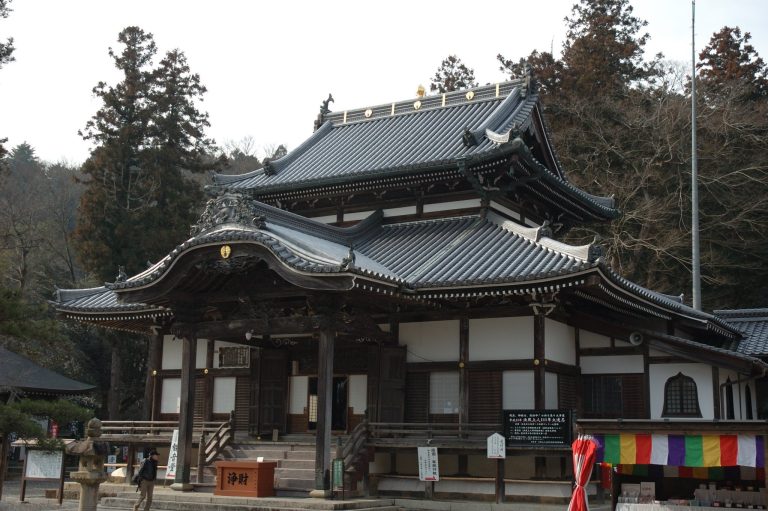
The main hall follows the Shimmei-zukuri style, a Shinto form recognized for its simple, ancient-looking design and gabled roof. It forms the principal surviving architectural element of the shrine complex, whose present shrine building dates from the rebuilding of 1923.
Cherry trees and loyalty monument
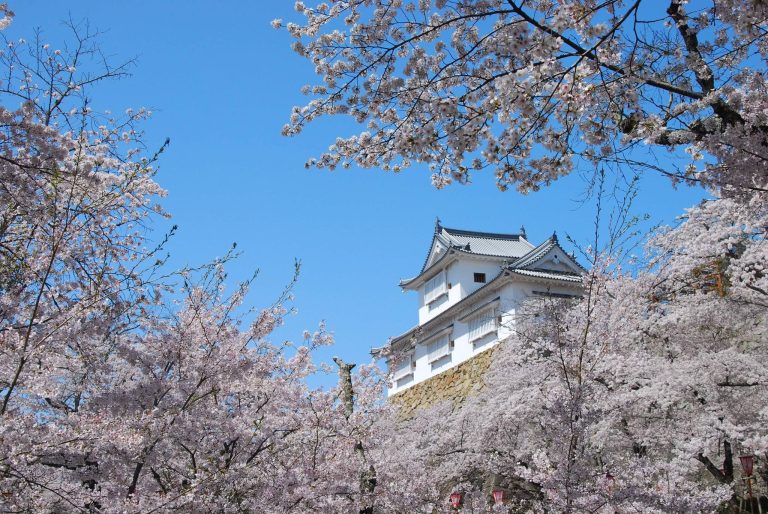
Approximately 100 Somei-Yoshino cherry trees grow within the precinct. The surviving monument erected in 1688 commemorates Kojima Takanori’s loyalty and stands at the traditionally identified location of the tree where he was said to have carved his poem. The shrine’s crest, a cherry blossom enclosed within a circle, reflects the site’s association with the tree and the shrine’s name.
Archaeological remains of Innoshō-no-yakata
Fortified residence
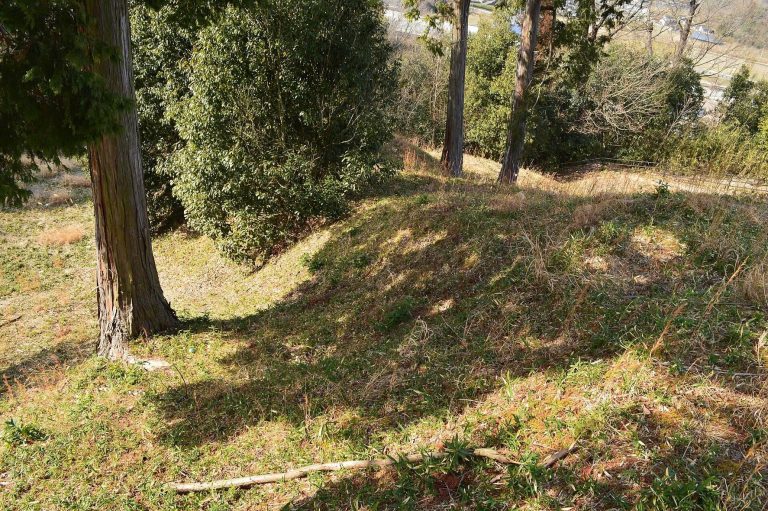
Innoshō-no-yakata covered approximately 200 meters from east to west and 150 meters from north to south. Excavations identified a well and several structures within the former residence. Recovered materials included celadon porcelain, white porcelain, and Bizen ware, providing physical evidence of activity at the medieval fortified site.
Shrine treasures
Inscribed sword
The shrine preserves a sword bearing the inscription “Kuniyuki.” Matsudaira Yoshitomo donated it, and it was designated an Important Cultural Property in 1929.
Statue and additional swords
Another treasure is a wooden statue of Kojima Takanori made in 1812 on the order of a Tsuyama Domain lord. The collection also includes three old swords, preserving material links with the shrine’s historical and commemorative traditions.