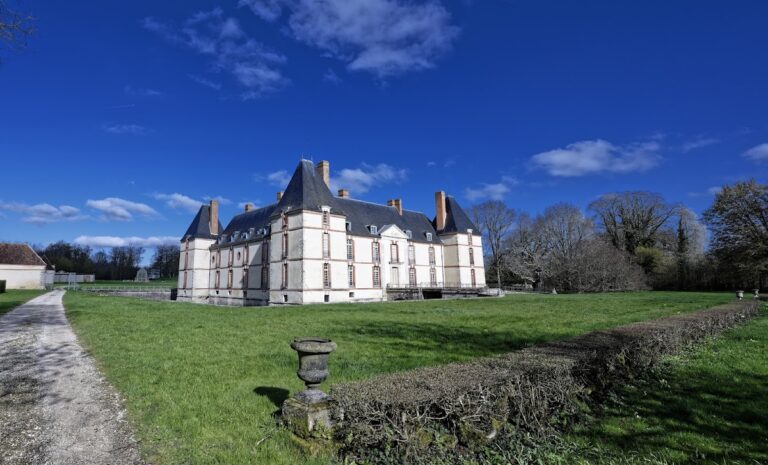
Jouarre Abbey: A Benedictine Monastery in France


Site at a Glance
- Rating
- 4.6
- Popularity
- Low
- Country
- France
- Primary era
- Early Modern
- External website
- Open
- Eras represented
- Medieval, Early Modern
- Civilizations
- Carolingian, French, Merovingian
- Site type
- Religious
- Remains
- Monastery
On this page10 sections
History
Jouarre Abbey is a Benedictine abbey in France, founded by the Frankish Merovingian dynasty around 630–635 on an estate at Jouarre. Its foundation was influenced by Saint Columbanus of Luxeuil, an Irish missionary and monastic founder whose communities shaped early medieval monasticism in western Europe.
A Merovingian double monastery
The foundation began as a double monastery, a religious institution that housed both male and female communities under one authority. At Jouarre, that authority rested with the abbess. Adon, the son of the nobleman Authaire, established the monastery, while Telchilde, a relative educated at Faremoutiers Abbey, became its first abbess. Adon was succeeded by his relative Agilbert, Telchilde’s brother and the future bishop of Paris. Adon’s stepmother Mode and her sister Balde later joined the women’s community, and Balde became the third abbess. Aguilberte, another early abbess, was also associated with the foundation.
Charlemagne later imposed the Rule of Saint Benedict on Jouarre. This sixth-century monastic code emphasized communal discipline, prayer, obedience, and work. The abbey continues to be occupied by Benedictine nuns, whose community combines prayer with the production of nativity scenes and ceramic statuettes.
Pilgrimage and medieval development
During the ninth and tenth centuries, Jouarre became an important pilgrimage center within the sphere of Aachen, the imperial capital. The acquisition of relics of Saint Potentian in the mid-ninth century helped draw pilgrims. Saint Osmanna was also buried at Jouarre before her body was transferred to the Abbey Church of Saint-Denis.
Viking attacks damaged the abbey, which was rebuilt in the tenth century. In the eleventh and twelfth centuries, a fortified settlement grew around the monastery and became the nucleus of the present town of Jouarre. The abbey’s wider institutional importance was reflected in Pope Innocent II’s visit in 1131 and in the synod held there in 1133. In 1225, Jouarre received immunity from interference by the bishop of Meaux and answered directly to the pope. Submission to the bishop was restored only in 1690, during the tenure of Bossuet, bishop of Meaux.
War, religious conflict, and early modern rebuilding
During the Hundred Years’ War, the abbey was ransacked and the nuns were forced into exile. They returned in 1433. In 1572, during the Saint Bartholomew’s Day massacre, a period of mass violence against Protestants in France, Abbess Charlotte of Bourbon-Montpensier escaped from Jouarre hidden in a hay cart. She fled to Germany and later married William I of Orange-Nassau, a leading Dutch nobleman and political figure in the revolt against Spain.
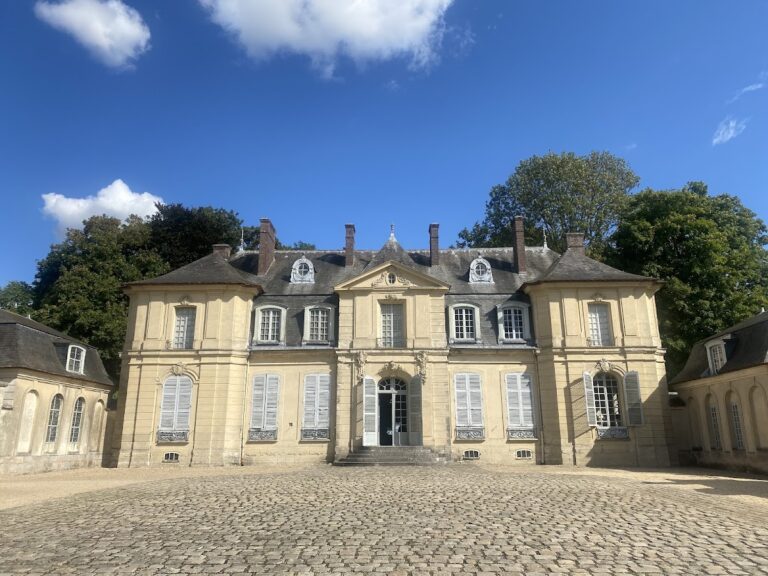
In the seventeenth century, Abbess Jeanne de Bourbon commissioned an imposing Classical-style abbey church. Abbess Jeanne of Lorraine, a personal friend of Queen Anne of Austria, frequently received the queen at Jouarre. During the eighteenth century, Abbess Catherine-Henriette de Montmorin de Saint-Hérem commissioned a large residential wing. The architect Augustin de Luzy reconstructed the abbey buildings between 1742 and 1753 in collaboration with her, while the Thianges Pavilion was built in the village to accommodate guests.
Revolution and nineteenth-century revival
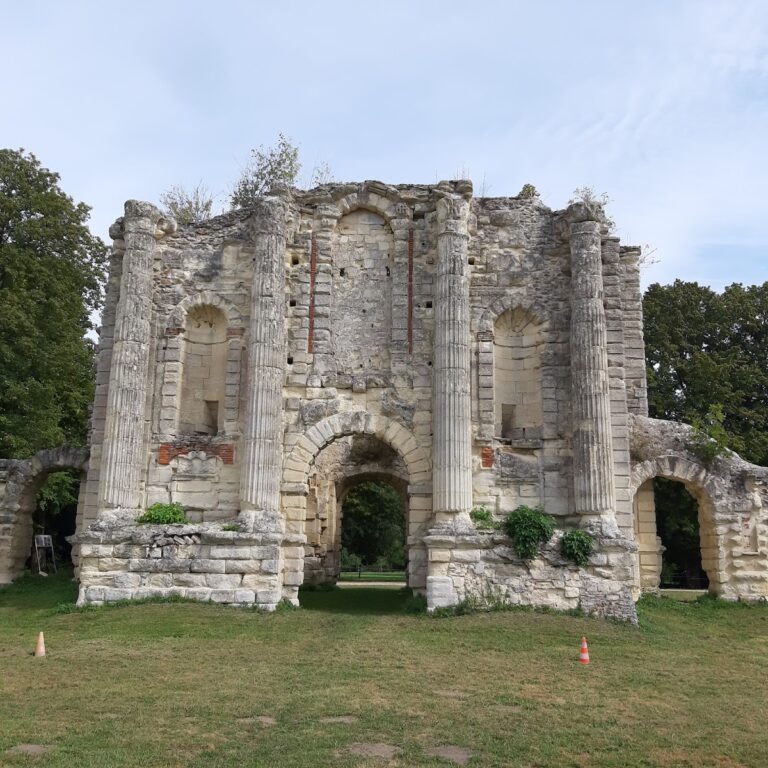
The French Revolution dispersed the nuns and confiscated the abbey buildings as national property. The seventeenth-century church was dismantled and sold stone by stone, while the cloister and chapter house were destroyed. The church site was used as a stone quarry before a new church was built in 1863.
In the nineteenth century, a community from Pradines Abbey re-established monastic life at Jouarre. The nuns gradually bought back much of the former monastic property, although the lands themselves never returned to the abbey. They purchased the abbey house in 1821 and opened a boarding school. Jouarre Abbey was formally classified as a historic monument in 1840, and its church was rebuilt in 1863. The community later founded the La Paix-Notre-Dame monastery at Flée in 1946 and Regina Laudis Abbey in the United States in 1947.
Remains
The Merovingian crypt
The surviving crypt beneath the abbey church is a Merovingian and pre-Romanesque structure. It contains stone sarcophagi and cenotaphs, memorial monuments that do not necessarily mark a person’s burial, associated with the monastery’s founders and early religious figures. These include Adon; Balde, the third abbess; Saint Telchilde, the first abbess; Mode, Telchilde’s aunt and Balde’s sister; Aguilberte, the second abbess; Agilbert, bishop of Paris and Telchilde’s brother; Ébrégisile, bishop of Meaux and Aguilberte’s brother; and Osanna, an Irish princess who lived in the seventh century.
One sarcophagus associated with Agilbert bears a carving of the Last Judgment and Christ in Majesty. An effigy of the Tetramorph, the Christian representation of the four Evangelists as a human figure, a lion, an ox, and an eagle, appears on one of the crypt’s monuments and is considered the oldest example of its kind in France. The crypts are the best-preserved remains of a larger building dating from the late eighth century.
Early medieval church remains
Archaeological remains observed beneath Saint-Paul Square in the nineteenth century and again in 1993 indicate that the earlier building had three aisles and was aligned with the present crypts. A Carolingian tower was attached to the church and served as a watchtower. Together, these remains preserve evidence of the abbey’s expansion after its Merovingian foundation and during the Carolingian period.
Eighteenth-century monastic buildings
The principal surviving monastic buildings belong to the eighteenth-century reconstruction directed by Augustin de Luzy in collaboration with Abbess Catherine-Henriette de Montmorin de Saint-Hérem. The large residential wing remains occupied by the Benedictine community. The Thianges Pavilion, built in the middle of the village, served as accommodation for guests. The abbey also retains a traditional vegetable and fruit garden.
The reconstructed abbey church
The seventeenth-century abbey church had a monumental Classical design before it was dismantled during the French Revolution. Its site was subsequently used as a source of building stone, and the church was rebuilt in 1863. The present church therefore forms part of the nineteenth-century revival of monastic life at Jouarre, while the surviving crypt beneath it preserves the abbey’s early medieval foundations.