Johanneskirche: A Roman Catholic Church and Hospitaller Foundation in Vienna
Site at a Glance
- Rating
- 4.5
- Popularity
- Very Low
- Country
- Austria
- Primary era
- Early Modern
- External website
- Open
- Eras represented
- Medieval, Early Modern
- Civilizations
- Habsburg, Holy Roman Empire, Knights Hospitaller
- Site type
- Religious
- Remains
- Church
On this page9 sections
History
Roman and Early Christian Origins
Johanneskirche is a Roman Catholic church in Unterlaa, Vienna, Austria. Its high-medieval fabric may reach back at least to the first third of the eleventh century, making it one of present-day Vienna’s oldest churches. The site stands within an area occupied during prehistoric and Roman times, and the church’s unusual position outside the village center reflects a long sequence of religious use.
The earliest structure at the site was probably a Roman-period temple. It was most likely a timber building raised on a substantial stone foundation. Its interpretation as a temple rests on its central position within a semicircle of five buildings and on an orientation with one corner pointing exactly north, an arrangement associated with protection against evil spirits.
Monks probably established the first Christian church over the Roman remains, reusing stones from the earlier settlement. The building may have been intended to replace the pagan temple with a Christian place of worship. It was probably a simple hall church measuring about 9 by 7 metres, with a choir added later. Five burials found inside the church during excavations in 1974 may have belonged to the builders of this first church. Another interpretation identifies them as priestly burials dating to around 1030, with an uncertainty of approximately fifteen years.
The Hospitaller Possession
On 4 December 1272, the Viennese citizen Paltram sold his fortified property at Unterlaa to Master Wilfing of the Hospitallers at Mailberg for 300 marks of silver. The Order of St John, a Catholic religious and military order founded to care for pilgrims and the sick in the Holy Land, thus acquired the church and became the exclusive landowner in Unterlaa. The order is now known as the Order of Malta.
The agreement required the Hospitallers to install six brothers at Unterlaa, including two clergy, care for six poor or wounded people, and provide three armed men during military action or a crusade. In 1272 the church was dedicated to John the Baptist, the Christian prophet and preacher regarded in the New Testament as the forerunner of Jesus. Remodeling after the transfer changed the south side and added a hospice on the north. The hospice was probably destroyed in 1465 together with Unterlaa Castle.
Baroque Reconstruction and Later Archaeology
The church underwent further changes during the Baroque period. It was probably first built as a two-storey hospital church in accordance with the order’s regulations, and later acquired a recessed octagonal choir tower in the form customary for the order.
Johanneskirche was largely destroyed during the Second Siege of Vienna in 1683 and rebuilt with a nave in 1686. Its furnishings date from the seventeenth century, while the sacristy beside the south side of the choir tower was added in 1779.
Excavations in and around the church have taken place since the 1960s. They have revealed individual finds from the beginning of the Neolithic period, the later Stone Age associated with settled farming and polished stone tools, as well as material from the Hallstatt period, an early Iron Age period in Central Europe conventionally dated here to about 700–500 BC. The first-century Roman settlement on Johannesberg was destroyed at an unknown date, but a grave stele for the indigenous Celt Devomarus and his family indicates that settlement in the area continued. The Roman settlement occupied Johannesberg, while its associated cemetery lay at the present church site.
Remains
Church and Chapel
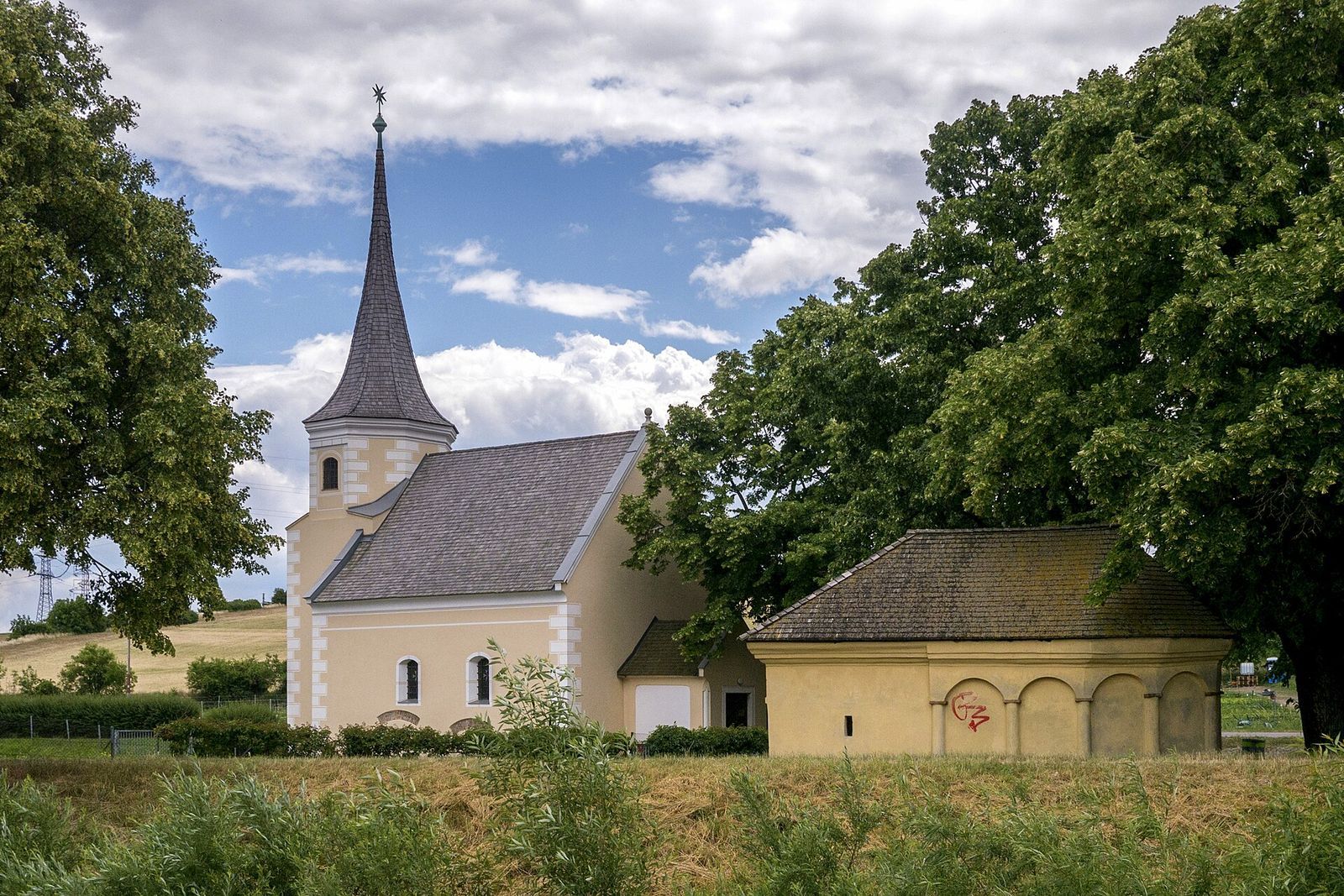
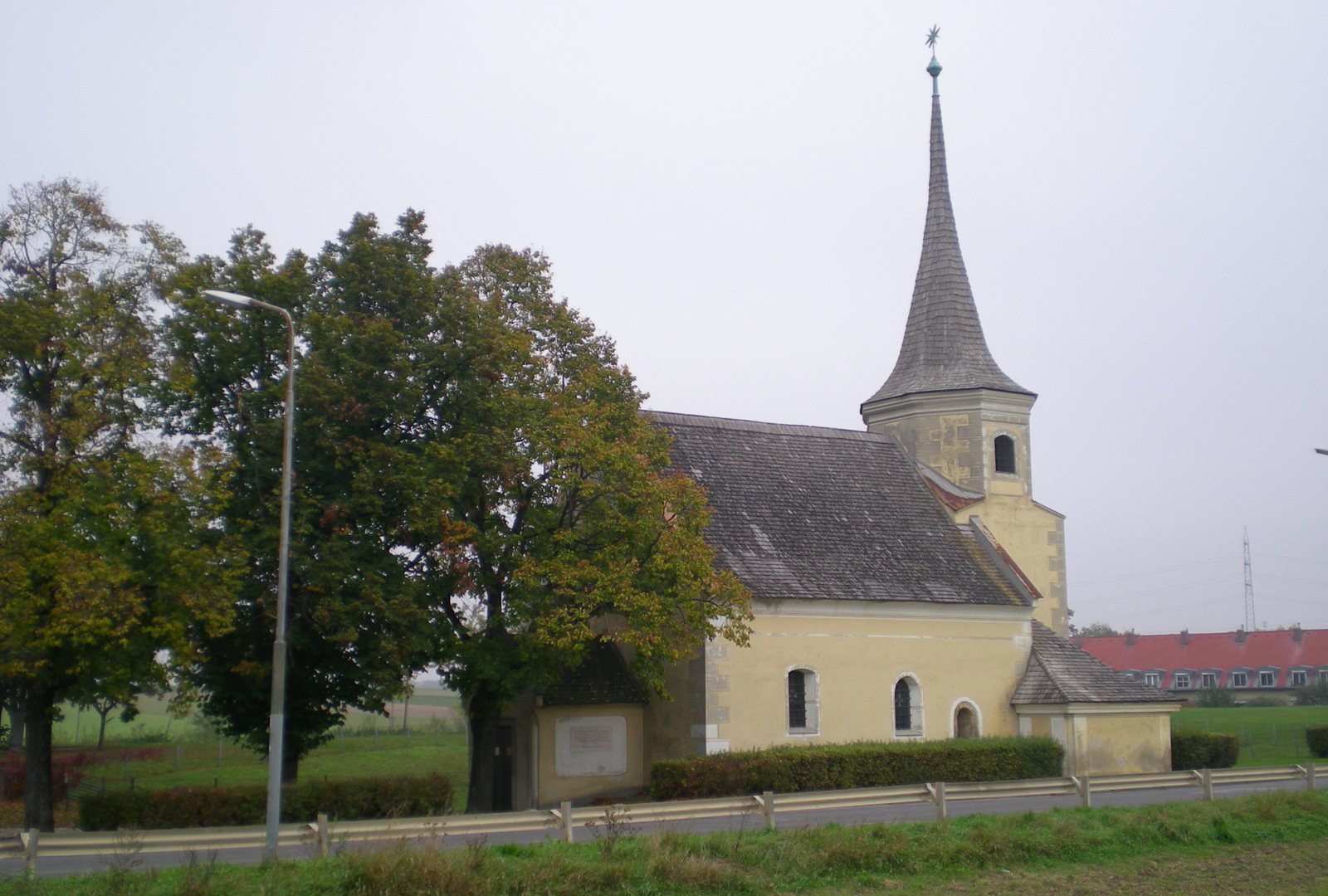
Johanneskirche is a single-nave choir-tower church. In this type of building, the lower storey of an eastern tower contains the protected sacred space. The church therefore consists of a single-aisled nave and a choir incorporated into the tower. The choir has a barrel vault with lunettes, and a sacristy adjoins the tower on its south side. Maltese crosses appear at the top of the tower and on the windows, recalling the building’s connection with the Order of St John.
Main Church
The surviving church contains furnishings from the seventeenth century, including a large rustic altar crucifix dated 1678. Its present form also reflects the rebuilding of the nave in 1686 and the addition of the sacristy in 1779.
Holy Sepulchre Chapel
A Holy Sepulchre Chapel stands immediately beside the church. Built around 1700, it represents or commemorates the tomb of Jesus in Jerusalem. The chapel has half-columns with blind arcades, sloping ventilation windows, and a shingled roof. Inside are an entrance vestibule and a burial chamber, while a niche in the north wall contains a recumbent figure of Christ.
Archaeological Remains
Archaeological remains around Johanneskirche include evidence of prehistoric settlement, the Roman settlement on Johannesberg, and the associated Roman cemetery beneath the church site. A small archaeological exhibition space in an ancillary building presents material from the area and is overseen by the Favoriten District Museum. The grave stele commemorating Devomarus, his wife Monema, and their sons is exhibited at the museum.