Schloss Kaiserebersdorf: A Former Imperial Castle in Vienna
Site at a Glance
- Rating
- 4.3
- Popularity
- Very Low
- Country
- Austria
- Primary era
- Early Modern
- Eras represented
- Medieval, Early Modern
- Civilizations
- Habsburg, Holy Roman Empire
- Site type
- Domestic
- Remains
- Castle
On this page8 sections
History
Schloss Kaiserebersdorf is a former imperial castle in Vienna, Austria, whose history extends from a medieval fortified estate to a Renaissance hunting palace and a Baroque residence. Its origins lie in an estate between the Schwechat and the Danube that Emperor Frederick Barbarossa granted to Konrad de Prato in 1162. A fortified castle was built there afterward, and the castle first appears in records in 1269.
Medieval estate and Ebersdorf lordship
The property later passed to the lords of Himberg, who adopted the name Himberg-Ebersdorf from 1243. The lords of Ebersdorf subsequently resided at the castle. They later became Counts of Thierstein and served as chief chamberlains in Austria, giving the estate a place within the political world of the Austrian nobility.
In 1485, forces led by Matthias Corvinus, King of Hungary from 1458 to 1490, besieged and captured the castle. The property entered Habsburg possession in 1499 through an exchange of estates between Veit II of Ebersdorf and Maximilian I, the Habsburg ruler who became Holy Roman Emperor in 1508. The court master of the hunt administered the castle, which was repeatedly used as a residence and as a base for hunting.
Renaissance hunting palace
The First Siege of Vienna in 1529, an Ottoman campaign against the Habsburg capital, caused extensive destruction at Kaiserebersdorf. Under Charles V, the still fortress-like castle was made habitable and transformed into a splendid Renaissance hunting and pleasure palace. Pietro Ferrabosco, Hans Tscherte, Hermes Schallautzer, and the stonemason Benedikt Kölbl were involved in this work. A forework, meaning an exterior defensive work in front of the main fortification, and a new moat were also constructed.
Ferdinand I enlarged the complex in 1550. Maximilian II then directed a further extensive expansion between 1558 and 1561. This phase altered the interior of the clock wing and added the Zögling wing to its southwest. A narrow connecting tract joined the two wings. The architectural changes accompanied the castle’s continued use as a Habsburg residence and hunting retreat.
Maximilian II also established a menagerie at Kaiserebersdorf in 1552. This historical collection of exotic and unusual living animals included lions, tigers, giraffes, and bears. It also housed Soliman, the first elephant in Vienna, which Maximilian had received from Spain as a wedding gift. A wolf enclosure for animals kept for hunting already stood on the grounds. The menagerie moved to Schloss Neugebäude in 1607 and later to Schönbrunn.
War, Baroque rebuilding, and institutional use
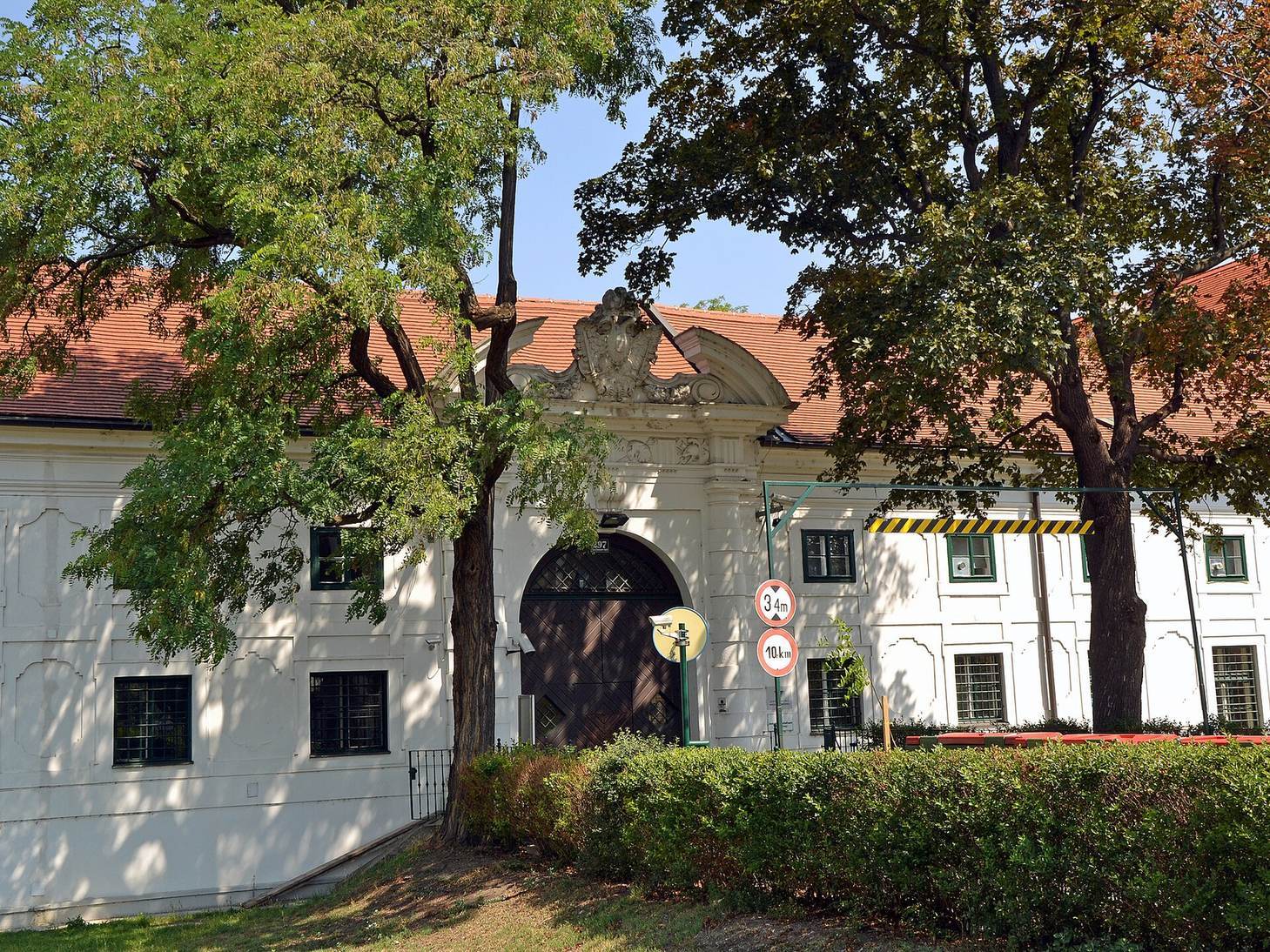
During the Bohemian revolt against Ferdinand II, Heinrich Matthias von Thurn used Kaiserebersdorf as his headquarters in 1619. In 1618, stonemasons from Kaisersteinbruch had created a new main portal. The castle was later destroyed by fire during the Second Siege of Vienna in 1683, another Ottoman campaign against the city. Leopold I ordered its reconstruction between 1687 and 1689, producing the Baroque form associated with the complex. Leopold spent each autumn at Kaiserebersdorf.
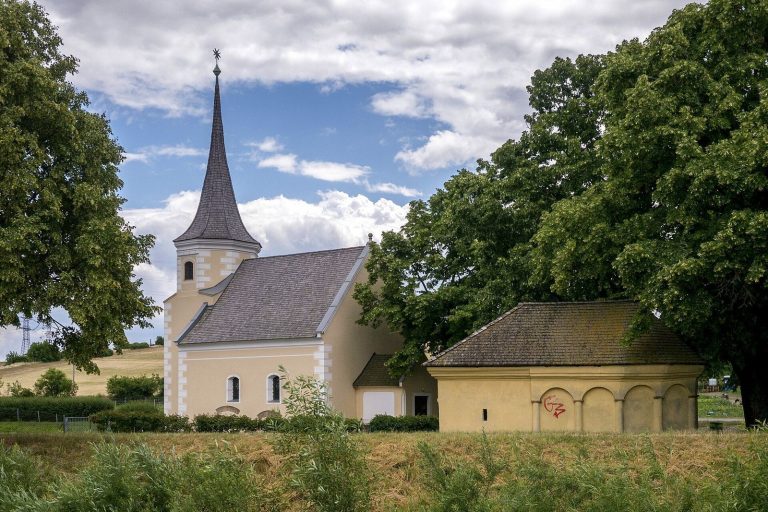
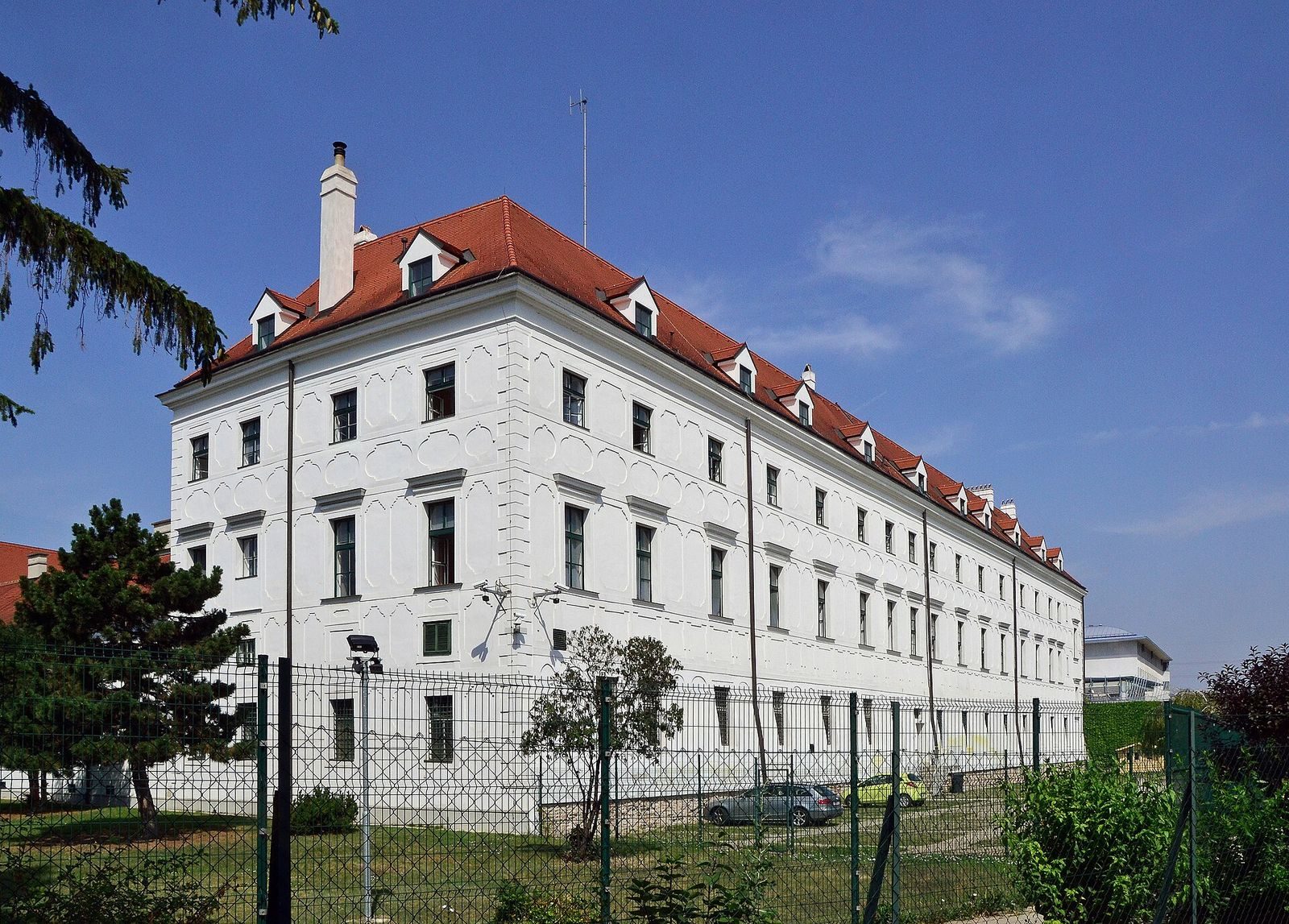
The Baroque rebuilding included a newly constructed chancery wing and south wing, and probably the castle chapel. The buildings received a more organized exterior articulation, meaning a deliberate architectural division of the façades. The initials of Leopold I remain on the double-headed eagle above the main portal, a heraldic emblem associated with imperial authority.
In 1745, Maria Theresa gave the castle to Anton Marxer, a cathedral canon and auxiliary bishop. An auxiliary bishop assists the diocesan bishop rather than governing a diocese independently. Marxer used the property to accommodate poor people and orphans. Joseph II converted the castle into an artillery barracks in 1773, and it served as a field and military hospital during the campaigns of 1792 and 1809.
Infantry of the Austro-Hungarian army occupied the castle from 1868, including the Hoch- und Deutschmeister regiment. Between 1883 and 1918, it housed the Austro-Hungarian military uniform depot. From the late 1920s, the former imperial residence became a juvenile correctional institution. Since 1975, it has housed Simmering Prison, a correctional institution for adult male prisoners. Schloss Kaiserebersdorf is protected in Austria as a listed historic monument.
Remains
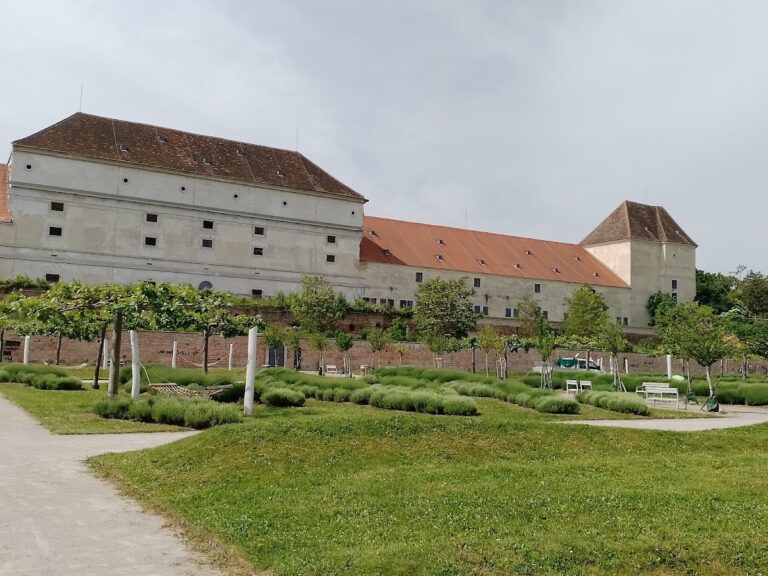
The surviving complex brings together elements of a medieval fortified castle, Renaissance rebuilding, and Baroque reconstruction. Its defensive enclosure originally stood between the Schwechat and the Danube. Later wings, portals, and institutional alterations preserve the changing purposes of the site across several centuries.
Fortified enclosure
The original castle had an inner moat, a fortified outer area between the inner defenses and the outer wall or moat, and a surrounding wall equipped with towers. Palisades and an outer moat strengthened the enclosure, with the outer watercourse formerly supplied by the Schwechat. The rebuilding after 1529 added a forework and a new moat, retaining defensive elements while adapting the fortress for use as a hunting and pleasure palace.
Renaissance and Baroque buildings
The 1558 to 1561 expansion reshaped the interior of the clock wing and created the Zögling wing southwest of it. The two wings were connected by a narrow tract, forming a distinct part of the surviving Renaissance arrangement. The main portal, made in 1618 by stonemasons from Kaisersteinbruch, belongs to the period before the castle’s destruction in 1683.
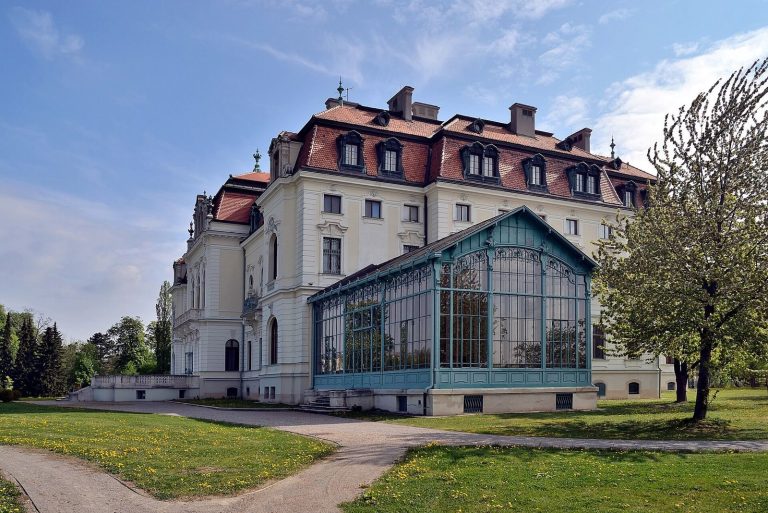
Reconstruction between 1687 and 1689 added the chancery wing and south wing and probably the castle chapel. The buildings acquired the façade organization that characterizes the Baroque complex. Above the main portal, the double-headed eagle still bears the initials of Leopold I, linking the surviving entrance to the ruler who ordered the rebuilding.
Menagerie and animal enclosures
The former menagerie formed part of the castle grounds from 1552. Its enclosures held large exotic animals, including lions, tigers, giraffes, bears, and Soliman, the elephant brought from Spain. The grounds also contained an earlier enclosure for wolves kept for hunting. The menagerie’s later transfer to Schloss Neugebäude and then Schönbrunn reflects a change in the location of the Habsburg animal collections, while the animal enclosures remain part of the site’s historical interpretation.