Calonge Castle: Medieval Fortress and Noble Residence

Site at a Glance
- Rating
- 4.4
- Popularity
- Low
- Country
- Spain
- Primary era
- Medieval
- Eras represented
- Medieval, Early Modern
- Civilizations
- Crown of Aragon, Spanish
- Site type
- Military
- Remains
- Castle
On this page10 sections
History
Calonge Castle is a medieval castle in Spain, located in the historic centre of Calonge in Catalonia. It appears in records from the beginning of the twelfth century and became a direct possession of the counts-kings, the medieval rulers of Catalonia and Aragon, before being held as a fief by Ramon de Solius. In 1193, he paid homage to Alfonso the Chaste for the castle described as “Calonge de Marítima.”
Early settlement and the Cruilles lordship
The settlement around the castle is older than the surviving fortification. Calonge is documented in 881, when Romanyà and Colonica marked the northern boundary of the Vall d’Aro granted to Teuter, bishop of Girona. In 968, the monastery of Sant Feliu de Guíxols possessed an estate at Calonge.
At the beginning of the thirteenth century, control of the castle passed to the House of Cruilles, a noble lineage that retained it for centuries. Gaston I, who died in 1229, is the earliest documented member of the family. Gilabert III of Cruilles joined the conquest of Mallorca with thirty knights from his lands, and in 1259 he pawned the castle’s revenues to the king for 8,000 sous. His successor, Gilabert IV the Great, married Guillema of Peratallada, bringing the Cruilles and Peratallada domains together. In 1269, Gaufred-Gilabert acknowledged that the castle was held as a fief from the infante Peter, a royal prince and son of James I.
King Peter II granted Gilabert of Cruilles the right to hold a market at Calonge in 1279. Under Berenguer of Cruilles, who died around 1330, the castle passed to the family’s secondary Calonge branch. This branch retained ownership, with varying success, together with civil and criminal jurisdiction over the territory. Gilabert of Cruilles recovered those judicial powers from the royal bailiff of Palamos.
Jurisdiction, war, and dynastic change
Peter III returned the civil and criminal jurisdictions to the Crown in 1371. King John I sold the Cruilles family the high and low jurisdiction in 1393, restoring authority over serious criminal matters and lesser civil or criminal cases, along with the entire jurisdiction of Calonge Castle and rights over Palamos. Bernat of Cruilles paid homage for the castle to King Martin in 1408 and to Ferdinand I in 1413.
Martí Guerau of Cruilles supported King John II during the Catalan Civil War, a fifteenth-century conflict between the monarchy and institutions opposing the king. In 1462, he gathered people from Calonge and neighbouring villages to defend the fortification of Girona. Around 1468, an adverse lawsuit and military action caused him to lose the barony, a territorial lordship that could include jurisdictional rights. He recovered the castle and barony of Calonge in 1471 but died before taking possession.
The castle and town were attacked and burned in 1477 during the conflict of the Remences, Catalan peasant tenants who challenged oppressive feudal obligations. The castle was burned again in 1485 and quickly restored. Pere Galceran later sold all jurisdictions and rights over the place and castle to Galceran de Requesens. This transferred Calonge from the Cruilles family to the House of Requesens and incorporated it into the County of Palamos.
Later ownership and modern protection
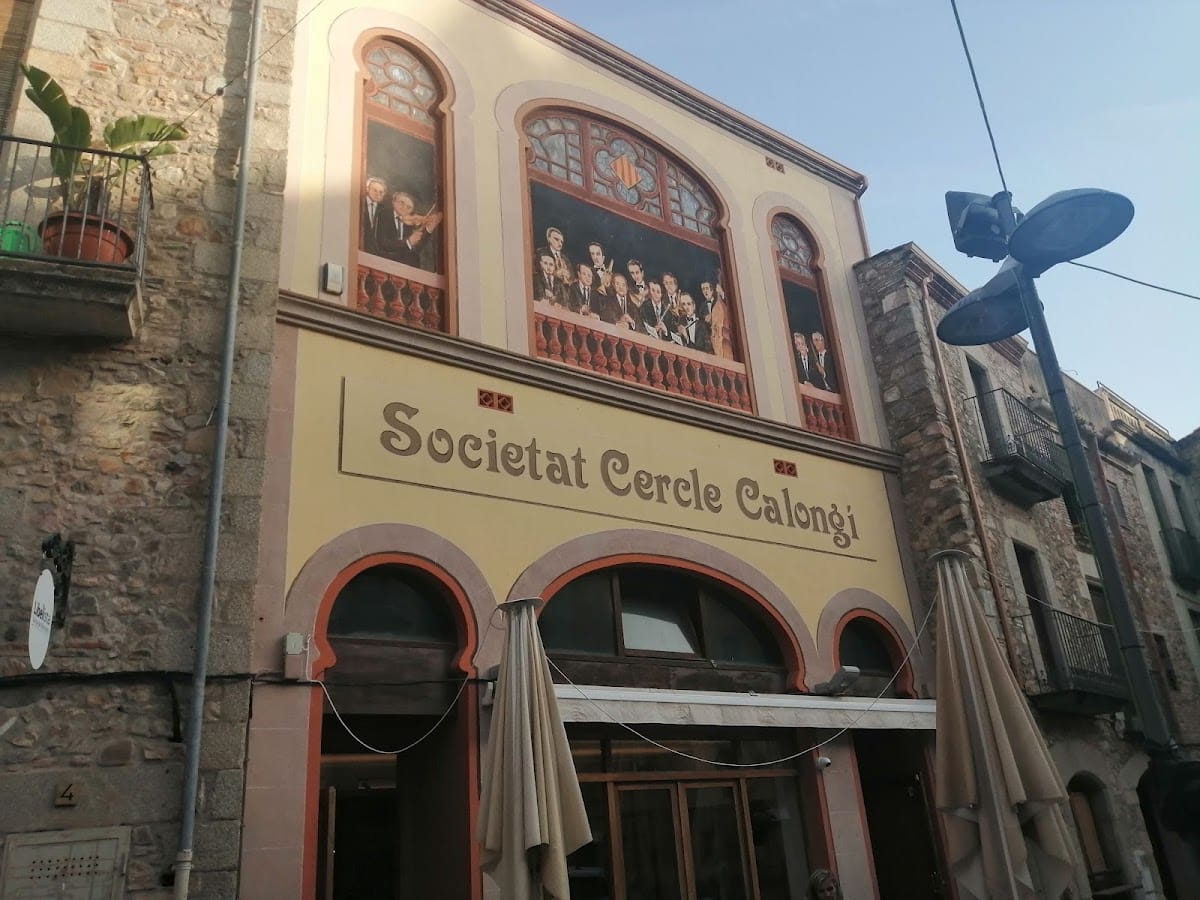
Through marriage, the castle passed to the Cardona-Anglesola family, then to the Duchy of Sessa and later to Castilianized nobility. Another dynastic marriage transferred it in the eighteenth century to the Osorio de Moscoso family. In 1899, the Osorio de Moscoso family sold the castle to the Calonge family known as the Casellas. It was subsequently used as a casino and theatre.
The Government of Catalonia now owns the castle and is responsible for its adaptation. It has been protected as a Cultural Asset of National Interest and as a historic monument since 1988. Several houses within the parade ground were demolished at the end of the twentieth century. One had been the residence of Lluís Vilar i Subirana, a major scholar of Calonge Castle. The castle has also hosted the Calonge Music Festival since 1968.
Remains
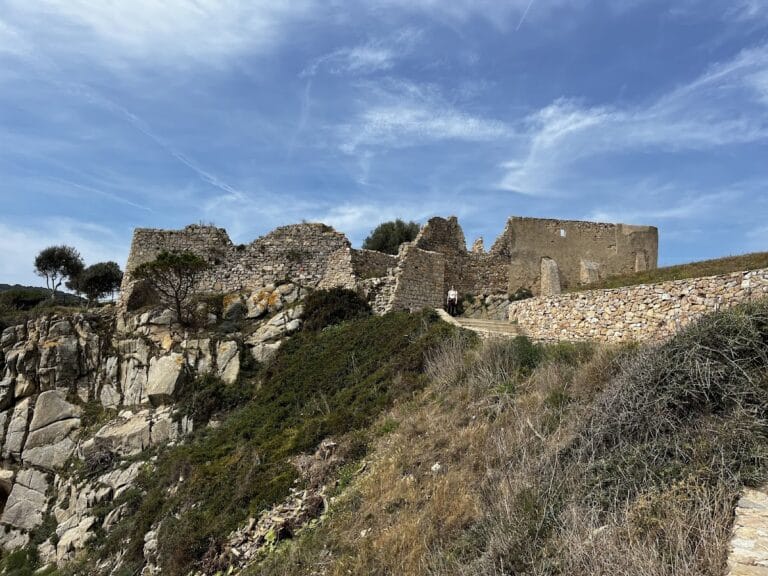
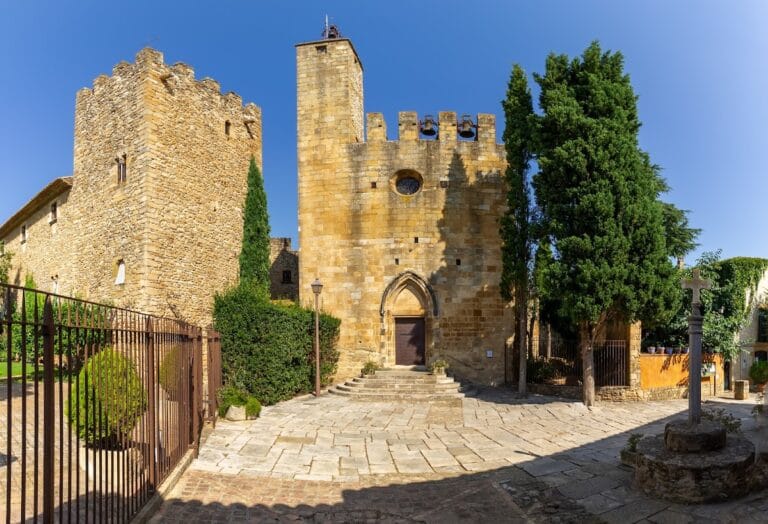
The surviving complex combines an uncertainly dated square tower, a larger fourteenth-century fortified enclosure, a late Gothic palace, later round towers, and a Renaissance wing. These elements form a layered record of the castle’s defensive and residential development.
Fortified and residential buildings
South-west tower
The oldest surviving element is a nearly square tower at the south-west of the enclosure. Its date is uncertain, although it may belong to around the twelfth century or to a later period. The tower measures 11.60 metres by 11.15 metres, with walls 1.10 metres thick, and survives to a maximum height of 10 metres. Wooden floors divided its interior into several storeys, using recesses in the perimeter walls. The upper crowning has not survived.
At the lower level, the north side has six arrow slits, the east side has seven, and the south side has two. These narrow defensive openings measure about 50 centimetres wide and between 70 and 90 centimetres high. A doorway in the east façade opens 6 metres above ground level. It is closed by a semicircular arch made from nine wedge-shaped stones, or voussoirs, and was probably reached by a rope or wooden ladder.
The tower is built from roughly dressed stones arranged in irregular courses. The stones are generally about 15 centimetres high and 20 centimetres long, while those around the arrow slits and at the corners are larger and more carefully worked.
Fourteenth-century enclosure
During the fourteenth century, a larger trapezoidal enclosure was added around the earlier tower. It contained arrow slits and was topped with battlements, the raised protective divisions along a fortified wall. The square tower occupied one corner of the expanded defensive complex.
Late Gothic palace and later towers
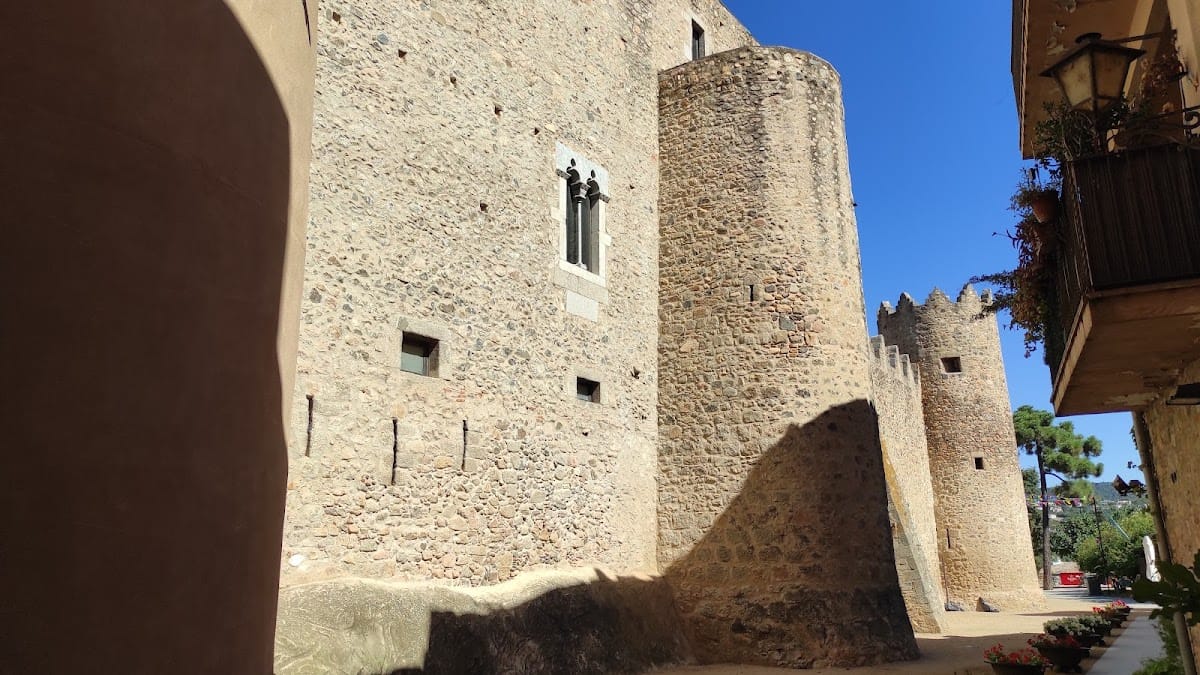
A late Gothic palace was attached to the south and east sides of the enclosure during the fifteenth century, possibly after the castle fire. The building belongs to the architectural tradition of pointed-arch Gothic forms and the later medieval designs that preceded the Renaissance.
Later work added round towers at three corners of the enclosure, while the fourth corner remained occupied by the square tower. A fourth, semicircular tower was also built on the east façade, extending the castle’s fortified perimeter.
Renaissance wing
Between the sixteenth and seventeenth centuries, a Renaissance wing was added to the complex. Renaissance architecture drew on classical forms and spread through Europe from the fifteenth century onward. The wing bears the coat of arms of the Dukes of Sessa, linking the surviving building to one of the aristocratic families that later held the castle.