Burg Beetzendorf: A Medieval Lowland Castle in Germany


Site at a Glance
- Rating
- 4.4
- Popularity
- Low
- Country
- Germany
- Primary era
- Medieval
- Eras represented
- Medieval, Modern
- Civilizations
- Holy Roman Empire
- Site type
- Military
- Remains
- Castle
On this page10 sections
History
Burg Beetzendorf is a medieval lowland castle in Germany, located in Beetzendorf, Saxony-Anhalt. Formerly known as Becendorf, it was built on relatively flat, marshy ground rather than on a steep hill. Its construction date remains uncertain, with estimates around 1140 and around 1200, while the first written reference dates from about 1204.
Early ownership and princely acquisition
Around 1204, the castle passed from the von Kröcher family into the pledged possession of the von der Schulenburg family. In this arrangement, possession was held as security for an obligation rather than as unrestricted ownership. The von Kröcher family still held the castle as a pledge in 1319, when it entered the service of Otto II the Strict, a medieval German territorial ruler.
A treaty of 1323 states that Otto the Mild had acquired Beetzendorf Castle. This acquisition must have taken place between 1319 and 1322. The castle therefore became involved in the territorial dealings of the two rulers before the von der Schulenburg family established its secure ownership.
The von der Schulenburg principal seat
In 1332, the knights Bernhard I von der Schulenburg, Dietrich II von der Schulenburg, and Werner III von der Schulenburg recorded a foundation at Beetzendorf Castle. In 1340, the castle was divided for the first time between the Black and White branches of the von der Schulenburg lineage. These were two branches of the same noble house, which held the castle jointly before the division. The same year provides the earliest secure evidence that the family owned Beetzendorf and the oldest known reference to a chapel at the site.
After the family left its ancestral castle near Stappenbeck in 1343, Beetzendorf became its principal seat. Together with Apenburg, it formed one of the hereditary estates at the core of the family’s territorial lordship until the nineteenth century. In 1424, Bernhard VI and Werner VIII von der Schulenburg, sons of Heinrich II von der Schulenburg, founded a chapel dedicated to Mary, the mother of Jesus. The chapel was probably abandoned during the Reformation, the sixteenth-century religious movement that divided Western Christianity and changed worship and church institutions.
Fortification, decline, and later use
By about 1600, the castle had been expanded in a fortress-like manner and equipped with moats. The enlarged defenses reinforced the standing of the von der Schulenburg family, which thereafter belonged to the upper rank of the Altmark nobility as a house established in a castle or palace.
From the second half of the sixteenth century, members of the family settled in Beetzendorf village and the surrounding area. As a result, the fortifications gradually lost their practical purpose. During the Thirty Years’ War, the major European conflict of 1618 to 1648, the castle was no longer defensible. Its last cannon was sold in 1642.
Parts of the complex remained inhabited by the von der Schulenburg family until 1760. Baron Achaz II von der Schulenburg, who lived from 1610 to 1680, was the last lord to reside in the castle itself. He built the Lieberoser Hof in the outer bailey, the fortified area beyond the main castle. Most of this building was demolished during the nineteenth century, and further parts of the complex were removed in 1780.
Preservation and modern adaptation
In 1845, a settlement concerning the exchange of Beetzendorf properties assigned the parcel containing the castle ruins to the Großer Hof estate. During the nineteenth century, Werner von der Schulenburg preserved the northern castle gate from decay and arranged its reconstruction. An open-air stage was added beside the northern gate between 1950 and 1952 and remains in use. The ruins are designated as a cultural monument.
Remains
Castle ruins and surviving grounds
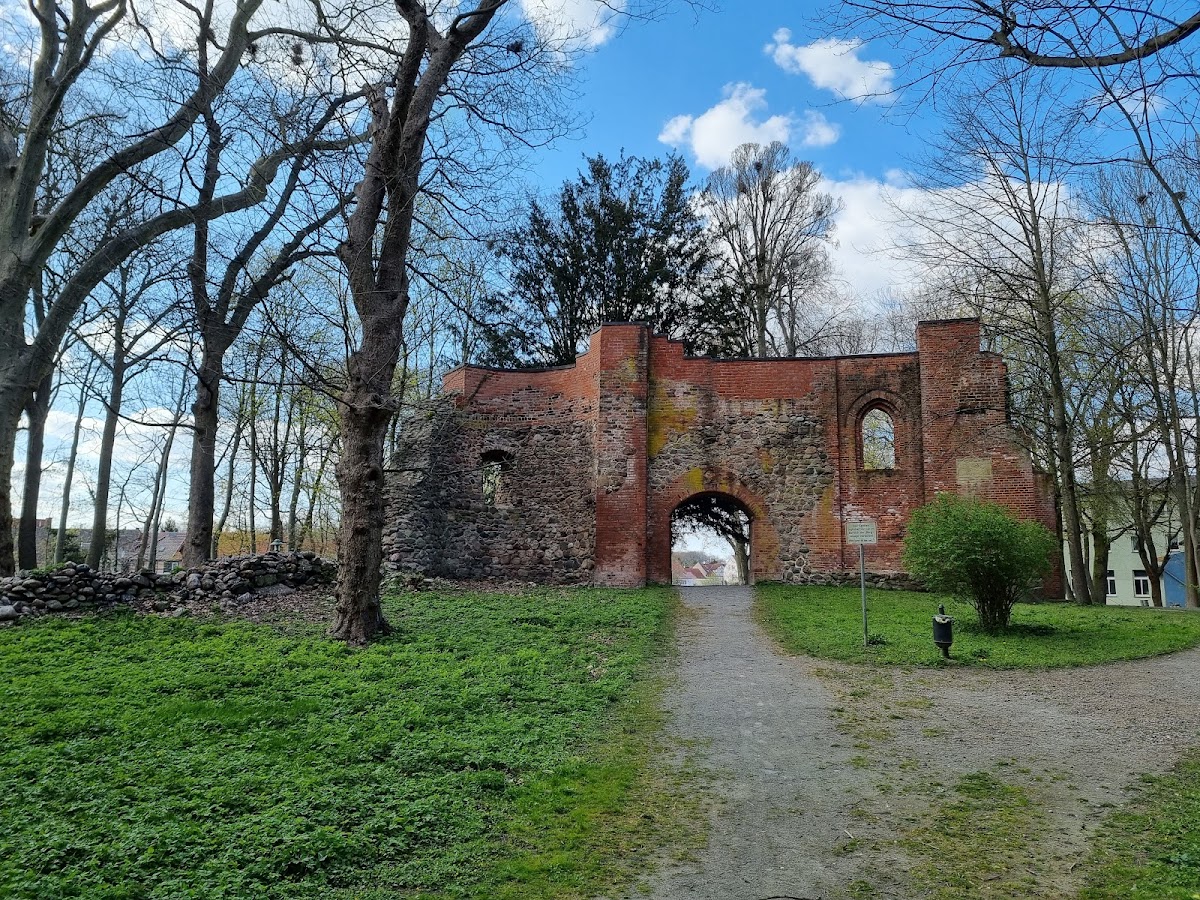
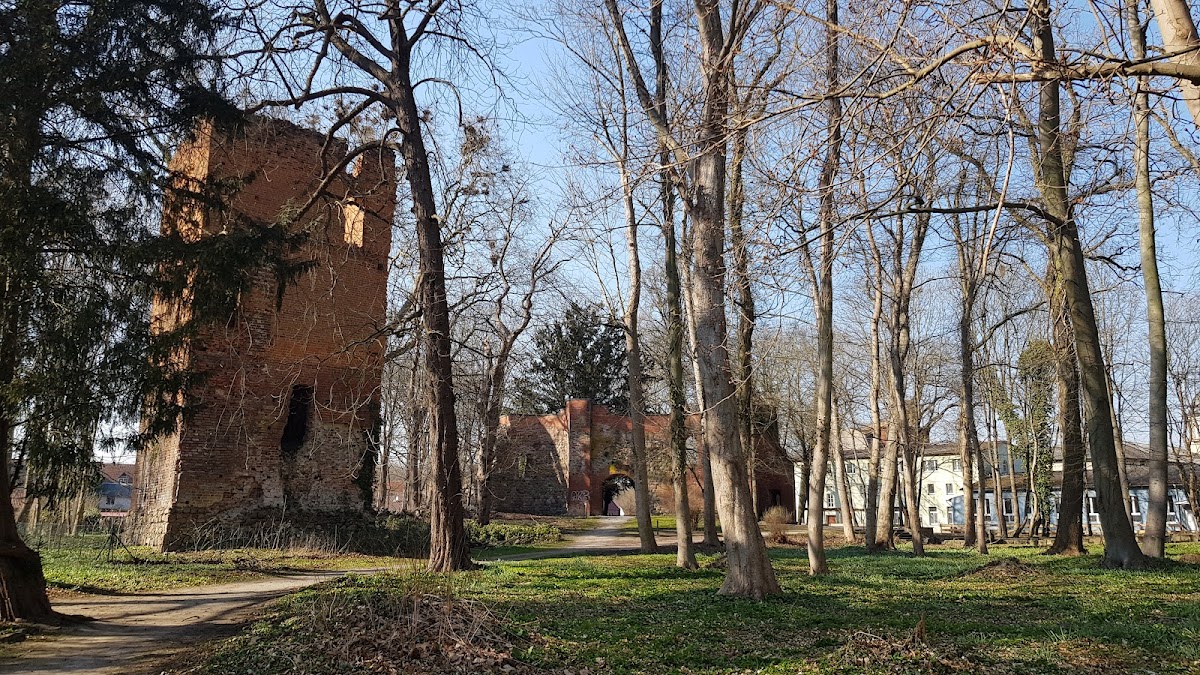
The surviving complex lies in the high forest of Beetzendorf Park and includes the northern castle gate and the keep. The site was established in marshy terrain, and its later defensive arrangement included moats by about 1600. The castle’s Baroque garden also survives in basic outline, preserving part of the grounds associated with its period as a noble residence.
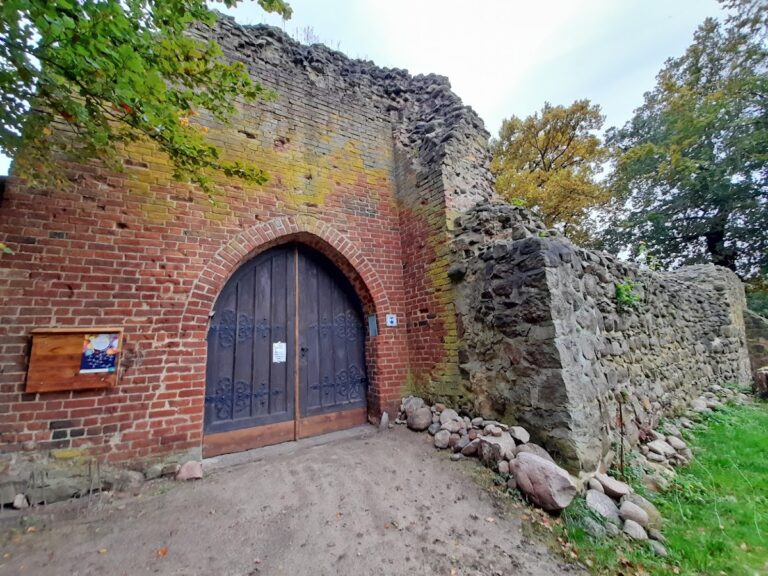
Northern castle gate
The northern castle gate was preserved and reconstructed in the nineteenth century. Between 1950 and 1952, an open-air stage was added to the gate structure, linking the surviving medieval castle fabric with a later cultural use. The stage remains in use.
Keep
The approximately 20-metre-high keep is built of red brick. Its square foundation measures 8.5 by 8.5 metres, while the walls are about one metre thick. The entrance is positioned high above the ground, approximately four metres up the tower, reflecting the keep’s role as the principal fortified tower of the medieval castle.
Outer bailey and garden
The outer bailey contained the Lieberoser Hof, built by Baron Achaz II von der Schulenburg. Most of the building was demolished in the nineteenth century. The Baroque garden remains visible in basic outline, providing a surviving element of the castle’s later residential landscape.
Nearby sites