Ilok Castle: A Historic Fortress in Croatia
Visitor Information
Google Rating: 4.7
Popularity: Low
Official Website: www.mgi.hr
Country: Croatia
Civilization: Early Modern, Medieval European
Site type: Military
Remains: Castle
History
Ilok Castle is located in the town of Ilok, Croatia, and was originally constructed by medieval European nobility. The earliest records indicate that the fortress was first mentioned in 1364, with its initial construction attributed to Ugrin of the Csák family during the early 14th century. Over time, the castle became an important stronghold in the region, particularly under the Újlaki (Iločki) family, one of the most influential noble houses of Croatian-Hungarian territories.
The castle reached its peak in the 15th century under the rule of Nikola Iločki (1410–1477), a prominent nobleman who held several titles such as Ban (governor) of Croatia, Slavonia, and Mačva, Duke of Transylvania, and King of Bosnia. Nikola Iločki transformed the castle from a mere fortress into a complex royal seat that reflected his high status and ambitions. The site included not only defensive structures but also a palace, a court chapel, a parish church, and a Franciscan monastery, supporting both administrative and religious functions. This period is often regarded as the golden age of Ilok.
In the 16th century, a major turning point occurred during the Ottoman expansion in Central Europe. Following the decisive Ottoman victory at the Battle of Mohács in 1526, the fortress was captured by Ottoman forces led by Sultan Suleiman the Magnificent. Under Ottoman rule, Ilok Castle became the administrative center of the Srem Sanjak, a local district governed by the empire. The castle remained in Ottoman hands until 1688, during which time it held considerable strategic and administrative importance.
After the Ottoman forces retreated following the Battle of Vienna in 1683, Emperor Leopold I compensated his allies and supporters with lands formerly controlled by the Ottomans. Ilok Castle and its surrounding estates were granted to Livio Odescalchi, nephew of Pope Innocent XI and member of the influential Italian Odescalchi family. The Odescalchis owned the property for about two centuries, during which they undertook substantial reconstruction of the castle in the Baroque style, reflecting 18th-century architectural trends.
The castle’s long history concluded a significant chapter in the 20th century when Yugoslav authorities nationalized it in 1945. After a period of restoration in the following decades, Ilok Castle was preserved as a cultural monument, serving as a key part of the region’s medieval heritage.
Remains
Ilok Castle occupies a commanding position atop a hill overlooking the town of Ilok, with expansive views of the Danube River and the Pannonian Plain. The fortress stretches in an irregular, elongated shape along the ridge for over 300 meters from west to east, shaped directly by the contours of the terrain. The original defensive precinct included formidable walls extending approximately 1350 meters in length, built to protect the castle’s inhabitants and resources.
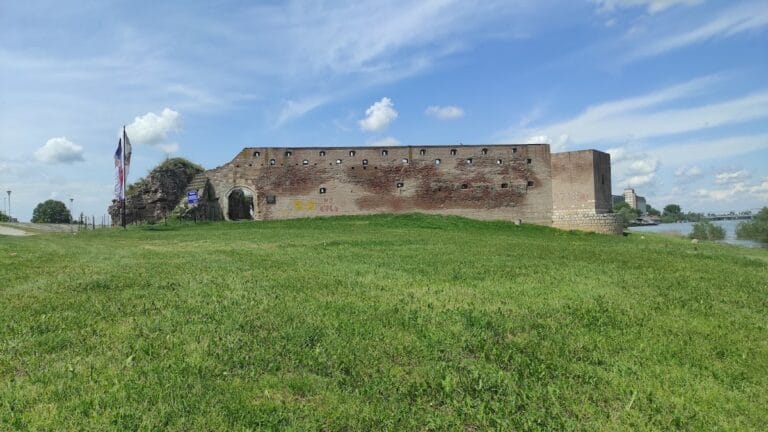
The castle’s outer walls are massive, well-preserved, and notably high, constructed from locally quarried stone. Along the walls, smaller towers of both round and rectangular shapes are spaced closely enough that defenders could protect one another with ranged weapons such as bows or early firearms. This arrangement allowed the fortress to withstand attacks by providing overlapping fields of defensive fire.
The main entrance was strategically designed as a fortified gateway complex, beginning with a barbican—a defensive outer enclosure designed to trap or slow attackers. This system included two successive gates protected by towers rising above them, with access to the barbican itself controlled by a drawbridge crossing a defensive ditch. Nearby, an additional smaller fortification further guarded the approach, demonstrating the importance placed on controlling entry into the castle grounds.
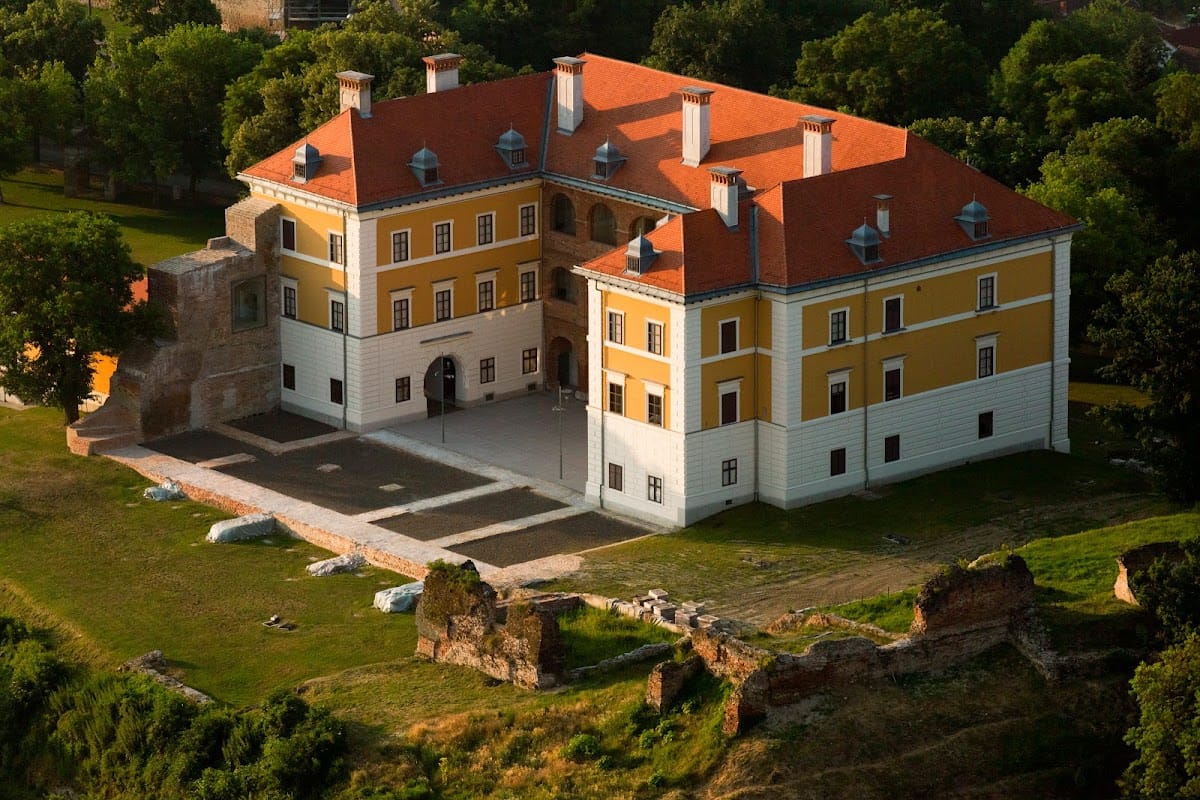
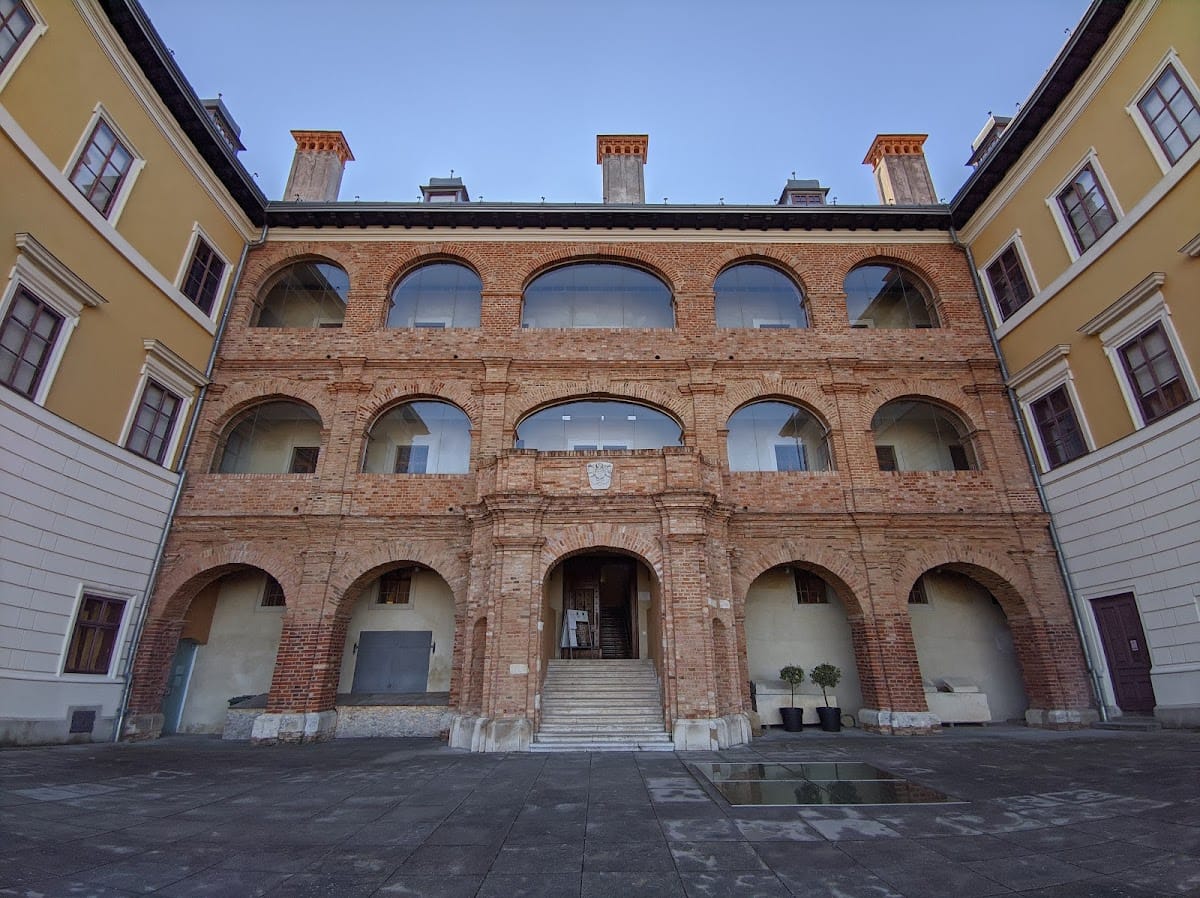
Inside the walls, the castle comprises two primary types of buildings. Residential structures include the notable two-story palace with four wings, commissioned by Nikola Iločki in the western section of the fortress. This palace served as a royal residence and administrative center. Religious buildings are also present, featuring a court chapel connected to the noble household and a Franciscan monastery established to serve the spiritual needs of the community and clergy.
One prominent feature of the fortress is a large rondella—a rounded bastion—located at the southwestern corner, designed to provide flanking fire along the walls. East of the rondella lie the remains of a historic castle garden, indicating that the site was not solely militaristic but also accommodated leisure and aesthetic considerations.
The castle’s design and layout closely resemble other well-known royal fortified residences in Central Europe, such as the royal fortifications of Prague’s Hradčany and the royal fortress of Buda. This similarity highlights Ilok Castle’s role as a royal capital and a center of political and military power in the region during its prime.
Today, the castle complex stands as the largest fortification ensemble in continental Croatia. It forms the heart of Ilok’s medieval historic core, which has been officially protected as a cultural and historical complex of the highest category, underscoring its value as a site of architectural, historical, and cultural significance.