Trsat Castle: A Medieval Fortress and Cultural Landmark in Rijeka, Croatia
Site at a Glance
- Rating
- 4.7
- Popularity
- High
- Country
- Croatia
- Primary era
- Medieval
- External website
- Open
- Eras represented
- Medieval, Modern
- Civilizations
- Habsburg, Kingdom of Croatia
- Site type
- Military
- Remains
- Castle
On this page12 sections
History
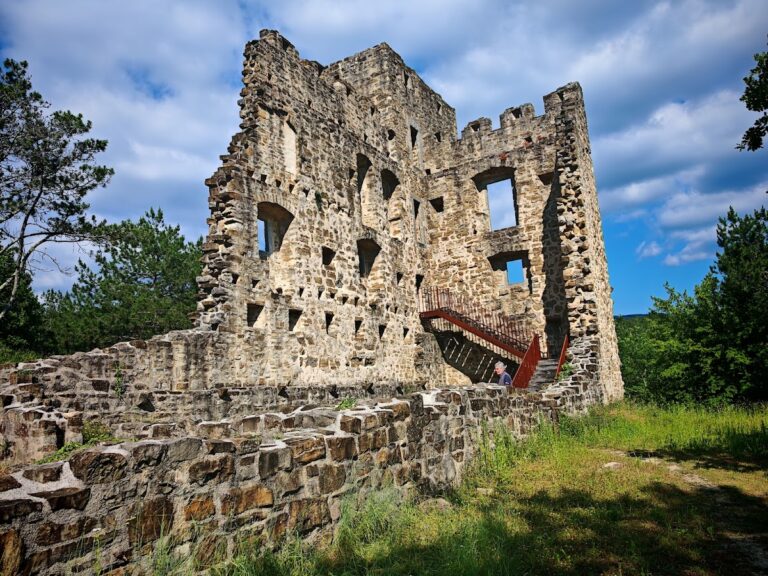
Trsat Castle is a medieval fortress in Rijeka, Croatia, built in the thirteenth century on a hill that had earlier served as a lookout and fortification. The present castle was established on the initiative of the Frankopans, a prominent Croatian noble family associated with the medieval Vinodol region, probably to protect their holdings. Its long history reflects the strategic importance of the site above the Rječina River and its later transformation into a nineteenth-century Neo-Gothic residence.
Earlier fortifications and medieval foundation
The elevated site is believed to have been used first by Illyrian groups and later by the Romans. It may have included an Iapodian hill-fort called Darsata before the Romans established Tarsatica. This fortification controlled access toward the sea along the Rječina River and overlooked ancient routes linking Aquileia with Pannonia and Senia, now Senj.
The Frankopan castle was first recorded in 1288 as a parish center. It remained in Frankopan possession into the early modern period before later passing to a Hungarian trading company. In June 1509, the Croatian ban Andrew Bot of Bajna recaptured Trsat with a Croatian army after the Venetians had seized it. He then entered Rijeka and expelled them. The Venetians withdrew from Rijeka in October of that year, after which the city returned to Maximilian of Habsburg.
Decline and Nugent transformation
During the seventeenth century, the castle declined as the perceived threats from Venice and the Ottoman Empire receded. An earthquake in 1750 accelerated its deterioration. In 1826, the municipality of Bakar acquired the property, which soon afterward passed to Field-Marshal Laval Nugent von Westmeath, an Irish-born officer who served as an Austrian field marshal and commanded Austrian troops in the Rijeka area. The Austrians later honoured Nugent by presenting him with the castle as a residence.
Nugent converted the deteriorating fortress into a substantial home and commissioned extensive Neo-Gothic renovations, a nineteenth-century revival of medieval Gothic architecture, directed by the Venetian builder Giacomo Paranuzzi. The castle remained with the Nugent family until shortly before the end of the Second World War, when its last private owner, Countess Eleonora Marie Emma Nugent, died in 1945. Laval Nugent von Westmeath had died on 22 August 1862 and was buried in a mausoleum constructed within the castle. His widow later sold most of the couple’s art collection.
Trsat Castle is protected as a cultural monument under reference number Z-342 and is controlled by the City of Rijeka. Restoration and cultural use have preserved its place in the city’s historical landscape, and the complex continues to serve as a setting for cultural events.
Remains
Hilltop fortress
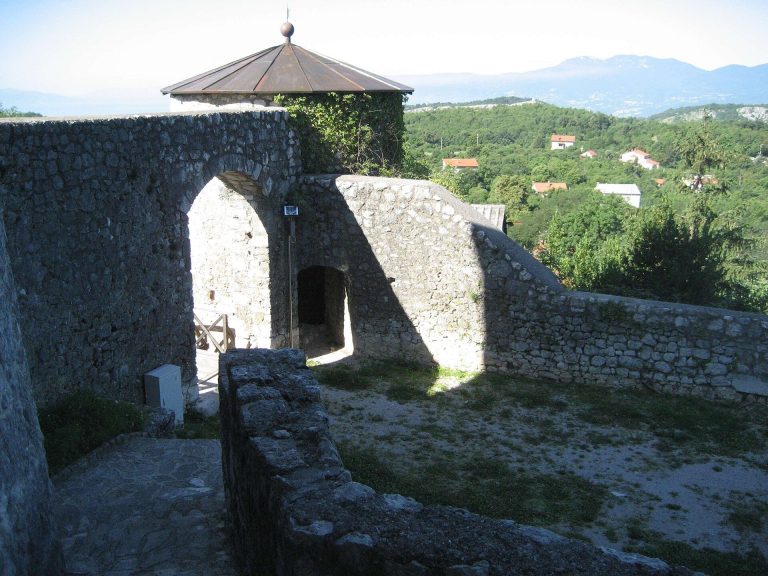
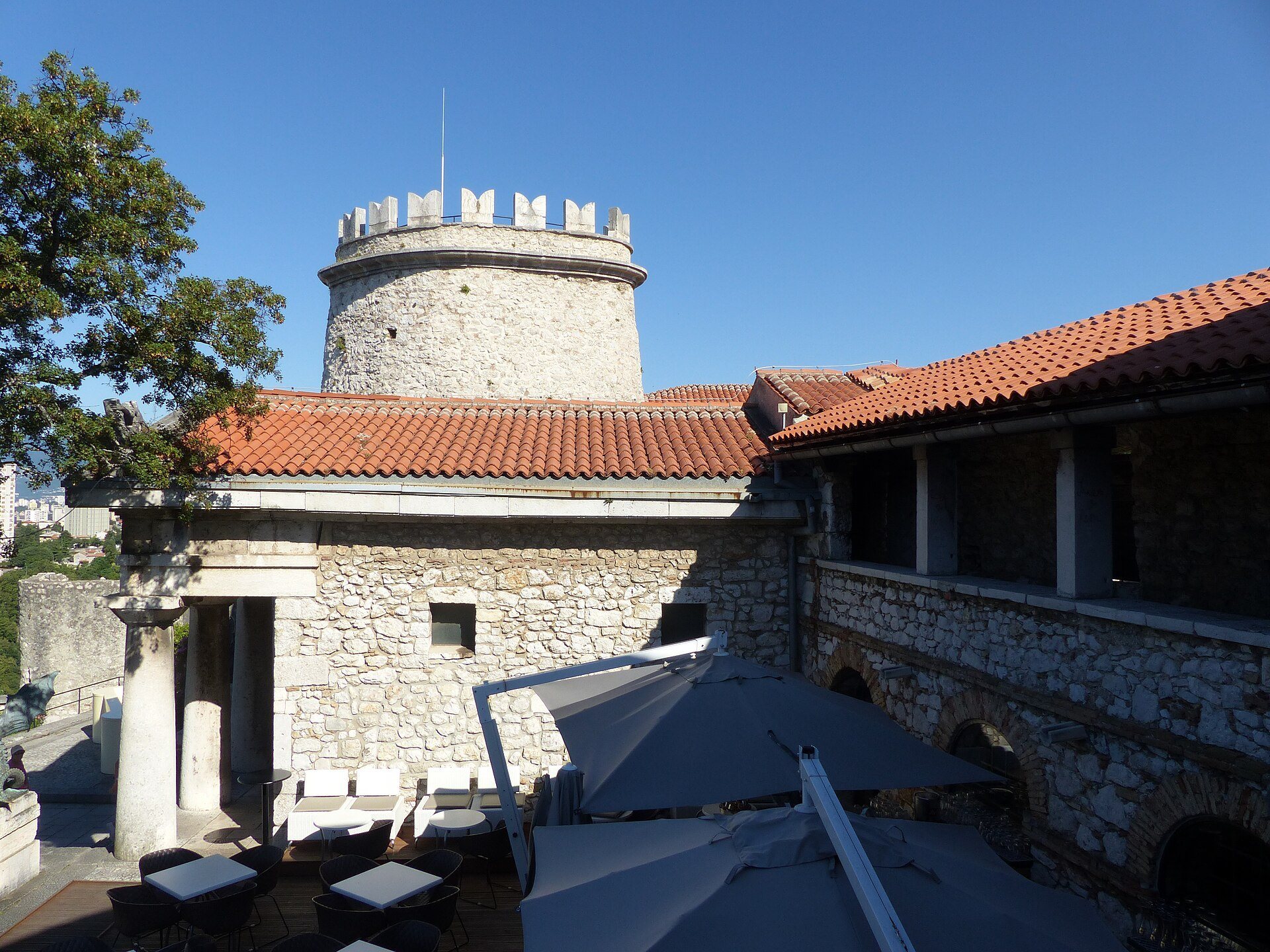
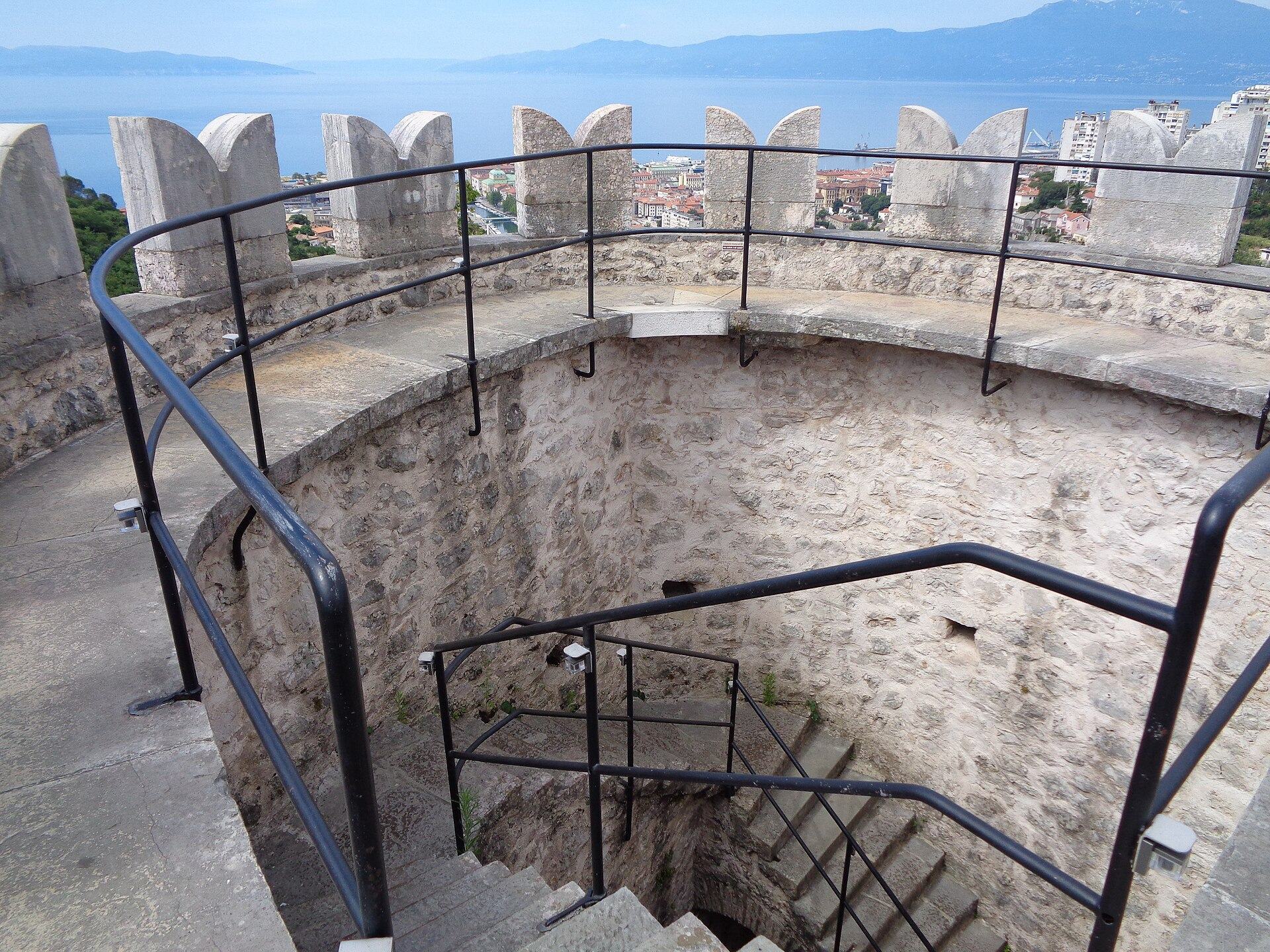
Trsat Castle occupies a steep hill approximately 138 metres above sea level in the Trsat district, above the Rječina gorge on the river’s left bank and northeast of Rijeka’s old town and city centre. Built of stone, the complex combines surviving medieval elements with extensive nineteenth-century reconstruction and renovation. Its courtyard has been converted into a restaurant, while the wider complex includes an entrance, a round tower, an oval tower, and prison spaces.
Entrance and towers
The entrance provides access to the stone castle complex, whose surviving defensive forms include a round tower and an oval tower. These medieval elements belong to the older fabric of the fortress, while the surrounding complex was substantially altered during the nineteenth-century rebuilding carried out for Laval Nugent von Westmeath.
Prison and dungeon
A castle prison forms part of the surviving complex, together with a prison or dungeon beneath the mausoleum. These spaces preserve the fortress’s institutional and defensive functions within the later residential setting.
Nugent memorial complex
Mir junaka mausoleum
The mausoleum known as Mir junaka, meaning “Peace of the Hero,” was built within the castle for Laval Nugent von Westmeath. It takes the form of a Doric temple, using the classical order known for sturdy columns and relatively plain capitals. The Nugent family coat of arms decorates the building, which also stands above the prison or dungeon incorporated into this part of the complex.
Bronze dragons
Two bronze dragon figures stand at the entrance to the mausoleum. The German-Austrian sculptor Anton Dominik von Fernkorn made them, and they were installed in 1864 as part of the memorial setting created for Nugent.
Nugent’s gallery
Nugent’s gallery contained works attributed to or associated with old Italian masters, including Titian, Tintoretto, and Andrea Schiavone. Most of the collection was later sold by Nugent’s widow, leaving the gallery’s history as part of the castle’s nineteenth-century cultural association.
Frankopan burial
One of the churches associated with the castle contains the burial of the Croatian nobleman Vuk Krsto Frankopan, linking the surviving complex to the family that established the medieval fortress.