Iwasaki Castle: A Japanese Hill Castle in Nisshin


Site at a Glance
- Rating
- 4
- Popularity
- Low
- Country
- Japan
- Primary era
- Medieval
- Eras represented
- Medieval, Early Modern, Modern
- Civilizations
- Oda regime
- Site type
- Military
- Remains
- Castle
On this page13 sections
History
Iwasaki Castle is a Japanese hill castle in Nisshin, Japan, built during the late Muromachi period, probably between the late fifteenth and early sixteenth centuries. It was a hirayama castle, a fortification on a hill or elevated ground, and occupied a strategic position on the highway linking Mikawa and Owari Provinces. Its origins remain uncertain, although Oda Nobuhide, a powerful sixteenth-century warlord and the father of Oda Nobunaga, is considered a possible founder.
Early Matsudaira and Niwa control
Iwasaki served as a support castle for Shobata Castle, whose lord was Oda Nobuhide. Its position may have helped protect territory controlled by the Oda family from the Imagawa clan. In 1529, Matsudaira Kiyoyasu, lord of Okazaki Castle and grandfather of Tokugawa Ieyasu, attacked the castle with an army of about 7,000 men. He captured it and used it as a base for the Matsudaira advance into Owari.
After Kiyoyasu was assassinated by his retainer Abe Masatoyo in 1535, Kiyoyasu’s son Matsudaira Hirotada moved his residence elsewhere, and Matsudaira authority at Iwasaki receded. Niwa Ujikiyo, lord of Hongo Castle and an earlier guide or supporter of the Matsudaira, then took control. The Niwa family and its descendants retained the castle for four generations.
Conflict within the Niwa family
A reported internal struggle called the Battle of Yokoyama took place in 1551. It involved Niwa Ujikiyo and his son Ujisato against Niwa Ujihide, lord of Fujishima Castle, and Ujihide’s son. Ujihide sought help from the seventeen-year-old Oda Nobunaga, later a major figure in Japan’s political unification. The Iwasaki Niwa forces ambushed Nobunaga’s army near Yokoyama and defeated it, forcing Ujihide and his son to flee to Mikawa.
This episode appears only in a Niwa military record compiled in 1790, so its details remain uncertain. The account nevertheless places Iwasaki within the rivalries that shaped the fragmented and war-torn Sengoku period, the era of prolonged political conflict that dominated much of Japan during the fifteenth and sixteenth centuries.
The 1584 siege and abandonment
The Battle of Iwasaki Castle in 1584 opened the Battle of Nagakute, which formed part of the wider Battle of Komaki and Nagakute. Niwa Ujitsugu commanded the garrison when forces of Toyotomi Hideyoshi, the leader of the regime that followed Nobunaga, besieged and captured the castle under the command of Ikeda Tsuneoki. The defenders blocked the Toyotomi side’s attempt to penetrate Mikawa and halted Ikeda’s advancing army, helping to break the broader military stalemate. The garrison suffered severe losses, including the death of Ujitsugu’s brother Niwa Ujishige, and about 300 defenders were killed.
Whether Iwasaki Castle was rebuilt after its fall in 1584 is uncertain. In 1600, Niwa Ujitsugu fought for Tokugawa Ieyasu at the Battle of Sekigahara. Ieyasu, who later established the Tokugawa shogunate, rewarded him with a domain assessed at 10,000 koku, a historical measure of rice-based productive value, at Ibo in Mikawa, in present-day Toyota. Iwasaki Castle was then abandoned.
Memorial and archaeological park
For more than three centuries after its abandonment, the site was not systematically maintained, and the main enclosure became farmland. In 1910, former retainers of the Owari domain erected a memorial on the enclosure’s turret platform to the Niwa soldiers killed during the 1584 battle. A memorial service continues there each year on April 9.
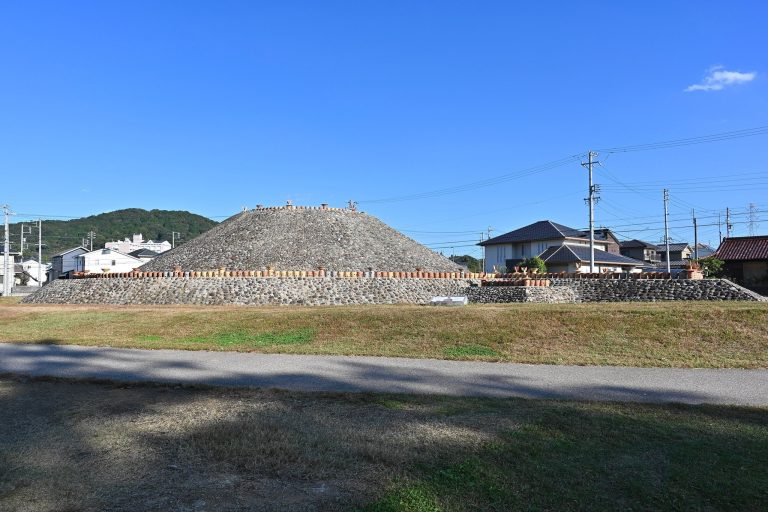
The site became Iwasaki Castle Ruins Park in 1987. Development included a reinforced-concrete mock donjon used as an observation tower and an associated mock turret containing the Iwasaki Castle Historical Museum. The work also damaged some archaeological remains, a decision criticized by castle researcher Yoshihiro Chida. Archaeological work during the development led to the accidental discovery of a tumulus believed to date from the sixth century, and a reconstruction of it now stands in the park.
Remains
Iwasaki Castle occupied approximately two hectares at the end of a plateau. A crosswise ditch separated this elevated ground from the rest of the upland. The main enclosure was arranged with earthen ramparts, dry moats, and belt-shaped baileys, while additional baileys, including the second enclosure, strengthened its approach. The site’s surviving and excavated features include these defensive earthworks, an earthen bridge, building foundations, a well site, and a turret site.
Enclosures and defenses
Main enclosure
The main enclosure formed the central fortified area. Its southeastern side contains remains of buildings, while an artificially raised turret platform stood in the northwest at an elevation of approximately 66 metres. The platform later became the location of the 1910 memorial to the Niwa soldiers who died in the 1584 battle.
Second enclosure and moats
The second enclosure helped protect the main enclosure and functioned as an approach or sortie area comparable to a horse-exit enclosure. A Japanese garden was later created there, including a suikinkutsu, a garden installation in which dripping water produces resonant sounds beneath the ground. The castle’s dry moats began as V-shaped ditches and were later altered in some sections into box-shaped moats. An earthen bridge forms another surviving element of the defensive layout.
Buildings and museum structures
Turret platform and building remains
Excavations identified the turret site and the remains of a well, while building foundations survive in the southeastern part of the main enclosure. These earthwork and foundation remains help define the arrangement of the castle’s principal occupied areas and defensive features.
Mock donjon and historical museum
The present mock donjon was constructed from reinforced concrete in 1987. It is a three-story, four-level watchtower-style observation structure rather than an authentic reconstruction of the castle’s principal tower. The associated two-story mock turret houses the Iwasaki Castle Historical Museum, which presents the history of the site and displays excavated materials, ceramics, samurai armour, and documents connected with the castle.
Reconstructed tumulus
Archaeological work connected with the park’s development uncovered a tumulus believed to date from the sixth century. The feature was reconstructed and is displayed within the park, adding evidence of activity on the site before the medieval castle was established.