Amanawa Shinmei Shrine: An Ancient Shinto Shrine in Kamakura


Site at a Glance
- Rating
- 4.1
- Popularity
- Low
- Country
- Japan
- Primary era
- Medieval
- Eras represented
- Medieval
- Civilizations
- Kamakura shogunate
- Site type
- Religious
- Remains
- Sanctuary
On this page12 sections
History
Amanawa Shinmei Shrine is a Shinto shrine in Kamakura, Japan, traditionally founded in August 710 and regarded as the oldest shrine in the city. Its principal sanctuary follows the Shinmei-zukuri style, an ancient form associated especially with the formal simplicity of Ise Grand Shrine. The shrine is dedicated primarily to Amaterasu, the Shinto sun deity and one of the tradition’s central divine figures.
Traditional foundation and early interpretations
The traditional foundation account is associated with Gyoki, a prominent Buddhist priest of the Nara period known for religious activity and public works. According to the 1712 Brief History of Amanawa-ji Shinmei-gu, Gyoki founded the shrine, after which Someya Tokitada, a wealthy and influential local patron, established the Shinmei-gu on Mikoshiyama and the temple En-tokuji at the mountain’s foot.
This account has been disputed. Another interpretation connects the shrine with Ise Grand Shrine because it stood within the Ise-owned estate of Oba Mikuriya, established around 1104–1106. The Azuma Kagami, a historical chronicle of the Kamakura shogunate, repeatedly calls it an “Ise auxiliary shrine.” The historian Takayuki Okutomi considered the story of Gyoki’s foundation fictitious.
A separate tradition links Amanawa Shinmei Shrine with the Kawachi branch of the Minamoto clan. It relates that Minamoto no Yoriyoshi married the daughter of Taira no Naokata, prayed at the shrine, and became the father of Minamoto no Yoshiie. Yoriyoshi is said to have repaired the shrine in 1063, while Yoshiie repaired it again in 1081. “Amanawa” was an old name for the Hase area. One interpretation derives ama from female divers and nawa from ropes used in fishing.
The shrine in the Kamakura period
The Azuma Kagami records that repairs and construction supervised by Adachi Morinaga were completed in January 1186. Minamoto no Yoritomo, founder of the Kamakura shogunate, then visited the shrine with Hōjō Masako, his politically influential consort and later administrator. Yoritomo returned to worship there on June 20 and August 22, 1194, and Minamoto no Sanetomo, the third shogun, is also recorded as having worshipped at the site.
The same chronicle describes Yoritomo visiting Morinaga’s residence, known as the “Amanawa house,” after worshipping at the shrine. A monument south of the shrine commemorates the traditionally identified location of that residence. The residence itself is associated with the area of the Imakoji-nishi archaeological site in Onarimachi.
Buddhist administration and later changes
The former Buddhist temple Amanawa-in served as the shrine’s attached temple, a Buddhist institution historically linked to and responsible for administering a Shinto shrine. Dokuon, a Rinzai Zen monk of Myoshinji in Kyoto who died in 1709, is traditionally credited with reviving the shrine. Shrine and temple buildings were constructed during this period, and Dokuon’s disciple Zuiho Sodo, a Buddhist cleric, became Amanawa-in’s abbot and wrote the 1712 history. The temple’s principal image was traditionally identified as Jizo Bodhisattva, a Buddhist figure associated with protection and compassionate care.
Amanawa-in was abolished during the modern separation of Shinto and Buddhism. In 1887, the Gosha Myojin, a guardian deity of Hasedera, was transferred to and merged with the shrine. The shrine’s official name was fixed as Amanawa Shinmei Shrine in 1932; before then, it was also known as Amanawa Shinmei-gu and Amanawa Shinmei-sha, and it had been classified as a village shrine.
Earthquake, rebuilding, and cultural associations
The Great Kanto Earthquake of 1923 half-destroyed the sanctuary and completely destroyed the worship hall. The shrine buildings were rebuilt in 1937, and a later reconstruction was completed in 1998.
The annual festival runs from September 7 to 14. A sacred-sake station and portable shrine are prepared, and a priest dispatched from Omachi’s Yakumo Shrine conducts the rites. The portable shrine procession takes place on the second Sunday of the festival.
A poem in volume 14 of the Man’yoshu, an early Japanese poetry anthology, has been interpreted as referring to the shrine’s mountain through its mention of “Mikoshinosaki,” and a monument to the poem stands within the precincts. Prince Munetaka also composed a poem about the autumn wind at Mikoshinosaki. The novelist Yasunari Kawabata lived nearby, and the Kamakura house and surroundings depicted in The Sound of the Mountain are regarded as modeled on the area around the shrine.
Remains
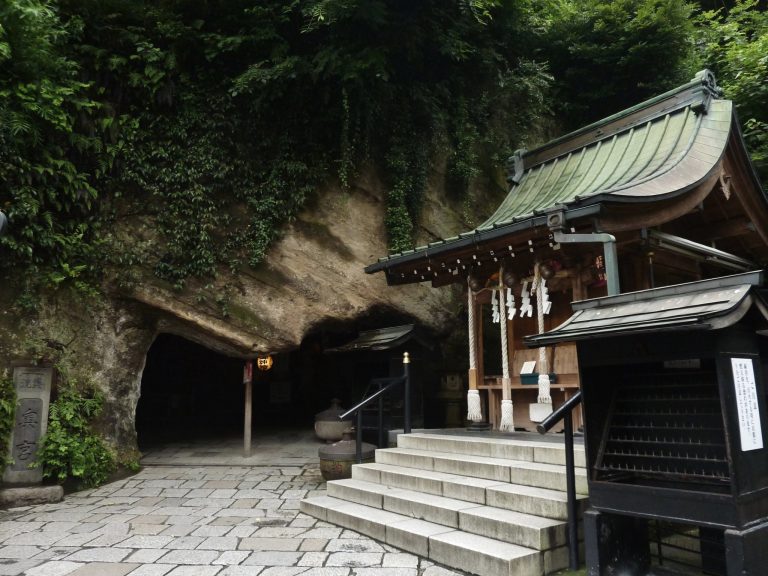
The precinct is organized with the worship hall at the front and the sanctuary behind it, reached within the shrine grounds by stone stairs. The two principal buildings display crossed roof-end timbers called chigi and five short logs, or katsuogi, set at right angles along each roof ridge. Together, these features express the shrine’s Shinmei-zukuri design.
Principal shrine buildings
Worship hall
The haiden, or worship hall, stands at the front of the precinct. It is the place where worshippers pray and was completely destroyed in the 1923 earthquake. The building was reconstructed in 1937 and included in the later rebuilding completed in 1998. Its roof carries chigi and five katsuogi.
Sanctuary
The honden, or inner sanctuary identified with the deity’s presence, stands behind the haiden. It follows the Shinmei-zukuri style and also has crossed chigi and five katsuogi along the roof ridge. The sanctuary was half-destroyed by the 1923 earthquake before the shrine buildings were rebuilt.
Mikoshiyama and commemorative features
Mikoshiyama setting
The traditional foundation story places the Shinmei-gu on Mikoshiyama, while the associated En-tokuji stood at the foot of the mountain. This arrangement forms part of the shrine’s traditional historical geography.
Residence monument
A monument south of the shrine marks the traditionally identified site of Adachi Morinaga’s residence. The residence is instead associated with the Imakoji-nishi archaeological site in Onarimachi, while the monument preserves the older local identification.