Huntington Castle: A Welsh Marches Frontier Fortress


Site at a Glance
- Rating
- 4.3
- Popularity
- Very Low
- Country
- United Kingdom
- Primary era
- Medieval
- External website
- Open
- Eras represented
- Medieval
- Civilizations
- English
- Site type
- Military
- Remains
- Castle
On this page7 sections
History
Huntington Castle is a ruined medieval fortress in the United Kingdom, near the modern England–Wales border. Probably built in the first half of the thirteenth century, it formed part of the defensive system of the Welsh Marches, the medieval frontier zone between England and Wales where castles served military and administrative purposes. The castle protected the valley and occupied an important frontier position.
Earlier Fortifications and Foundation
Huntington probably succeeded nearby Kington Castle, which was likely destroyed in 1216. An earlier motte-and-bailey castle known as Tarrett stood about one mile to the southeast. It was probably built by William FitzOsbern, an eleventh-century Norman magnate who constructed several castles along the Welsh border in 1070.
The later castle was probably built by Reginald de Braose between 1217 and 1224. Reginald belonged to the powerful de Braose baronial family, which held lands and castles along the Welsh border. The earliest recorded reference to Huntington dates from July 1228, when King Henry III seized it after Reginald’s death. The castle apparently returned to the de Braose family, but after the death of Reginald’s son William de Braose in 1230, it passed with the Barony of Kington to the de Bohun family.
War and Noble Possession
During the Second Barons’ War in the 1260s, the de Bohuns supported Simon de Montfort in his conflict with King Henry III. Edward I consequently transferred Huntington and other castles in the Welsh Marches to Roger Mortimer, a major marcher lord and military commander. Rebel barons besieged Huntington in July 1264, but the castle did not surrender.
After the royal victory at Evesham, Roger Mortimer used Huntington as a base while recovering Brecon Castle, which had been captured by Llywelyn ap Gruffudd, the leading Welsh prince of the thirteenth century. Huntington later returned to the de Bohuns and remained in their possession until the death of their last male heir in 1372.
Mary de Bohun, the family’s eldest daughter, married Henry, Earl of Derby. Her husband was later made Duke of Hereford by his cousin Richard II, and the castle remained in Henry’s hands until he became King Henry IV in 1399. Henry then granted Huntington to Edmund Stafford, 5th Earl of Stafford. After Edmund was killed at the Battle of Shrewsbury in 1403, possession passed to his widow, Anne, Countess of Stafford.
Refortification and Decline
Anne feared an invasion by Owain Glyndŵr, the Welsh leader whose revolt against English rule became a major conflict in the early fifteenth century. She refortified Huntington and appointed John Sment as constable, the official responsible for the castle’s command and defence. After Glyndŵr’s forces defeated the English at the Battle of Bryn Glas, they approached Huntington but did not besiege it. Instead, they drove away cattle, took flour from the local mill, and burned the mill.
Peace returned to the Welsh Marches during the reign of Henry V, after which Huntington appears to have declined. By 1564 the castle belonged to the Crown, but it later passed through several hands. It was completely abandoned by the time of the English Civil War in 1642, although its stone keep was still standing in 1670. Huntington is now listed on Historic England’s Heritage at Risk Register in poor condition, with its surviving earthworks and masonry heavily overgrown.
Remains
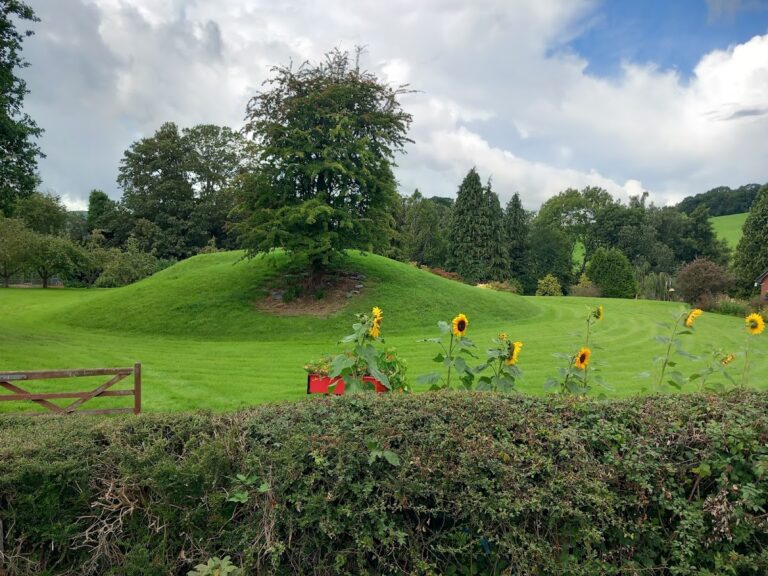
Huntington occupies an elevated position about 4 kilometres southwest of Kington in Herefordshire, near the modern England–Wales border. The ruined castle overlooks the valley. Steep ravines protected the site on its north and west sides, while a moat fed by a brook defended the south and east.
Earthworks and Castle Layout
The castle was a motte-and-bailey complex. This type of fortress combined a raised earth mound, or motte, usually carrying a fortified residence, with an adjoining enclosed court known as a bailey. Huntington’s motte, inner court, and associated earthworks survive, forming the main outline of the castle. Earth banks remain in place, together with fragments of masonry, while dense vegetation now covers much of the surviving structure.
Surviving Masonry
Sections of stonework survive among the earth banks, including part of a semicircular tower. These fragmentary remains belong to the castle’s later stone defences and are heavily covered by vegetation. The stone keep, or donjon, meaning the principal fortified tower of a castle, was still standing in 1670 but has since disappeared.